

Why Most Families Don't Have a Plan - and Why That's Worth Changing
Emergency preparedness rarely feels urgent until it suddenly is. Most families intend to create a plan someday, but competing priorities push it down the list. The result: when something actually happens - a fast-moving wildfire, a power outage in sub-zero temperatures, a gas leak - household members respond on instinct rather than preparation, and that gap in readiness is where confusion and preventable harm enter the picture.
The good news is that building a solid family emergency plan doesn't require special expertise, expensive equipment, or weeks of effort. The framework below walks you through the core steps in a logical order. You can complete a working first draft in a single afternoon and refine it from there.
What you will need
What You'll Need Before You Start
Gather the tools and information below before your planning session. Having everything in front of you reduces back-and-forth and helps the whole family stay focused during what can feel like a heavy conversation.
Printed household contact sheet
A laminated or waterproof card listing key phone numbers - out-of-area contact, local emergency services, neighbors, and school - stored in each go-bag and posted in the home.
Battery-powered or hand-crank emergency radio
Provides access to official weather alerts and emergency broadcasts when power or cell service is unavailable.
Go-bag (emergency supply kit) per household member
A pre-packed bag containing 72 hours of supplies - water, food, medications, documents, and comfort items - ready to carry out the door quickly.
Pet emergency kit
Separate supply bag for pets including food, water, leash or carrier, vaccination records, and any medications.
Paper map of your local area
A physical backup for navigation if GPS and cell service fail during an evacuation.
Waterproof document folder
Stores copies of identification, insurance cards, prescriptions, and financial records that may be needed after an emergency.
In a Real Emergency, Call 911 First
This guide helps you prepare in advance - it does not replace real-time emergency services. In any life-threatening situation, call 911 immediately. Do not delay calling for help while trying to follow a written plan.
Building Your Plan Step by Step
Work through these steps in order during your first planning session. You won't finish everything perfectly in one sitting - that's fine. The goal is to have a documented, shared foundation that you can improve over time.
Identify the hazards most relevant to your location
Start by understanding what you're planning for. Look up the most common emergencies in your region - your local emergency management agency's website is a reliable starting point. Consider: severe weather (tornadoes, hurricanes, ice storms), flooding, wildfires, extended power outages, and household emergencies like fire or gas leaks.
List two or three high-probability scenarios and one low-probability but high-impact scenario (such as a regional evacuation). Your plan doesn't need to cover every possibility perfectly, but it should be grounded in what's most likely where you live.
Map out two escape routes from every room
For each room in your home, identify a primary exit (usually a door) and a secondary exit (typically a window). Draw a simple floor plan - it doesn't need to be precise - and mark both exits on each room. Note any obstacles: furniture, window locks, or storm screens that would need to be removed quickly.
For households with young children or pets, assign each child a responsible adult or older sibling for evacuation, and designate a role for pet retrieval only if it is safe to do so. Practice never delays evacuation - that assignment exists for clarity, not guarantee.
Choose meeting points and an out-of-area contact
Select two outdoor meeting points: one immediately outside your home (e.g., the end of the driveway or a front yard tree) and one farther away in case the immediate area is inaccessible (e.g., a neighbor's home two blocks away or a community landmark). Make sure every family member - including school-age children - can name both locations.
Designate an out-of-area contact: someone who lives at least 100 miles away who can serve as a central communication point if local lines are jammed. Everyone in your household should have that person's phone number memorized or written on a card they carry.
Account for children, pets, and special medical needs
Generic emergency plans assume able-bodied adults - your plan must do better. For each household member, note any considerations that affect how they evacuate or shelter:
- Young children: Who carries them? Which adult is responsible if parents are separated? Coordinate with your child's school or daycare - most have their own emergency protocols, and you need to know them. See also: age-appropriate ways to talk with kids about home safety.
- Pets: Know which local shelters or hotels accept pets. Many public emergency shelters do not. Keep vaccination records accessible in your pet's emergency kit.
- Medical needs: Maintain a written list of all medications, dosages (as prescribed), and the name of each prescribing provider. Store copies in your go-bag and with your out-of-area contact.
Build your go-bags and stock a shelter-in-place supply
A go-bag is a pre-packed kit designed to sustain one person for 72 hours. Pack one per household member (including pets). Core contents: water (one gallon per person per day), non-perishable food, a flashlight, batteries, a first-aid kit, copies of important documents, cash in small bills, a phone charger, and any required medications or medical supplies.
Separately, stock a shelter-in-place supply in your home - typically two weeks of food and water - for scenarios where leaving is not possible or advised (severe winter storms, certain hazardous material incidents).
Supporting your preparedness financially is also wise. A dedicated emergency fund can cover unexpected costs that arise during or after a crisis. See our overview of emergency fund basics for practical guidance on sizing and placement.
Write it down, share it, and schedule practice
A plan that exists only in one person's head is fragile. Write your completed plan in plain language, make printed copies, and share it with every adult in the household and with caregivers or babysitters who regularly spend time in your home. Store a digital copy in a shared cloud folder accessible to multiple family members.
Schedule at least two practice drills per year - one announced, one as a surprise. Walk through the escape routes, meet at both designated points, and run through the contact protocol. Treat it as a routine, not a drill to be feared. Safety priorities shift as children grow, so revisit roles and assignments whenever your household changes significantly.
Don't Overlook Medical and Mobility Needs
If any household member uses medication, medical equipment, or has a mobility limitation, these needs must be explicitly addressed in your plan. Coordinate with relevant healthcare providers in advance to understand what supplies are essential and how long you could safely manage without resupply. Never make changes to anyone's medical routine based on general preparedness advice.
Keeping the Plan Current and Keeping Everyone Calm
An emergency plan is a living document, not a one-time project. Life changes - babies arrive, children grow, medical situations evolve, and families move. Each of these shifts can affect who needs what kind of help during a crisis.
Use Family Meetings to Practice and Refine
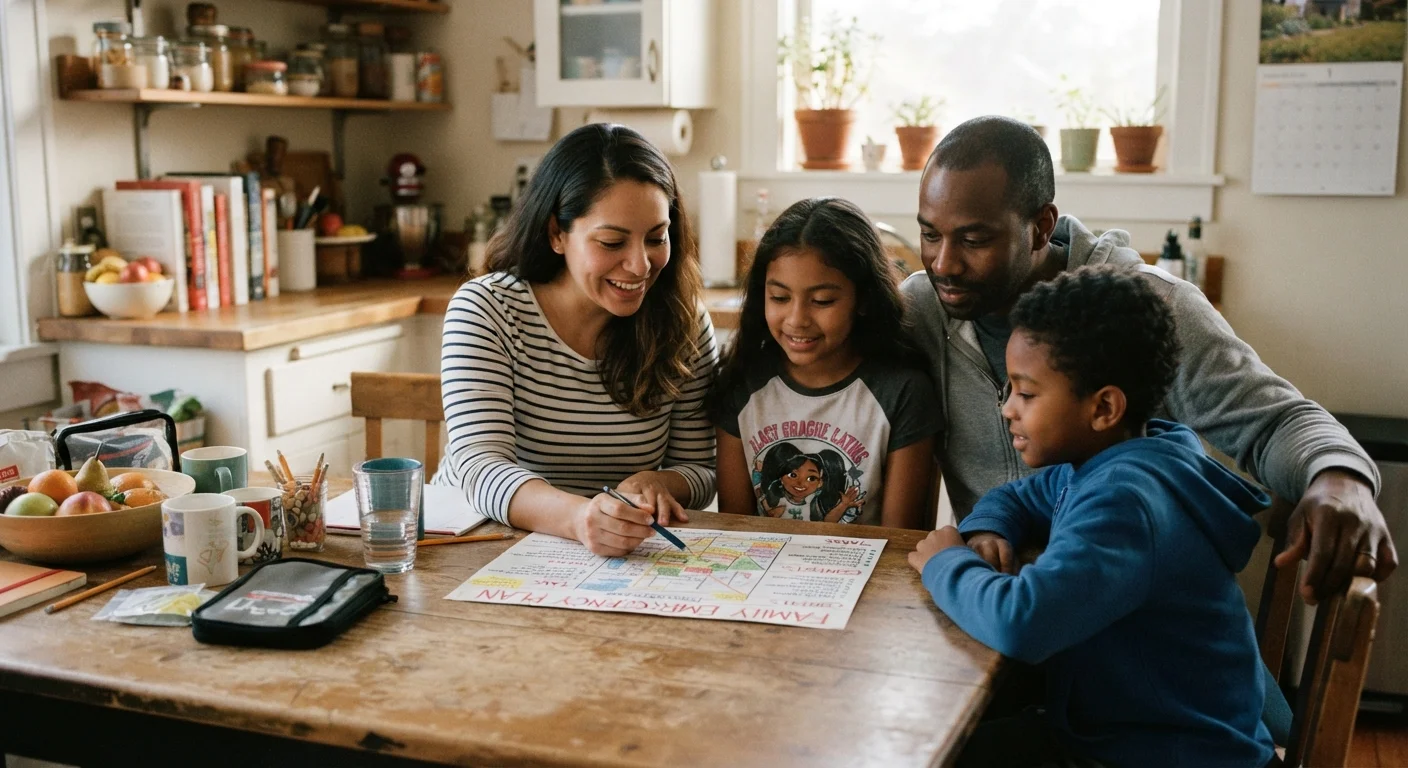
A regular family meeting is an ideal setting to review your emergency plan without making it feel stressful. Keep the tone matter-of-fact: 'Let's go over what we do if the smoke alarm goes off.' Repetition builds confidence, not fear.
Keeping preparedness normalized - rather than treating it as something alarming - helps children engage constructively rather than with anxiety. Framing drills as a family routine, similar to checking the smoke alarm batteries, goes a long way. For families navigating shared custody or non-traditional living arrangements, coordinate with all households involved so that children have consistent information no matter where they are. Co-parenting frameworks that include shared emergency protocols reduce confusion significantly.
This article provides general safety information for educational purposes only. It is not a substitute for guidance from local emergency management authorities, healthcare providers, or other licensed professionals. Always follow instructions from official emergency services during an actual emergency.
The content on this site is for informational purposes only and is not a substitute for professional advice. Always consult a qualified professional for guidance specific to your situation.