

The Simple Physics That Makes It Work
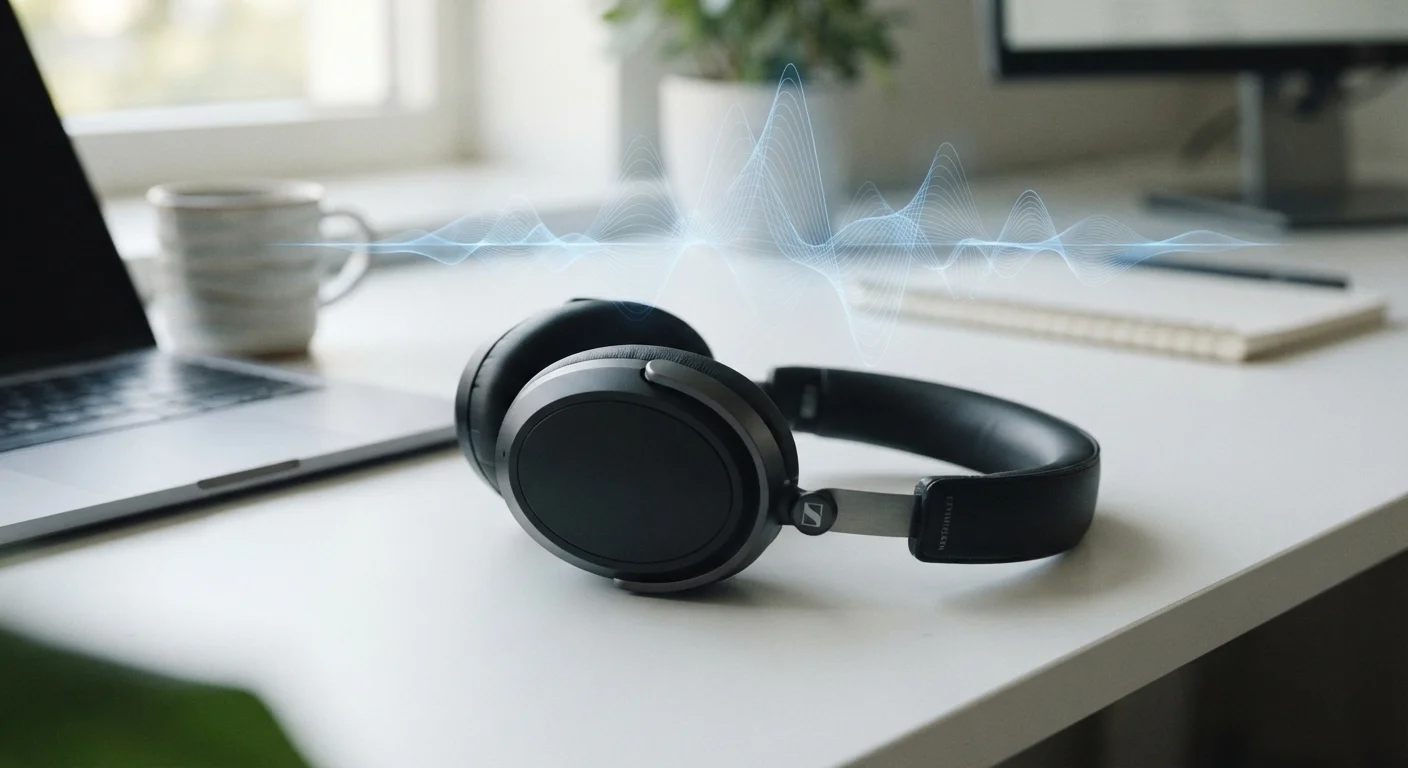
Sound is just pressure waves moving through air — ripples of compression and expansion that your ears interpret as noise. The clever insight behind ANC is that two identical waves, timed perfectly out of step with each other, cancel each other out. Physicists call this destructive interference.
Imagine a wave that goes up, then down. Now introduce a second wave that goes down first, then up — its exact mirror image. When they overlap, the peaks fill the valleys and both waves effectively disappear. No wave, no sound.
ANC hardware applies this principle in real time. A small microphone on the outside of your headphone listens to the ambient noise around you. A processor analyzes that incoming signal and instantly produces the inverse — the "anti-noise" — which is then played through the speaker alongside your audio. The two signals meet at your eardrum and largely cancel each other out.
A Quick Way to Feel the Effect
Put on a pair of ANC headphones without playing any music, then toggle ANC on and off. The change in ambient noise is immediately noticeable — that's destructive interference happening in real time. It's one of the clearest ways to see physics working in an everyday device.
What's Actually Inside Your Headphones
Making destructive interference happen reliably in the real world requires three key components working in tight coordination:
- External microphones — Usually positioned on the outer face of each ear cup or earbud. They continuously sample the sound environment around you.
- An ANC processor chip — A dedicated circuit that takes the microphone input, calculates the inverse waveform, and outputs it with extreme speed — typically within microseconds.
- Feedforward vs. feedback configurations — Some headphones use only external mics (feedforward), others add a second internal mic that listens to what your ear actually hears and fine-tunes the cancellation (feedback). Many modern devices combine both approaches, called hybrid ANC.
For a deeper look at how headphone hardware specs connect to sound quality, see our plain-English headphone glossary.
20–30 dB
Typical low-frequency noise reduction from ANC
Independent acoustic testing commonly finds ANC headphones can reduce steady low-frequency noise by 20 to 30 decibels, roughly comparable to cutting perceived loudness in half or more.
~1,000x
Speed of ANC processor vs. human reaction time
ANC chips analyze and generate counter-signals within microseconds — far faster than any human reflex — which is what makes real-time cancellation physically possible.
Why ANC Handles Some Sounds Better Than Others
ANC is remarkably effective on predictable, low-frequency noise — the drone of a jet engine, the rumble of a subway car, the hum of an air conditioner. These sounds have long, steady, repeating wave patterns that the processor can anticipate and counter accurately.
Higher-frequency sounds — like consonants in speech or a barking dog — have much shorter, more erratic waves. The processor simply cannot compute a precise counter-signal fast enough before the wave has already passed. This is why ANC quiets a coffee shop's background roar but doesn't make the person at the next table inaudible.
ANC Isn't a Complete Sound Blocker
Even the most sophisticated ANC systems reduce noise rather than eliminate it entirely. Real-world listening environments are complex and constantly changing, which limits how perfectly any processor can compute a counter-signal. Combining ANC with a good physical seal from well-fitting ear tips or cups gets you the closest thing to true quiet.
This frequency limitation is a feature of physics, not a flaw in the technology. Understanding it helps set realistic expectations for what your headphones can and cannot do.
Real-World Situations Where ANC Makes a Genuine Difference
Knowing when ANC earns its keep helps you get more out of your headphones. The technology shines in sustained-noise environments and is less transformative in already-quiet spaces.
Frequently Asked Questions
ANC excels at blocking steady, low-frequency sounds like engine hum, HVAC systems, and airplane cabin noise. It is less effective against sudden, unpredictable sounds like voices or a door slamming, because the processor does not have enough time to compute an accurate counter-signal.
Some people feel a mild sensation of pressure or 'ear suck' when ANC is active — this is normal and not harmful. It happens because your brain registers the sudden quiet as a change in pressure. If the sensation bothers you, many headphones let you adjust or disable ANC strength.
Yes. Running the microphones and noise-processing chip requires continuous power. Most ANC headphones can still deliver many hours of use, but expect noticeably shorter battery life with ANC enabled versus disabled.
Passive noise isolation is purely physical — ear cups, foam tips, and tight seals block sound by acting as a barrier. ANC is electronic and actively counters sound waves. The two approaches complement each other, and most quality ANC headphones use both simultaneously for better overall quieting.
Absolutely. Many people use ANC-equipped headphones with no audio playing at all, simply to reduce environmental noise while concentrating, reading, or sleeping. The cancellation works independently of whatever you are or are not listening to.
The content on this site is for informational purposes only and is not a substitute for professional advice. Always consult a qualified professional for guidance specific to your situation.