

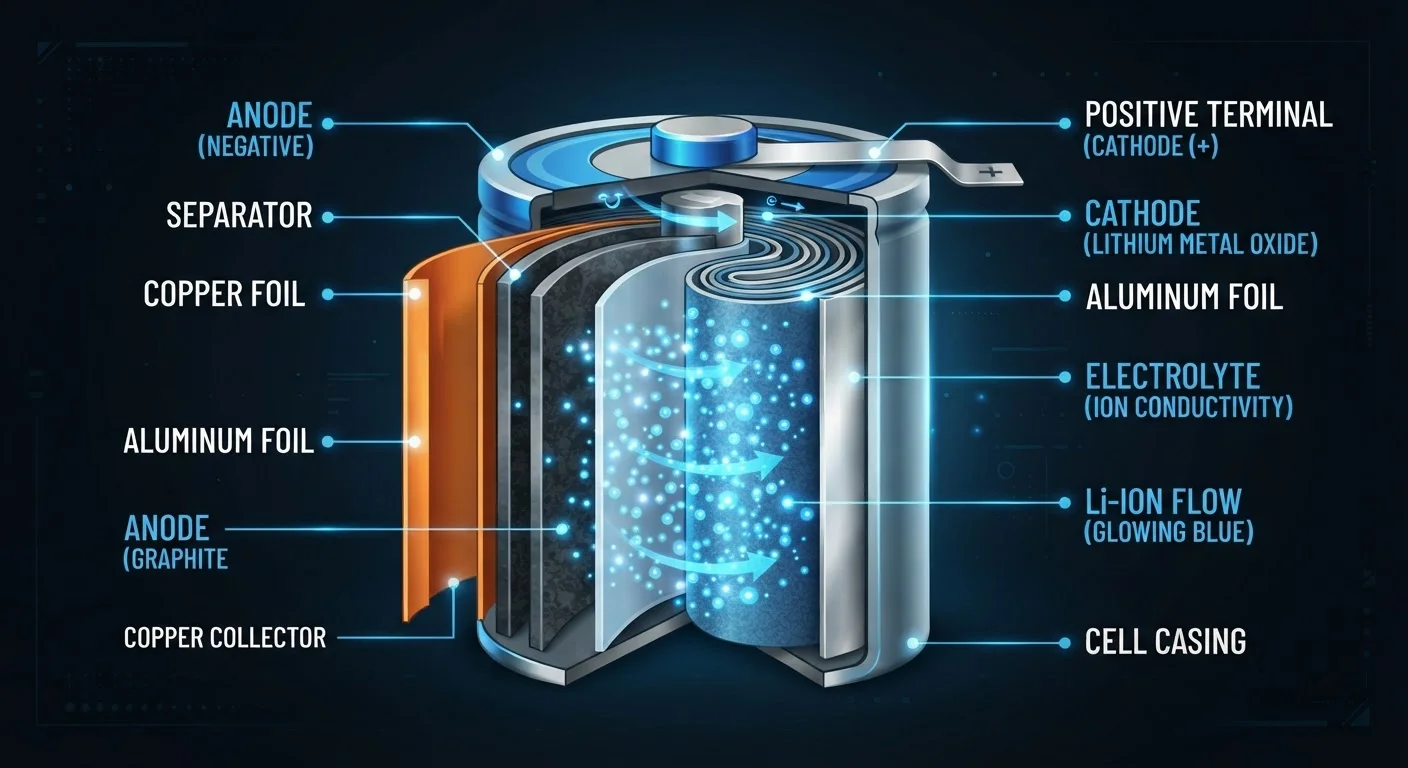
The Basic Idea: Ions on the Move
Think of a lithium-ion battery less like a container that holds electricity and more like a seesaw. On one side is the anode (typically made of graphite); on the other is the cathode (a lithium metal oxide compound). Between them sits a liquid or gel called the electrolyte, which acts as a highway specifically for lithium ions.
When you plug in your phone to charge, an external power source pushes lithium ions from the cathode, through the electrolyte, and into the anode — essentially loading one side of the seesaw. When you unplug and start using your device, those ions naturally want to flow back. As they travel from the anode back to the cathode, they release energy that powers your screen, processor, and speakers.
The electrons, meanwhile, can't travel through the electrolyte — they're forced to go the long way around, through your device's circuit. That flow of electrons is the electrical current your phone runs on.
300–500
Typical rated full charge cycles before noticeable capacity loss
Most lithium-ion battery manufacturers rate cells to retain roughly 80% of original capacity within this cycle range under standard conditions.
~8%
Capacity lost per year under typical smartphone use
Battery health tracking data from device manufacturers suggests average users see gradual but measurable capacity reduction annually.
20°C–25°C
Ideal storage temperature for lithium-ion cells
Battery research generally identifies room temperature as optimal; temperatures above 35°C (95°F) are widely cited as accelerating chemical degradation.
Why Batteries Degrade — and What That Really Means
Every time lithium ions move in and out of the electrode materials, those materials experience a tiny amount of physical change — expanding slightly during charging, contracting during discharge. Over hundreds of cycles, this microscopic stress adds up. The electrode structure becomes less efficient at hosting ions, which means fewer ions can make the trip each cycle. The result: your battery holds less charge than it once did.
Other factors speed this process up. High heat accelerates unwanted chemical reactions inside the cell that degrade the electrolyte. Charging to 100% consistently keeps the anode in a maximally stressed state. Deep discharges to 0% can also strain the cathode. None of these will ruin a battery overnight, but they quietly add up over the lifespan of a device.
Extend Battery Life With Simple Habits
Try to charge your device before it dips below 20%, and unplug — or use an 80% charge limit setting — before it hits 100%. Keep devices away from heat sources like direct sunlight, hot cars, or charging on thick blankets that trap warmth. These small adjustments reduce cumulative stress on the battery's electrode materials over time.
For more on how your everyday usage patterns affect charge, see The Habits That Quietly Drain Laptop Battery Life.
Practical Implications for How You Use Your Devices
Understanding the chemistry gives the everyday advice real meaning. Keeping your device out of hot cars and direct sunlight isn't just caution — it prevents the electrolyte from breaking down faster than normal. Avoiding full 0-to-100 charge cycles when possible reduces physical stress on the electrodes. And using your manufacturer's built-in battery health settings (most modern phones and laptops offer them) helps the software manage charge intelligently on your behalf.
Wireless charging introduces its own set of questions — including whether it accelerates battery wear compared to a cable. Wireless Charging Myths That Are Worth Dropping covers the facts there in detail.
None of these habits will make your battery last forever — that's not how chemistry works. But understanding why these recommendations exist means you're making informed choices rather than following rules you don't understand.
“The lithium-ion battery is a prime example of how basic materials science, translated into engineering, can change everyday life — but it also reminds us that chemistry has limits, and those limits show up over time.”
— Jeff Dahn, Battery researcher and professor at Dalhousie University, known for his work on lithium-ion battery longevity
Frequently Asked Questions
Each charge cycle causes minor physical stress on the battery's electrode materials, gradually reducing how many ions they can hold. Over hundreds of cycles, the total capacity your battery can store shrinks noticeably. This is normal chemistry, not a defect.
Modern devices have charge management circuits that stop drawing power once full, so overnight charging won't overcharge or damage the battery instantly. However, keeping a battery at 100% for extended periods does cause mild chemical stress over time. Many devices now offer 'optimized charging' settings that pause at 80% to reduce this wear.
Yes. Cold temperatures slow down ion movement inside the battery, causing a temporary drop in performance and apparent capacity. The battery typically recovers when warmed up, but repeated exposure to extreme cold can cause lasting damage to internal components.
One full charge cycle equals 100% of the battery's capacity used — but not necessarily in one sitting. Using 50% today and 50% tomorrow counts as one cycle. Most lithium-ion batteries are rated to retain strong capacity for 300–500 full cycles, though this varies by device and usage.
Keeping a lithium-ion battery in the middle range of charge — roughly 20% to 80% — does reduce chemical stress on the electrodes compared to frequent full charges and deep discharges. This is generally sound practice for maximizing long-term battery health, though occasional full cycles are fine.
The content on this site is for informational purposes only and is not a substitute for professional advice. Always consult a qualified professional for guidance specific to your situation.