

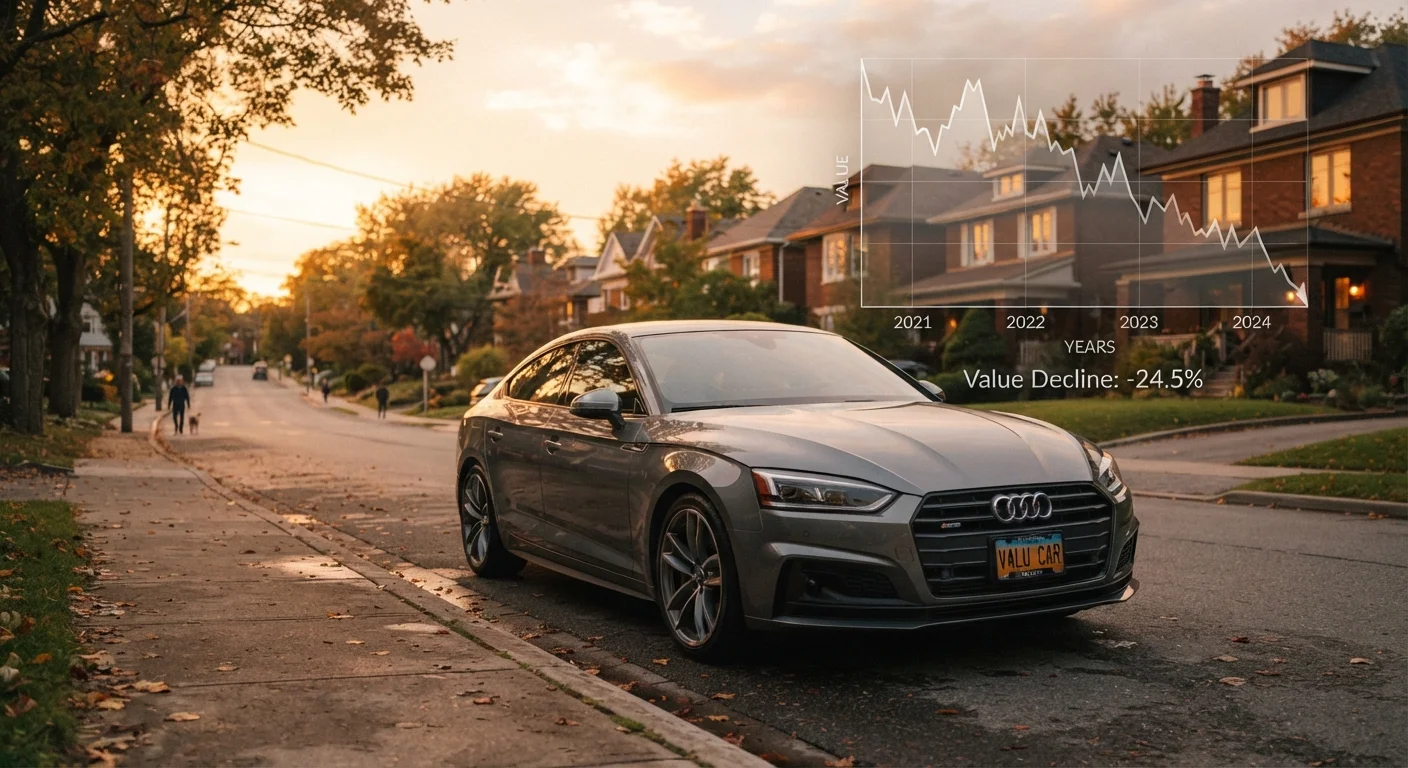
The Invisible Cost Every Driver Carries
When Americans calculate the cost of owning a car, they tend to focus on the obvious line items: the monthly payment, gas, and insurance. Depreciation rarely makes the mental list — yet for most drivers, it's the single largest expense over the life of ownership. Understanding it isn't just an accounting exercise; it directly shapes every major decision you make about a vehicle.
Unlike a repair bill, depreciation doesn't arrive in your mailbox. It accumulates silently as your car's market value declines relative to what you paid. By the time most owners are ready to sell or trade in, the gap between original purchase price and what the market will pay can be staggering. See how depreciation fits into the broader picture in our look at the hidden costs of car ownership.
~20%
Value lost in the first year of ownership
Industry analysts consistently estimate that new vehicles lose roughly 15–20% of their value within the first 12 months of registration.
~50%
Value lost within five years
Many vehicles retain only about half their original purchase price after five years, depending on make, model, and condition.
#1
Largest cost of car ownership over time
Studies from automotive research organizations regularly rank depreciation as the single biggest expense for the average American vehicle owner.
How Depreciation Actually Works
Depreciation isn't linear. The steepest drop happens early — a new vehicle can lose a significant portion of its value within the first 12 months simply because it is no longer considered new. After that initial cliff, the rate of decline typically moderates, though it never fully stops.
Several forces drive this process:
- Supply and demand: Popular models with limited inventory depreciate more slowly. A vehicle that's abundant on used-car lots loses value faster.
- Mileage: Higher odometer readings signal more wear and signal a shorter remaining useful life to prospective buyers.
- Condition: Dents, faded paint, worn interiors, and mechanical issues all reduce what the market will pay.
- Accident history: Even a well-repaired vehicle carries a value penalty if a collision appears on its history report.
- Technology shifts: As vehicle technology evolves — particularly with the rise of electric vehicles — older powertrains can depreciate faster as buyer preferences shift.
Keep Your Service Records
Save every receipt and maintenance record for your vehicle — oil changes, tire rotations, brake work, and inspections. When it comes time to sell or trade in, documented service history can meaningfully boost what buyers and dealers are willing to pay.
What Owners Can (and Can't) Control
Some depreciation factors are simply outside your hands: the overall economy, fuel price trends, and shifting consumer tastes. But a meaningful portion of your vehicle's retained value is within your influence.
Consistent maintenance is one of the most effective tools. A vehicle with documented service history — oil changes, tire rotations, fluid top-offs — signals to future buyers that the car was cared for. Neglecting routine service doesn't just risk mechanical failure; it erodes resale value in ways that often exceed the cost of the skipped maintenance itself. Our guide on seasonal car prep walks through a year-round maintenance rhythm that supports both reliability and resale value.
Mileage management also matters. High annual mileage accelerates wear and lowers resale value, while vehicles with lower-than-average mileage for their age tend to command a premium on the used market. If your driving patterns allow flexibility, this is a lever worth considering.
“The best way to think about depreciation is as a rental fee you pay for the privilege of driving a new car. The faster a vehicle depreciates, the higher that implicit rental cost becomes.”
— Consumer Financial Education Perspective, Widely cited framing in personal finance and automotive cost education
Depreciation and Your Ownership Decisions
Depreciation intersects with nearly every major ownership choice. If you're financing a vehicle and the loan balance exceeds the car's current market value, you're in what lenders call a 'negative equity' or 'underwater' position — a situation where selling or trading the car means you still owe money even after the transaction.
The lease-versus-buy question is also deeply tied to depreciation. Lease payments are in part a reflection of projected depreciation over the lease term — meaning vehicles that hold value well tend to be more attractive lease propositions. Our article on leasing vs. buying explores this dynamic in full.
For first-time owners navigating these decisions, our guide to the first year of ownership offers grounded, practical context for getting started on the right foot.
Depreciation Varies by Vehicle Type
Electric vehicles, luxury models, and economy sedans all follow different depreciation curves based on market demand, technology shifts, and brand perception. General depreciation rules provide a useful baseline, but your specific vehicle's trajectory may look quite different.
This article provides general information about vehicle depreciation for educational purposes. It is not financial or legal advice. Consult a qualified financial professional for guidance specific to your situation.
Frequently Asked Questions
A new vehicle commonly loses around 15–20% of its purchase price in the first year. This drop is steepest right away because the car transitions from 'new' to 'used' status the moment it's registered and driven.
No — depreciation rates vary significantly by segment, brand reputation, fuel type, and consumer demand. Trucks and SUVs with strong resale markets tend to hold value better than many sedans.
Yes, indirectly. If you ever trade in, total the vehicle, or need a loan based on vehicle equity, depreciation directly affects what you recover. It also shapes whether you're 'underwater' on a car loan — owing more than the car is worth.
You can't stop depreciation, but you can reduce its pace. Keeping mileage reasonable, maintaining the vehicle consistently, avoiding accidents, and preserving interior condition all help retain resale value.
Lease payments are essentially structured around the vehicle's projected depreciation during the lease term. The more a vehicle is expected to depreciate, the higher the monthly payment tends to be.
Buying used means you let the first owner absorb the steepest early depreciation. However, older vehicles may come with higher maintenance costs and fewer warranty protections, so the overall equation depends on the individual vehicle and your circumstances.
The content on this site is for informational purposes only and is not a substitute for professional advice. Always consult a qualified professional for guidance specific to your situation.