

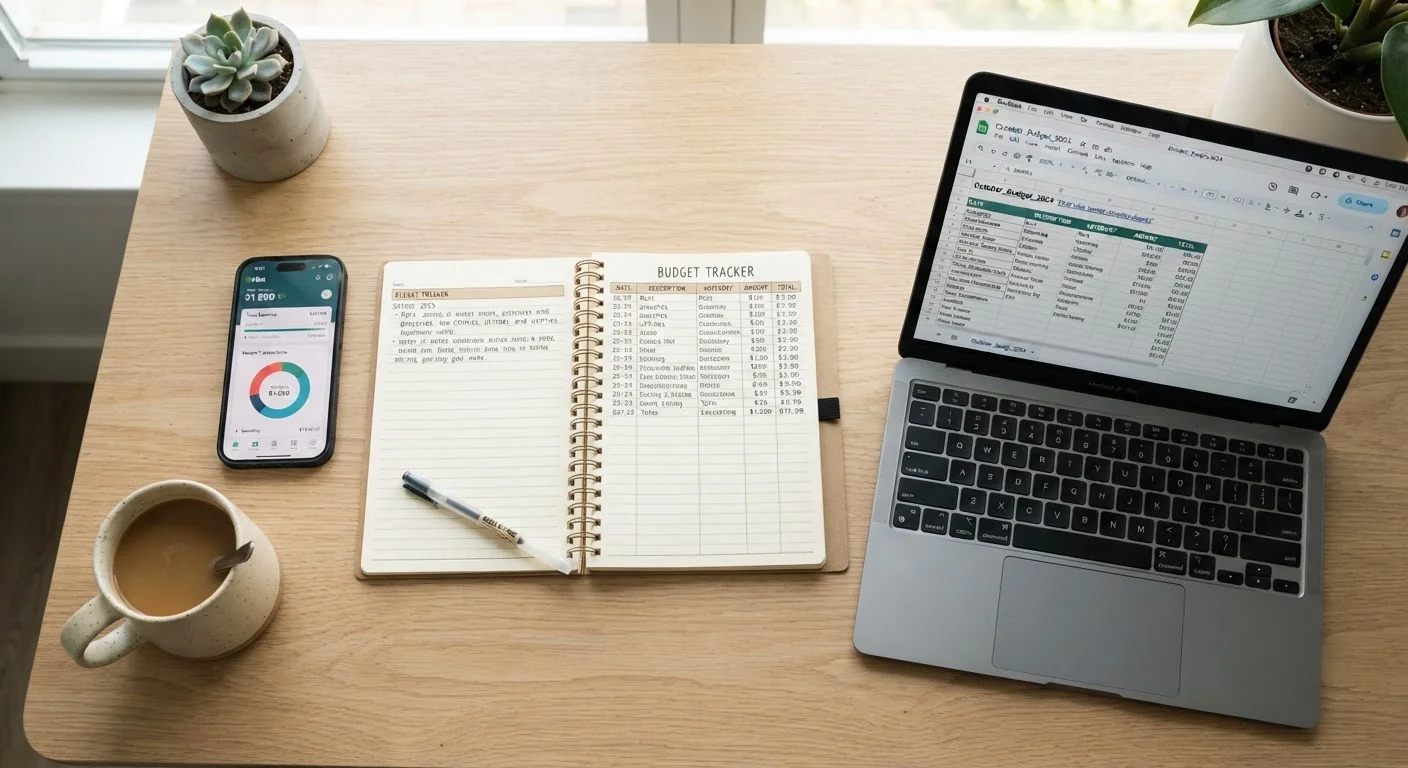
Our Verdict
No single budgeting tool is objectively superior - each format serves a different type of person in a different season of financial life. Paper trackers work well for those who learn through writing and want simplicity. Spreadsheets reward those who enjoy customization and want complete control over their data. Apps reduce friction for those who need automation to stay consistent. Whichever you choose, what matters most is that the tool fits your habits, not the other way around.
Ideal for anyone ready to start tracking spending but unsure which format will realistically stick given their lifestyle and comfort with technology.
Why the Tool Choice Actually Matters
Most budgeting advice focuses on what to do with your money - set categories, cut spending, save more. Far less attention goes to how you track it. But the format you use shapes whether a budget becomes a lasting habit or gets abandoned after two weeks.
Research on habit formation consistently shows that friction is the enemy of consistency. A tool that feels cumbersome to update simply won't get updated. That's why matching the tool to your personality and lifestyle is a practical financial decision, not a minor preference. Before you commit to any system, it's worth understanding what each format genuinely offers - and where it falls short. You can also explore different budgeting methods to see which pairs best with each tool.
Paper Spending Trackers: Tactile and Intentional
A paper notebook or printed spending log requires you to write down every transaction by hand. That manual friction is both its primary weakness and, for some people, its greatest strength.
Paper builds spending awareness through manual reflection
Writing each expense by hand creates a moment of intentional awareness that digital auto-import cannot replicate, which many people find effective for controlling impulse spending.
Spreadsheets offer complete customization with no recurring cost
You can design categories, formulas, and layouts to match your exact financial situation without paying a subscription fee or sharing account credentials.
Apps automate transaction import and reduce manual effort
Direct bank connections pull in spending data automatically, making it easier to stay current with your budget without daily manual entry.
Paper requires no technology or internet access
A notebook works anywhere and needs no software updates, account connections, or device compatibility - an advantage for those who prefer keeping finances entirely offline.
Apps provide visual dashboards and trend reports instantly
Charts, category summaries, and spending alerts are generated automatically, giving a quick financial snapshot without building formulas or drawing graphs manually.
Spreadsheets keep all financial data under your direct control
Unlike apps requiring third-party access to bank accounts, a spreadsheet stores data locally or in your own cloud account, limiting external exposure of sensitive information.
The act of physically recording a purchase forces a moment of reflection that tapping a screen rarely does. Many people find that handwriting expenses makes overspending more emotionally salient. Paper also requires no account connections, no subscriptions, and no software updates - it simply works. For those concerned about digital privacy or who prefer analog systems, it's the most straightforward option available.
Paper offers no automation, calculations, or error checks
Every total must be calculated by hand and verified manually, making math errors easy to miss and trend analysis time-consuming to produce.
Spreadsheets require upfront setup and ongoing maintenance
Building a functional budget spreadsheet demands time, some formula knowledge, and regular manual updates - a real barrier for those who find the process tedious.
Apps require sharing sensitive financial account access
Connecting bank accounts to a third-party app involves a meaningful privacy trade-off, and users should understand how their data may be stored, used, or protected.
Paper scales poorly with complex financial situations
Multiple income sources, credit cards, investment accounts, and shared household budgets quickly outgrow what a notebook can practically organize and track.
App automatic categorization is frequently inaccurate
Algorithms misclassify transactions regularly, requiring manual corrections that can offset much of the time saved through automation.
Many feature-rich budgeting apps carry subscription costs
Premium app tiers that offer full functionality often require monthly or annual fees, adding an ongoing expense that free tools like spreadsheets and paper avoid entirely.
Lost or damaged paper means lost financial records
Unlike digital tools, a paper tracker has no backup - a spilled drink or misplaced notebook permanently erases months of spending history.
The downsides are real: paper offers no automatic totals, no charts, and no alerts. Math errors go unchecked unless you review carefully, and a lost notebook means lost data. Paper also scales poorly with complex finances - multiple income streams, investment accounts, and joint budgets become difficult to manage across a few notebook pages.
Paper trackers pair naturally with the envelope budgeting method, where physical cash allocation mirrors the tangible nature of the tool itself. See how that approach compares to other frameworks in our 50/30/20 vs. envelope budgeting comparison.
Spreadsheets: Flexible but Demanding
A spreadsheet - whether in a desktop application or a cloud-based tool - gives you a blank canvas to build exactly the budget structure you want. You control every category, formula, and layout.
~1 in 3
Americans who follow a formal household budget
Surveys conducted by Gallup have consistently found that fewer than one-third of U.S. adults maintain a detailed monthly budget, suggesting most people track spending loosely if at all.
73%
People who feel more in control after tracking expenses
A National Foundation for Credit Counseling survey found that the majority of respondents who began tracking spending reported a greater sense of financial control shortly after starting.
Spreadsheets are particularly well suited to people who enjoy working with numbers or who have non-standard financial situations: variable income, multiple expense categories, or tracking both personal and shared household budgets. Templates are widely available for free, and even modest formula knowledge lets you automate running totals, track monthly trends, and flag spending patterns visually.
The trade-off is setup and maintenance time. A spreadsheet does nothing on its own - you must enter transactions manually (unless you build or borrow an import system), update formulas when categories change, and remember to back up your file. For people who find spreadsheet maintenance tedious rather than satisfying, the tool quickly becomes a burden rather than a resource. Cloud-stored spreadsheets introduce mild privacy considerations but are generally less exposed than app-based systems that require full bank account access.
Budgeting Apps: Convenient but Not Without Caveats
Digital budgeting applications can connect directly to your bank and credit card accounts, pulling in transactions automatically and categorizing them with varying degrees of accuracy. For people who struggle with manual data entry, this automation is genuinely valuable.
A Note on App Data Privacy
When a budgeting app connects to your bank account, it typically uses a read-only data aggregator service - meaning it can view transactions but generally cannot initiate transfers. However, your financial data is stored on the app provider's servers and may be used for analytics or product targeting depending on the company's privacy policy. Before linking accounts, review the app's data sharing and retention practices carefully. Opting out of data-sharing features, where available, is a reasonable precaution.
Apps typically offer visual dashboards, spending alerts, and trend reports that paper and spreadsheets can't match without significant manual effort. Some support goal tracking, bill reminders, and net worth monitoring. For busy households managing multiple accounts, an app can centralize information in a way no other format easily replicates.
That said, apps come with trade-offs that matter. Connecting financial accounts to a third-party service involves sharing sensitive credentials or read-access tokens - a privacy and security consideration worth taking seriously. Many feature-rich apps charge monthly or annual subscription fees. Automatic categorization is frequently inaccurate and requires regular correction. And the sheer volume of features can paradoxically make budgeting feel more complicated than it needs to be.
Once you've picked your tool, a monthly budget reset checklist can help you review progress and adjust your plan each month, regardless of which format you use.
How to Choose the Right Fit for You
The honest answer is that the right tool depends entirely on you - your habits, your comfort with technology, how complex your finances are, and how much time you're willing to invest in maintenance.
If you're just starting out and want to build awareness, a paper tracker's manual friction can be an asset. If you have specific categories to monitor and enjoy data, a spreadsheet rewards that inclination. If consistency is your primary challenge and you're comfortable granting app access to financial accounts, automation may be worth it.
One practical approach: start with the format that feels least intimidating. A budget you actually use for three months beats a sophisticated system you abandon in week two. You can always migrate formats as your needs evolve. For guidance on building the habits that make any tool effective long-term, see habits that separate consistent budgeters.
This article is for general informational purposes only and does not constitute personalized financial advice. Consider consulting a qualified financial professional for guidance tailored to your specific circumstances.
The content on this site is for informational purposes only and is not a substitute for professional advice. Always consult a qualified professional for guidance specific to your situation.