

Option A
The 50/30/20 Rule
The streamlined, percentage-based framework for big-picture budgeters.
Best for: People who want a simple, flexible structure without tracking every purchase category.
Option B
Envelope Budgeting
The hands-on, category-by-category system for detail-oriented spenders.
Best for: People who benefit from firm, visible spending limits and frequent check-ins with their money.
How Each Framework Actually Works
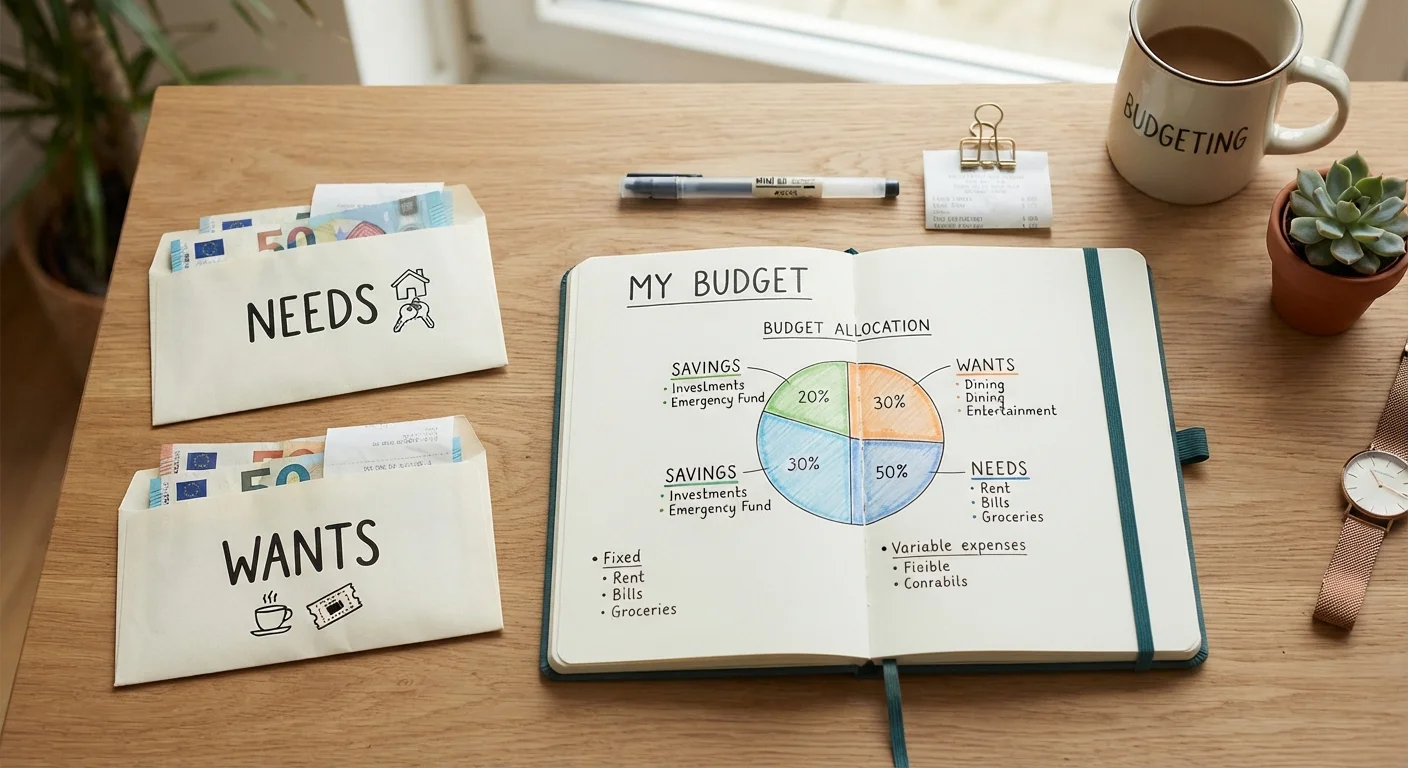
The 50/30/20 rule was popularized as a way to simplify household budgeting into three broad categories. After-tax income is split as follows: 50% toward needs (housing, utilities, groceries, minimum debt payments), 30% toward wants (dining out, subscriptions, entertainment), and 20% toward savings and debt repayment. The appeal is that percentages scale automatically - whether you earn $40,000 or $120,000 a year, the math adjusts without rebuilding the system from scratch.
Envelope budgeting works differently. At the start of each month or pay period, you assign a specific dollar amount to each spending category - groceries, gas, dining, clothing - and either place physical cash in labeled envelopes or replicate the system digitally. When an envelope is empty, spending in that category stops until it's refilled. This constraint is the entire point: the envelope becomes a hard boundary, not a guideline.
For a broader look at how these two approaches fit among other popular methods, see the full comparison of budgeting methods including zero-based and pay-yourself-first frameworks.
| Criterion | 50/30/20 Rule | Envelope Budgeting |
|---|---|---|
| Setup effort | Low - three categories only | Higher - many categories to define |
| Ongoing maintenance | Minimal monthly check-ins | Regular tracking and refilling |
| Spending control | Broad guidance, flexible | Hard category-level limits |
| Adaptability to income changes | Automatic - percentages scale | Requires manual recalculation |
| Best for irregular income | Less suited - ratios can distort | Well suited - fixed dollar amounts |
| Overspending visibility | Low - broad buckets hide detail | High - empty envelope signals stop |
| Beginner friendliness | Very accessible | Moderate learning curve |
Effort, Flexibility, and Where Each Method Falls Short
The 50/30/20 rule's biggest strength is also its most significant limitation: its flexibility. Because it groups expenses into just three buckets, it doesn't tell you much about where within those buckets your money is going. Someone who classifies a gym membership, streaming services, and frequent restaurant meals all as "wants" can still overspend without any clear signal from the framework itself.
Envelope budgeting, by contrast, surfaces overspending almost immediately - there's no cash left in the envelope. But that precision comes at a cost. Setting up and maintaining a dozen or more categories requires consistent effort, especially for two-income households where coordination matters. Digital envelope apps have reduced the friction of carrying physical cash, though the underlying discipline requirement remains.
~33%
Americans with a detailed monthly budget
Gallup polling has consistently found that roughly one in three U.S. adults maintains a detailed household budget, suggesting most people operate without a formal system.
78%
Workers living paycheck to paycheck
Multiple surveys over recent years have found that a large majority of U.S. workers report difficulty saving or building a buffer between paychecks, regardless of income level.
20%
Savings target in 50/30/20 framework
Financial educators generally recommend saving or directing at least 20% of after-tax income toward savings and debt reduction as a baseline goal.
It's also worth noting that the 50/30/20 split can feel misaligned for lower-income households where necessities already consume well above 50% of take-home pay, leaving little room for the prescribed ratios. An honest look at the 50/30/20 rule's strengths and limitations explores this tension in more depth.
Digital Envelope Tools Have Changed the Game
Modern budgeting apps now offer virtual envelope systems that eliminate the need to carry physical cash. Users can set digital category limits, move funds between envelopes, and track spending in real time from a smartphone. This has made envelope budgeting significantly more practical for people who rely primarily on debit or credit cards for daily purchases.
Choosing - or Combining - What Works for You
Neither framework is objectively better. The right choice depends on what's causing friction in your financial life right now. If your primary challenge is that you've never had a budget at all, the 50/30/20 rule offers a gentle, achievable entry point. If your challenge is that you've had a budget but keep blowing past certain categories, envelope budgeting's hard limits address that directly.
Some people find success blending both: using the 50/30/20 percentages to set top-level targets, then using envelope-style allocations within the "wants" category to manage the specific areas where they tend to overspend. This hybrid approach captures the simplicity of one framework and the accountability of the other.
Whatever method you choose, the tool you use to track it matters too. Comparing spending trackers, spreadsheets, and apps can help you match your chosen framework to a format you'll actually stick with. For guidance on structuring a monthly plan that makes room for savings, building a monthly budget that works provides a practical starting point.
Long-term success with any budgeting method also depends on habit formation - consistency matters more than the specific system. Habits that separate consistent budgeters from everyone else outlines the routines that help people stick with their chosen approach over time.
This article is for general informational and educational purposes only and does not constitute personalized financial or legal advice. Consult a qualified financial professional before making decisions based on your specific circumstances.
The content on this site is for informational purposes only and is not a substitute for professional advice. Always consult a qualified professional for guidance specific to your situation.