

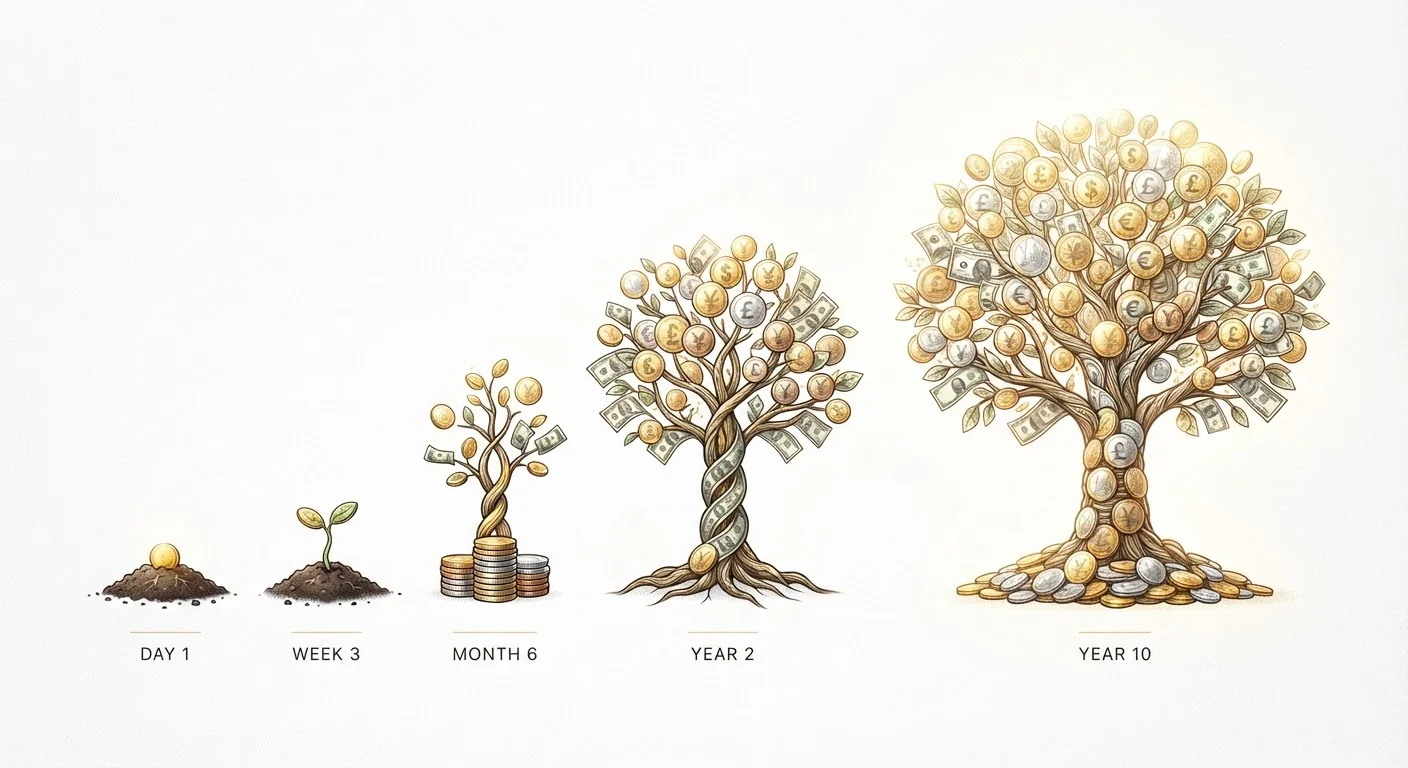
How Compound Interest Actually Works
At its core, compound interest is elegantly simple: you earn returns on your returns. In the first year, you earn interest on your starting balance. In the second year, that interest is added to your principal, and you earn interest on the combined total. Each cycle raises the base, which raises future earnings - creating exponential rather than linear growth.
Consider a straightforward illustration. Suppose you invest $5,000 at a hypothetical 7% average annual return (a figure often used as a rough historical approximation for diversified stock portfolios, though past performance never guarantees future results). After year one, you have approximately $5,350. After year two, you earn 7% on $5,350 - not the original $5,000. By year 30, without adding another dollar, that initial $5,000 has grown to roughly $38,000. The math is the same in each period; the power comes from letting it run.
~$38,000
Value of $5,000 after 30 years at 7% annual return
This illustrative figure assumes no additional contributions and consistent compounding; actual returns vary and are not guaranteed.
72 ÷ rate
Years to double money (Rule of 72)
Dividing 72 by the annual return rate gives a rough estimate of doubling time - at 6%, money doubles in approximately 12 years.
10 years
Early investor's contribution window that can outpace 30-year late start
A commonly cited illustration showing how starting early - even briefly - can outperform a much longer but later investing period, assuming equal rates of return.
This is why compounding is often described as a mechanism rather than a trick - it is simply interest doing what interest does, repeatedly, over a long enough runway.
Why Time Is the Critical Variable
Among all the factors in the compounding equation - principal, rate, and time - time exerts the greatest influence on the final outcome. This is because compounding is non-linear: growth accelerates in later years, not earlier ones. The bulk of a compounding portfolio's gains often arrive in the final decade of a multi-decade holding period.
A commonly cited comparison illustrates this vividly. An investor who contributes $200 per month starting at age 25 and stops at 35 - contributing for just 10 years - can potentially end up with more at retirement than someone who contributes the same $200 per month from age 35 to 65 - 30 full years of contributions. The early starter's money has more time to compound, even though they contributed far less. This is general education, not a guarantee; actual outcomes depend on rates of return, fees, taxes, and many other factors.
Start Before You Feel Ready
One of the most common compounding mistakes is waiting until you have a larger sum to invest. Because time is the dominant variable, even a modest monthly contribution started today can outperform a larger contribution started years from now. Prioritize beginning, then scale up over time.
For new investors, this dynamic is one of the strongest arguments for beginning to invest early - even before you feel you have enough. The first steps toward investing can feel small, but the time those early dollars spend compounding may matter more than the dollar amount itself.
Where Compounding Shows Up in Real Life
Compound interest operates across multiple corners of personal finance - sometimes in your favor, sometimes against you.
On the investing side, compounding applies wherever returns are reinvested: retirement accounts, index funds, dividend-reinvesting brokerage accounts. Understanding the vehicles that hold these investments is equally important; see our explainer on stocks, bonds, and mutual funds for context on the building blocks commonly used.
On the debt side, credit cards and certain loans compound interest on unpaid balances, making it easy for relatively small balances to balloon. The principles of debt management apply the same logic in reverse: paying down high-interest balances early limits compounding's negative effect.
Fees are a quieter compounding force worth noting. A 1% annual investment management fee may sound trivial, but compounded over 30 years, it can consume a meaningful portion of total portfolio growth. Our companion piece on fees and expense ratios unpacks exactly how this erosion works.
Lump Sum vs. Regular Contributions
Compounding works whether you invest a single lump sum or make regular contributions over time. If you're weighing these two approaches, our piece on lump-sum vs. regular contributions outlines the key trade-offs. Both strategies benefit from the same underlying compounding mechanism - the difference lies in timing and risk exposure.
This article is for general informational and educational purposes only and does not constitute personalized financial or investment advice. Consult a qualified financial professional before making decisions based on your individual circumstances.
Frequently Asked Questions
Simple interest is calculated only on the original principal - it never grows. Compound interest is calculated on the principal plus all accumulated interest, so the base grows with each period. Over long timeframes, this difference becomes enormous.
Yes. Many savings accounts and certificates of deposit compound interest, typically daily or monthly. However, the interest rates on cash savings are generally much lower than long-term investment returns, so the compounding effect is more modest.
Absolutely. Credit card debt, personal loans, and other high-interest borrowing compound in the same way. If you carry a balance, the amount you owe can grow quickly. Paying down high-interest debt is generally a financial priority for this reason.
The Rule of 72 is a simple mental math shortcut: divide 72 by an annual interest rate to estimate how many years it takes to double your money. At a 6% average annual return, money roughly doubles in about 12 years.
No. Even modest, consistent contributions can grow substantially over decades thanks to compounding. The key variable is time, not the initial amount. Starting small and early consistently outperforms starting large and late.
The content on this site is for informational purposes only and is not a substitute for professional advice. Always consult a qualified professional for guidance specific to your situation.