

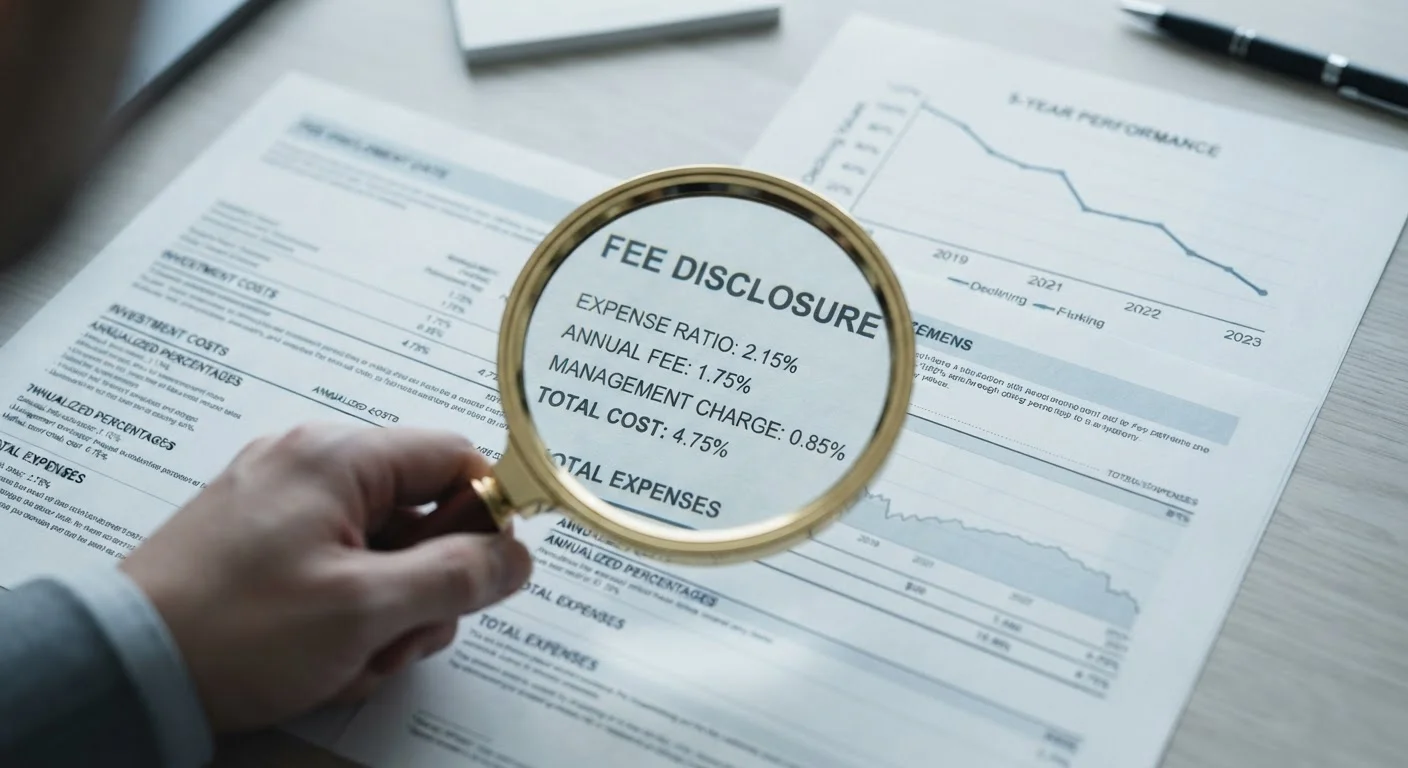
Why Investment Fees Deserve Serious Attention
Most investors focus on returns - how much a fund gained last quarter, or which sectors are outperforming. But there's a quieter number that shapes long-term outcomes just as powerfully: the fees you pay. Understanding those fees is one of the most practical steps any investor can take.
As compound interest amplifies gains over decades, it also amplifies the drag of fees. A cost that sounds trivially small - say, 1% per year - doesn't stay small. It compounds in reverse, quietly reducing the pool of money that could otherwise be growing on your behalf.
This isn't about alarm or shame. It's about clarity. Once you know what you're paying and why, you can make more deliberate choices about where your money works hardest.
~0.06%
Average expense ratio of U.S. index equity ETFs
According to Morningstar's annual fund fee study, asset-weighted average fees for passive U.S. equity ETFs have declined sharply over the past decade.
~0.66%
Average expense ratio of actively managed U.S. equity funds
Morningstar data indicates actively managed funds continue to charge substantially more than passive alternatives on an asset-weighted basis.
$100K+
Potential 30-year cost of a 1% fee difference
On a $50,000 portfolio earning 7% annually, a 1% annual fee gap can reduce ending wealth by over $100,000 relative to a lower-cost fund.
The Landscape of Investment Fees
Expense ratios get the most attention, but they're one of several costs investors may encounter. Here's a plain-language breakdown of the main fee types:
- Expense ratio: The ongoing annual fee built into a fund's daily pricing. Expressed as a percentage of assets, it covers management, administration, and sometimes distribution costs.
- Sales loads: One-time commissions paid when you purchase (front-end load) or redeem (back-end load) shares in certain mutual funds. Many funds today are sold without loads.
- Account maintenance fees: Some brokerages charge flat annual or monthly fees to maintain an account, though these have become less common.
- Trading commissions: Per-trade fees charged when you buy or sell securities. Commission-free trading is now widely available, but some platforms still charge for certain transactions.
- Advisory or management fees: If you use a financial adviser or robo-adviser, you may pay an additional layer of fees - typically 0.25% to 1% annually - on top of the underlying fund expenses.
Each fee type operates differently, but they all share one characteristic: they reduce what you keep. Savvy investors look at the total cost picture, not just one line item.
The Compounding Cost: A Concrete Illustration
To appreciate how fees accumulate, consider two hypothetical investors who each start with $50,000 and earn the same 7% gross annual return over 30 years. Investor A holds a fund with a 0.10% expense ratio; Investor B holds a fund charging 1.10%.
After 30 years, Investor A's portfolio would grow to approximately $370,000. Investor B's, after the higher fee erodes returns annually, would land near $270,000. That $100,000 difference - produced by a 1% annual fee - represents money that worked for the fund company rather than for the investor.
This is why even modest differences in expense ratios matter enormously over long time horizons. The math isn't complicated, but its implications are frequently underestimated. If you're also considering how and when to contribute, the fee structure of your chosen funds should factor into that decision as well.
Use the Expense Ratio as a Starting Filter
When comparing funds with similar investment objectives, treat the expense ratio as a first filter rather than an afterthought. All else being equal, the lower-cost option keeps more of your returns working for you. Many brokerage platforms allow you to sort or filter funds by expense ratio, making this comparison straightforward.
Actively Managed vs. Passive Funds: A Cost Comparison
Actively managed funds employ professional managers who research and select securities with the goal of outperforming a market benchmark. That expertise comes at a price - active funds typically carry expense ratios of 0.50% to 1.00% or more.
Passively managed index funds and ETFs, by contrast, simply track a market index. Because they require minimal active decision-making, their costs are much lower - often below 0.10% for broadly diversified funds.
A common misconception is that higher fees signal better performance. Research consistently shows that most actively managed funds do not outperform their benchmark index after fees are accounted for over long periods. This doesn't mean active management is always the wrong choice, but it does mean the fee burden requires a meaningful performance advantage to justify. Common investing myths, including the idea that higher cost always means higher quality, are worth examining before building a portfolio.
Fees Are Only One Factor in Fund Selection
While low costs are a meaningful advantage, expense ratios shouldn't be the sole criterion. Tax efficiency, diversification, asset allocation, and how a fund fits your overall strategy all matter. Think of fee comparison as a necessary - but not sufficient - step in evaluating investment options. A qualified financial adviser can help you weigh these considerations in the context of your specific goals.
How to Evaluate the Fees You're Paying
Reviewing what you currently pay doesn't require a finance degree. A few practical steps:
- Find the expense ratio for every fund you hold. It's listed in the fund's prospectus and on your brokerage's fund detail page.
- Check for account-level fees by reviewing your brokerage statements. Look for annual maintenance charges or inactivity fees.
- Ask about advisory fees if you work with a human or robo-adviser. Understand whether those fees are charged on top of the underlying fund expenses.
- Add up the layers to estimate your total annual cost as a percentage of assets. Compare that against what you might pay in a lower-cost alternative.
Understanding costs is also a natural complement to building a personal budget - both are fundamentally about knowing where your money goes and making intentional decisions with it. For investors using a dollar-cost averaging approach, selecting low-cost funds as the vehicle for regular contributions can meaningfully improve long-term outcomes.
This article is for general informational and educational purposes only and does not constitute personalized financial, investment, tax, or legal advice. Consult a qualified financial professional before making investment decisions based on your individual circumstances.
Frequently Asked Questions
For passively managed index funds and ETFs, expense ratios below 0.20% are widely considered low. Actively managed funds often charge 0.50% to 1.00% or more. As a general principle, lower is better - every dollar paid in fees is a dollar not compounding for your future.
Because fees reduce the base on which your returns compound, their impact grows over time. A 1% annual fee on a $50,000 portfolio earning 7% annually could reduce your ending balance by more than $100,000 over 30 years compared to a 0.10% fee fund.
Yes. Expense ratios are deducted regardless of fund performance. In a down year, you still pay the management fee, which means fees can deepen losses in poor market conditions.
A sales load is a one-time commission paid when you buy (front-end load) or sell (back-end load) a fund. An expense ratio is an ongoing annual fee. Both reduce your returns but at different times and in different ways. Many funds today are no-load.
Expense ratios are disclosed in a fund's prospectus and on its summary fact sheet. Most brokerage platforms display the expense ratio prominently on the fund's information page, making it straightforward to compare before investing.
The content on this site is for informational purposes only and is not a substitute for professional advice. Always consult a qualified professional for guidance specific to your situation.