

Our Verdict
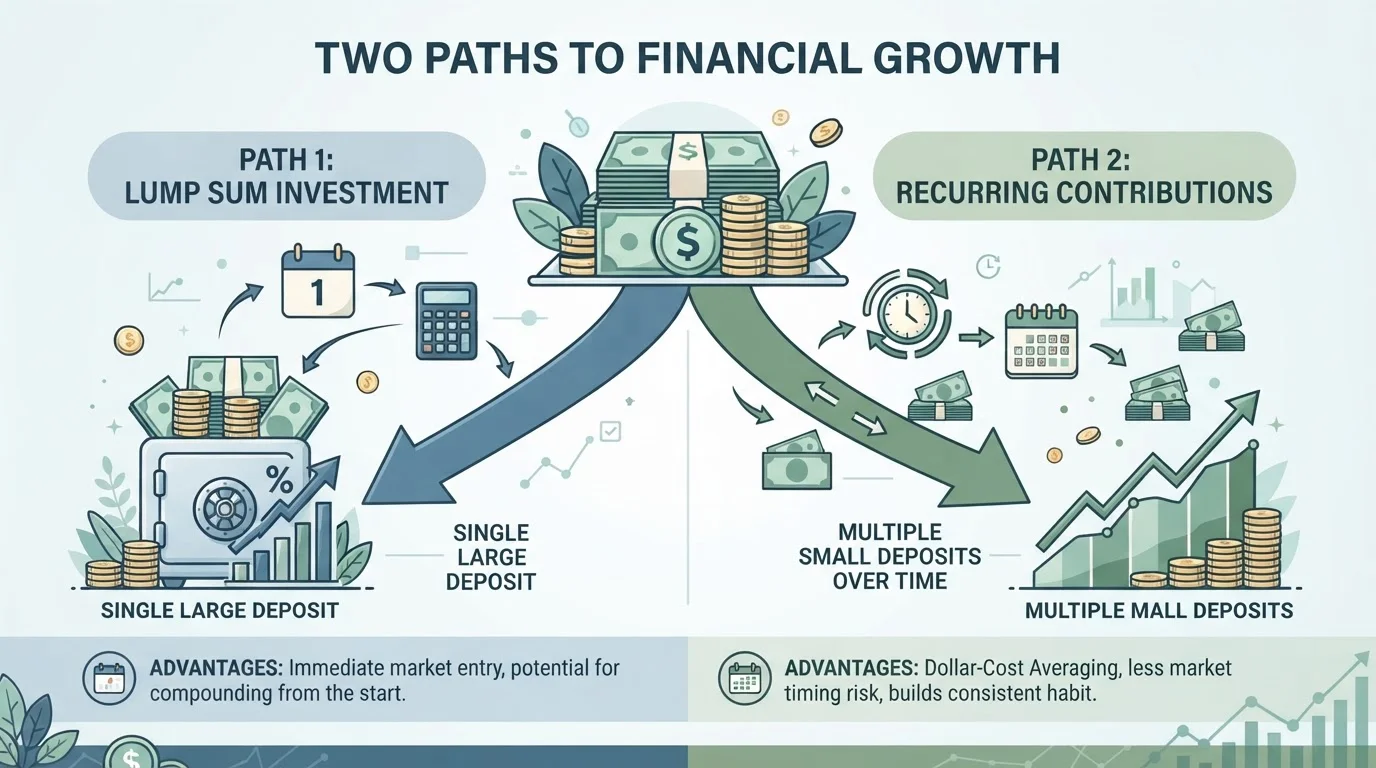
Research consistently shows lump-sum investing edges out periodic contributions in the majority of historical market periods, largely because money invested earlier has more time to compound. However, regular contributions remain a highly effective and psychologically sustainable approach — especially for investors working with a paycheck rather than a windfall. Neither method guarantees results, and both carry market risk.
| Best for | Recommended |
|---|---|
| Those who have received a windfall and can tolerate short-term volatility | Lump-Sum Investing |
| Salaried earners building wealth gradually from regular income | Regular Contributions |
| Investors who experience high anxiety around market timing | Regular Contributions |
| Those seeking maximum long-term mathematical efficiency with available capital | Lump-Sum Investing |
What Each Approach Actually Means
Lump-sum investing means deploying a large amount of capital into the market at a single point in time — for example, investing an inheritance, bonus, or savings balance all at once. Regular contributions (often called dollar-cost averaging when applied to a fixed sum) means investing smaller amounts at consistent intervals, such as contributing to a 401(k) with every paycheck.
For many Americans, regular contributions aren't a strategic choice — they're the natural result of investing from a salary. But when a windfall arrives, the question of whether to invest it all immediately or spread it out becomes genuinely important. If you're new to investing concepts altogether, see our beginner's guide to investing before diving into strategy comparisons.
| Lump-Sum Investing | Regular Contributions | |
|---|---|---|
| Best historical performance | Outperforms in ~2/3 of market periods | Underperforms lump-sum in rising markets |
| Timing risk | High — single entry point | Low — spread across many entry points |
| Requires large upfront capital | Yes | No — works with any income level |
| Behavioral difficulty | Higher — sharp drops feel acute | Lower — gradual, automated, less stressful |
| Suits market environment | Trending upward markets | Volatile or uncertain markets |
| Time in market | Maximized from day one | Builds gradually over time |
What the Research Shows
Vanguard's widely cited analysis of U.S., UK, and Australian markets found that lump-sum investing outperformed a 12-month phased investment approach in roughly two-thirds of historical rolling periods. The logic is straightforward: markets have trended upward over long horizons, so money that enters the market sooner has more time exposed to that growth.
The power behind both strategies ultimately traces back to the same engine — compound interest. The earlier capital is invested, the longer it compounds. A delay of even one or two years can meaningfully reduce long-term outcomes.
~68%
Periods lump-sum outperformed phased investing
Vanguard research across U.S., UK, and Australian markets found lump-sum investing beat a 12-month phased strategy in approximately two-thirds of historical rolling periods.
10+ years
Time horizon that reduces entry-point risk
Financial research broadly suggests that over longer horizons, a poor market entry point has a diminishing impact on overall portfolio performance relative to time invested.
That said, lump-sum investing's statistical edge narrows or reverses in prolonged bear markets. Investors who deployed a lump sum just before a major downturn faced steeper short-term losses than those contributing gradually. This is where timing risk becomes real — and why regular contributions offer a genuine hedge against it.
The Role of Behavioral Finance
The mathematically optimal choice and the personally sustainable choice are often different things. An investor who deploys a lump sum and immediately watches the market drop 15% may panic and sell — locking in losses and forfeiting the recovery. The same investor contributing monthly may barely notice the same decline because each new contribution is simply buying at lower prices.
This is not a trivial concern. Emotional decision-making is one of the most documented causes of underperformance among individual investors. A strategy that keeps you invested through volatility is practically more valuable than one that's theoretically superior but psychologically difficult to maintain.
Consider a Middle Path
If you have a lump sum but high anxiety about market timing, a compromise approach — investing a meaningful portion immediately and spreading the remainder over three to six months — captures much of the statistical benefit of lump-sum investing while providing psychological comfort. This is not a guarantee of better outcomes, but it may help you stay invested rather than sitting in cash indefinitely waiting for the 'right moment.'
Regular contributions also impose a useful discipline: by automating monthly investments, you build savings habits that align with broader financial goals. For guidance on structuring that kind of system, budgeting methods like pay-yourself-first can complement an investment contribution plan effectively.
Practical Considerations Before You Decide
Before choosing an approach, consider these factors honestly:
- Capital availability: If you're investing from a salary, regular contributions are your default — lump-sum investing requires a large balance on hand.
- Risk tolerance: Lump-sum investing concentrates timing risk at a single point. If a sudden 20% drop would cause you to sell, a phased approach may protect against that reaction.
- Investment horizon: Longer time horizons reduce the impact of a bad entry point. Younger investors with decades ahead may weather a poor lump-sum entry far better than someone five years from retirement.
- Asset allocation: How you divide money between stocks, bonds, and other assets also shapes your exposure to timing risk — something worth revisiting as life circumstances change. Our overview of asset allocation across life stages explains this in more detail.
Those interested in a structured regular-contribution strategy can also explore dollar-cost averaging as a formalized framework for periodic investing regardless of market conditions.
This article is for general informational and educational purposes only and does not constitute personalized financial, investment, tax, or legal advice. Investing involves risk, including the possible loss of principal. Past market performance does not guarantee future results. Please consult a qualified financial adviser before making decisions about your own investments.
The content on this site is for informational purposes only and is not a substitute for professional advice. Always consult a qualified professional for guidance specific to your situation.