

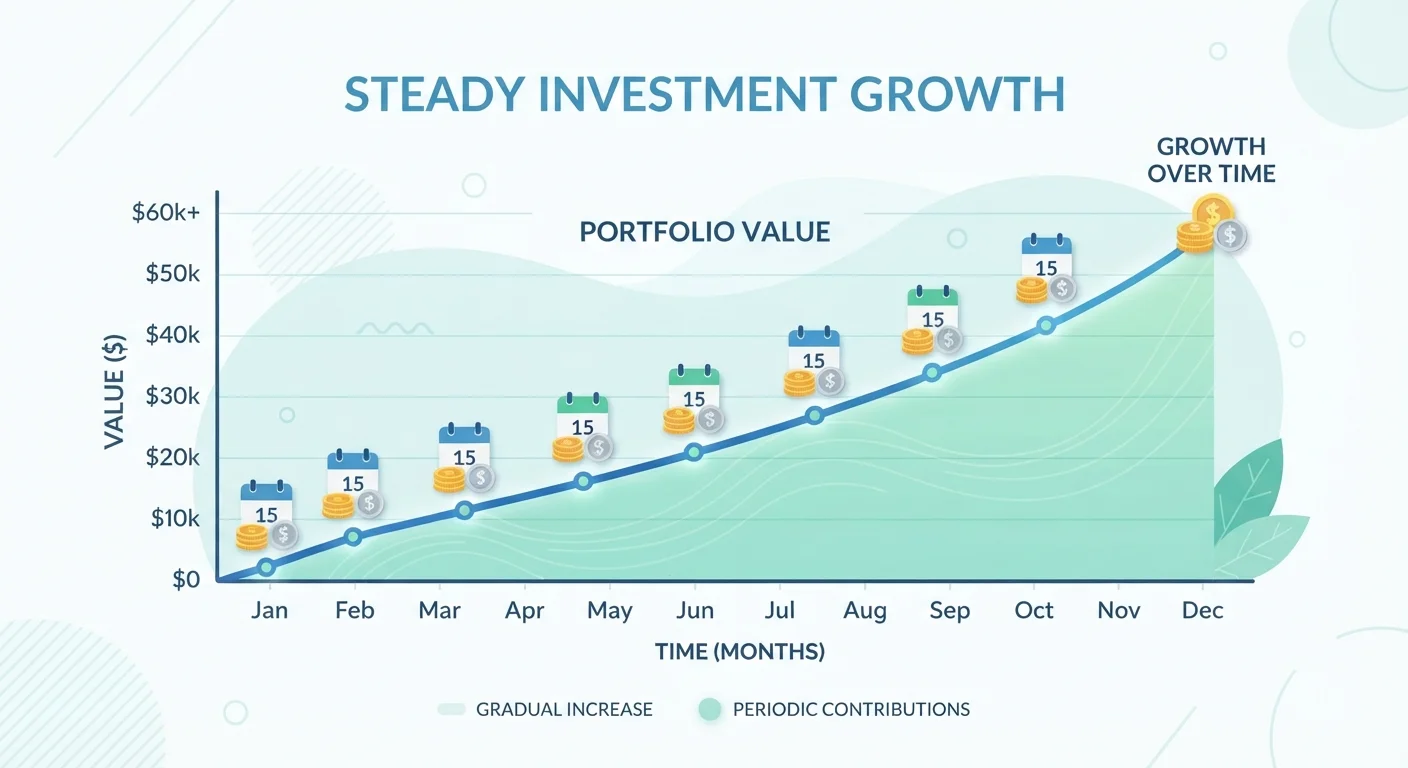
How Dollar-Cost Averaging Works in Practice
The mechanics of DCA are straightforward. Suppose you commit to investing $200 every month into a broad market index fund. In a month when the fund's share price is $50, your $200 buys four shares. The following month, if the price drops to $40, the same $200 buys five shares. When prices rise to $80, you buy 2.5 shares. Your per-share cost averages out over time — often below what you'd have paid if you invested everything at a single point.
This contrasts with trying to "time the market," where an investor waits for what they believe is the ideal entry point. Market timing is notoriously difficult even for professional fund managers, and waiting for the "right" moment often means staying out of the market entirely — which carries its own cost.
If you're just getting started, this beginner's guide to investing covers the core concepts and account types worth understanding first.
~$7T
Held in U.S. workplace retirement plans
The majority of 401(k) contributions are made on a regular payroll schedule — a structural form of DCA — according to the Investment Company Institute.
70%+
Of individual investors cite market volatility as a concern
A recurring finding in investor sentiment surveys from FINRA and similar organizations is that volatility deters many people from investing consistently.
20+ years
Typical time horizon where DCA shows the clearest benefit
Academic research on systematic investing strategies generally finds the most favorable risk-adjusted outcomes over multi-decade horizons.
The Behavioral Advantage: Removing Emotion from the Equation
One of DCA's most underappreciated benefits is psychological. Markets are volatile, and price swings naturally trigger anxiety. Investors who invest reactively — piling in during rallies and pulling back during downturns — often buy high and sell low, the opposite of a sound strategy.
By committing to a fixed schedule, DCA removes the need to make a decision every time you invest. Your contributions happen automatically, regardless of whether the headlines are alarming or exuberant. This discipline is especially valuable for new investors who may not yet have experience riding out market cycles.
Automate to Stay Consistent
The simplest way to maintain a DCA strategy is to automate it. Most brokerage accounts and workplace retirement plans allow you to set a recurring contribution amount and schedule. Automation removes the temptation to skip contributions during turbulent markets — exactly when consistency matters most.
DCA pairs well with other foundational principles. Diversification — spreading investments across different asset classes — reduces concentration risk, while thoughtful asset allocation ensures your mix of stocks, bonds, and cash aligns with your timeline and goals.
Where DCA Fits — and Where It Has Limits
Dollar-cost averaging is not a silver bullet. It works best as a long-term strategy — think decades, not months — because short time horizons leave little room for markets to recover from downturns. It also assumes the underlying investment has sound long-term prospects; DCA into a declining asset does not automatically produce gains.
Costs also matter. Frequent purchases can accumulate transaction fees in some account structures, which erode returns over time. Understanding expense ratios and investment fees is essential before setting up any automated contribution plan.
Finally, DCA requires a funding source. Building a sustainable contribution habit means your investing schedule needs to fit within a realistic budget. If you haven't mapped your monthly cash flow, budgeting basics is a practical starting point before automating investments.
This article provides general financial information for educational purposes only and is not personalized investment advice. Consider consulting a licensed financial professional before making investment decisions.
Frequently Asked Questions
Research generally shows that lump-sum investing outperforms DCA when markets trend upward, since the money is working sooner. However, DCA reduces the risk of investing everything right before a downturn and can be more practical for people who don't have a large sum available at once. See <a href="/finance/investing-essentials/lump-sum-investing-vs-regular-contributions-how-the-two-approaches-compare">how the two approaches compare</a> for a fuller breakdown.
No. DCA reduces timing risk but does not prevent losses if an investment declines in value over the long term. All investing involves risk, and past performance does not guarantee future results.
DCA fits naturally into tax-advantaged accounts like 401(k)s and IRAs, where contributions can be automated. It also works in standard brokerage accounts, though the tax treatment of gains and dividends differs.
There is no universal minimum. Many brokerage platforms and workplace retirement plans allow contributions as low as a few dollars per period, especially with fractional share options. What matters most is consistency, not the size of each contribution.
DCA can work particularly well during prolonged downturns because each contribution buys more shares at lower prices. If the market eventually recovers, those lower-cost shares can contribute meaningfully to long-term gains — though recovery is never guaranteed.
The content on this site is for informational purposes only and is not a substitute for professional advice. Always consult a qualified professional for guidance specific to your situation.