

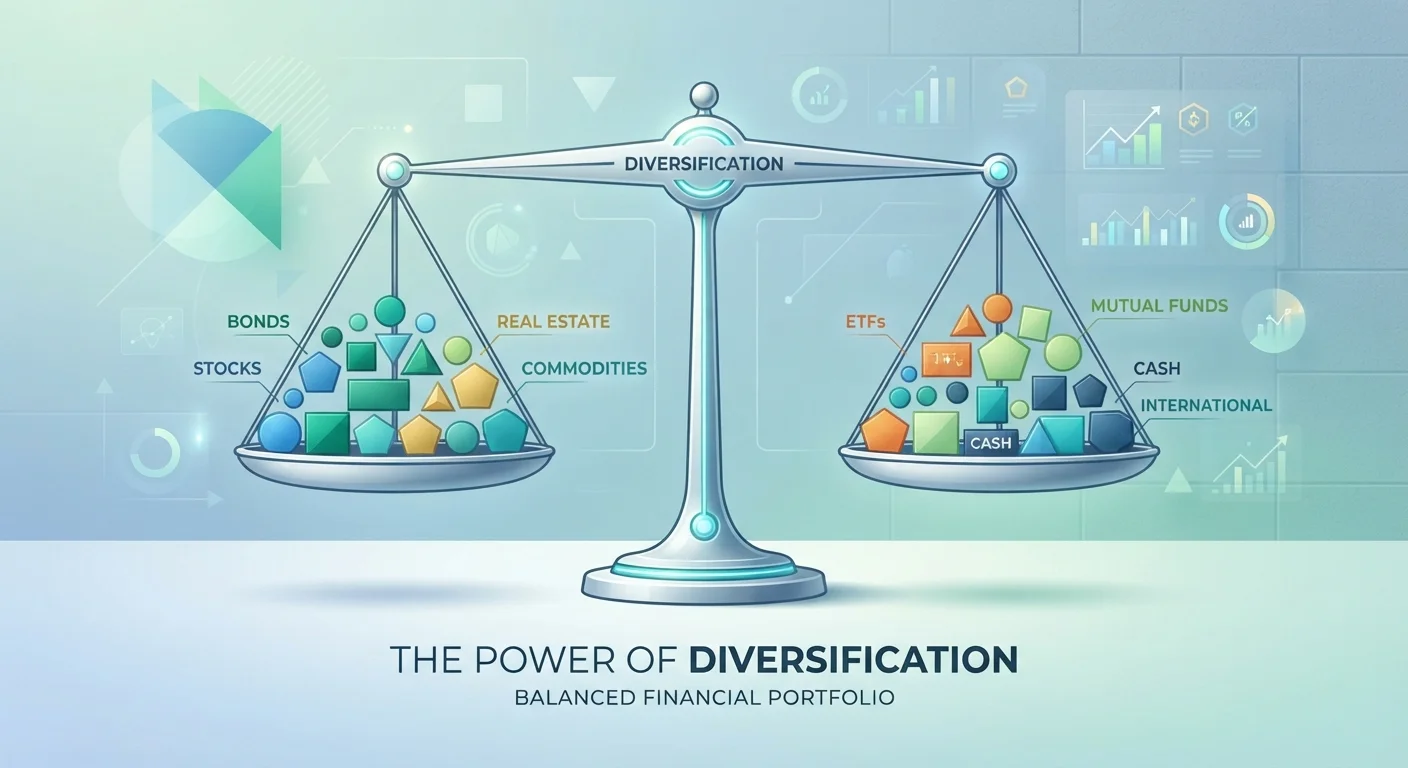
The Core Idea: Why One Basket Is a Problem
Imagine putting all your savings into a single company's stock. If that company thrives, so do you. But if it stumbles - due to a scandal, a failed product launch, or a broader industry slump - your entire financial position takes the hit. Diversification exists to prevent exactly that scenario.
The underlying logic is straightforward: different investments tend to respond differently to the same economic events. When one sector suffers, another may benefit. By holding a variety of assets, you reduce the chance that any one event can significantly damage your overall portfolio.
This is general financial education, not personalized investment advice. For guidance specific to your situation, consult a qualified financial professional.
“Diversification is the only free lunch in investing. By spreading your holdings, you can reduce risk without necessarily sacrificing expected return.”
— Harry Markowitz, Nobel Prize-winning economist and pioneer of Modern Portfolio Theory
What a Diversified Portfolio Actually Looks Like
Diversification operates on several levels simultaneously:
- Asset classes: Mixing stocks, bonds, and cash equivalents. These categories historically move with different rhythms. See how stocks, bonds, and mutual funds differ for a deeper breakdown of each.
- Sectors: Within stocks, spreading exposure across technology, healthcare, energy, consumer goods, and financials, rather than concentrating in one industry.
- Geographies: Holding both domestic and international investments to reduce reliance on a single country's economic performance.
- Investment styles: Blending growth-oriented and value-oriented holdings, as well as large-cap and small-cap companies.
A beginner doesn't need to build this manually. A single broad-market index fund or a target-date retirement fund can provide exposure across thousands of companies and multiple asset classes in one step.
~20-30
Stocks needed to reduce company-specific risk
Finance research has long suggested that holding around 20-30 uncorrelated stocks can substantially reduce unsystematic portfolio risk, though the exact number varies by study.
3,700+
Companies in a broad U.S. total market index
A single broad U.S. total stock market index fund can provide exposure to thousands of companies across all sectors, illustrating how index investing delivers built-in diversification.
What Diversification Does - and Doesn't - Do
Diversification is effective at reducing unsystematic risk - the risk associated with a specific company or sector. If one stock in a 40-holding portfolio drops 50%, the damage to your overall portfolio is limited.
However, diversification cannot protect against systematic risk - the kind that affects markets broadly, such as a recession, a financial crisis, or a sharp rise in interest rates. In those environments, many asset classes can decline together, even in a diversified portfolio.
This is why diversification is best understood as a risk-management tool rather than a performance booster. It smooths out the volatility caused by individual failures, but it doesn't shield you from the natural ups and downs of markets over time. Pairing diversification with a long-term perspective and a consistent contribution strategy - such as dollar-cost averaging - can help manage those broader fluctuations.
Review Your Mix Periodically
Market movements can shift your portfolio's allocation over time. A portfolio that started as 60% stocks and 40% bonds might drift to 70/30 after a strong equity run. Periodically rebalancing - selling some of what has grown and adding to what has shrunk - helps maintain your intended risk level. Speak with a financial professional to determine a rebalancing approach suited to your goals.
Getting Started With Diversification
You don't need a large sum of money or a financial adviser to begin diversifying. Many investors start with broad-based index funds that track the entire U.S. stock market or a global index, instantly spreading capital across hundreds or thousands of companies.
As your portfolio grows, consider whether your allocation across asset classes still reflects your risk tolerance and time horizon. A younger investor with decades ahead may hold a higher proportion of stocks; someone closer to retirement might shift toward more bonds to reduce volatility.
If you're still building the financial foundation before you invest, the pre-investing checklist is worth reviewing first. And if you're new to investing altogether, this practical starting point for first-time investors walks through what to consider before putting money to work.
Diversification isn't a one-time decision - it's an ongoing practice of reviewing whether your mix of investments still aligns with your goals as circumstances change.
This article is for general informational and educational purposes only and does not constitute personalized financial or investment advice. Consult a licensed financial professional before making investment decisions.
Frequently Asked Questions
No. Diversification reduces the risk tied to any single investment but cannot protect against broad market downturns that affect all asset classes simultaneously. It is a risk-management tool, not a loss-prevention guarantee.
There is no magic number, but research generally suggests that owning around 20-30 uncorrelated stocks can significantly reduce company-specific risk. Holding index funds or ETFs can achieve broad diversification with just a few holdings.
Yes. Owning too many similar assets can dilute potential gains without meaningfully reducing risk further. Over-diversification can also make a portfolio harder to manage and may increase costs.
No. True diversification spans asset classes - stocks, bonds, real estate, cash equivalents - as well as sectors and geographic regions. Owning 50 technology stocks, for example, is not well-diversified.
Absolutely. Beginners can achieve meaningful diversification through low-cost index funds or target-date funds, which automatically spread money across hundreds of holdings. It doesn't require expertise to get started.
The content on this site is for informational purposes only and is not a substitute for professional advice. Always consult a qualified professional for guidance specific to your situation.