

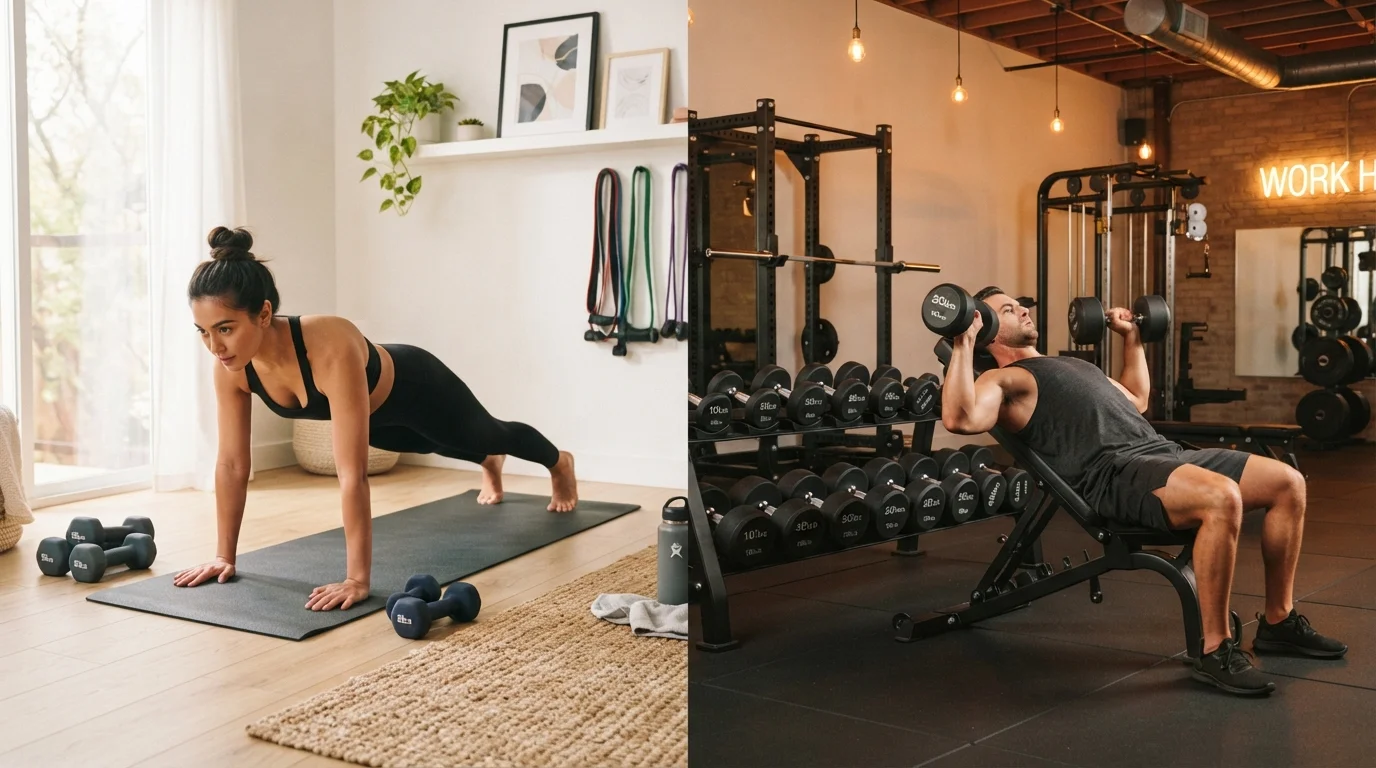
Our Verdict
Home workouts win on convenience and cost, while gyms offer equipment variety and a structured environment that many people find motivating. Neither has a meaningful edge when it comes to actual fitness outcomes — what drives results is showing up regularly. The best setting is the one that removes the most friction from your specific life.
Home workouts suit people with tight schedules, limited budgets, or privacy preferences; gyms are a stronger fit for those who benefit from social accountability, want access to specialized equipment, or struggle to self-motivate at home.
The Core Question: Where Will You Actually Work Out?
When comparing home and gym exercise, the most important variable isn't equipment or cost — it's adherence. Research consistently shows that the single strongest predictor of fitness progress is workout frequency, not intensity or environment. That reframes the entire debate: the better setting is whichever one you'll reliably use.
That said, real structural differences between the two environments affect everything from your budget to your exercise variety to how you feel walking in the door. Understanding those trade-offs helps you make a genuinely informed decision rather than defaulting to whatever's most convenient in the short term.
For a broader look at designing a routine you'll actually sustain, see building a weekly exercise schedule from scratch.
Advantages and Disadvantages of Home Workouts
Working out at home removes the single biggest barrier most people cite: the commute. No travel time, no waiting for equipment, no membership fee. For anyone with a demanding schedule or young children, this friction reduction alone can mean the difference between exercising and not exercising.
No commute removes the most common barrier
Eliminating travel time makes it far easier to fit exercise into a packed day. Studies on exercise adherence consistently identify convenience as a top factor in whether people maintain a routine.
Lower long-term cost than most gym memberships
A modest home setup — mat, resistance bands, adjustable dumbbells — can cost less than a single year of gym membership fees and continue to pay off for years.
Privacy and comfort for self-conscious beginners
Many people feel more comfortable learning new movements or working through early fitness stages without an audience, which can lower the psychological barrier to starting.
Flexible scheduling around any lifestyle
Home workouts can happen at 5 a.m. or 11 p.m. without regard for gym hours, class schedules, or peak-hour crowds.
The trade-offs are real, though. Home environments can be full of distractions — a couch, a pet, a notification — and most people don't have access to the full range of equipment a commercial gym provides. Progressive overload, the principle of gradually increasing challenge over time, becomes harder to execute without a variety of weights or machines. Motivation can also drift without external accountability.
Limited equipment restricts exercise variety
Without access to a full weight rack, cable system, or cardio machines, certain training goals — particularly heavy compound lifting or sport-specific conditioning — are difficult to achieve at home.
Distractions undermine focus and intensity
Household interruptions, screens, and domestic tasks compete for attention in ways that a dedicated gym environment doesn't allow. Many people find their effort drops without a defined workout space.
Lack of social accountability reduces consistency for some
For people who are externally motivated, the absence of workout partners, classes, or even a staff check-in can make it easier to skip sessions without consequence.
Upfront equipment costs can be a barrier
While cheaper long-term, building even a basic home gym requires an initial investment in equipment and space that not everyone has available.
It's worth noting that bodyweight training and minimal equipment (resistance bands, a single set of adjustable dumbbells) can cover a wide range of fitness goals. Low-impact exercise formats in particular translate well to a home setting.
Advantages and Disadvantages of Gym Workouts
A commercial gym's primary offering is equipment density — cable machines, free weights in multiple increments, cardio equipment, and often group fitness classes. This variety supports a wide range of training styles, from cardio-focused programming to strength-specific work. For people who want to explore different modalities without upfront investment, a monthly membership provides access to tools that would cost thousands to replicate at home.
~$58/month
Average U.S. gym membership cost
According to industry surveys, the average American pays between $40 and $70 per month for a gym membership, not counting initiation fees or add-on classes.
~23%
Adults meeting both aerobic and muscle-strengthening guidelines
The CDC reports that only about 1 in 4 U.S. adults meets the Physical Activity Guidelines for both aerobic activity and muscle-strengthening, regardless of where they exercise.
The gym environment also tends to have a psychological effect: many people report working harder and more consistently when surrounded by others who are exercising. That social accountability is genuinely useful, though it isn't universal — some people find the gym environment stressful or intimidating.
The practical drawbacks include cost, commute, and scheduling constraints. Peak hours can mean crowded equipment and waiting. For those interested in free weights versus machines, the gym is typically the only realistic place to compare them in practice.
What the Research Actually Shows
Multiple studies comparing home-based and gym-based exercise programs have found no significant difference in fitness outcomes when participants follow structured programs in either setting. A 2019 study published in the journal Heliyon found that home-based resistance training produced comparable strength and body composition improvements to gym-based training over 12 weeks. The environment matters far less than program quality and consistency.
Making the Choice — or Combining Both
For many people, the most practical answer is a hybrid: a gym membership for strength training or classes, combined with home sessions for cardio, flexibility work, or days when travel isn't feasible. This approach spreads cost across both settings while preserving flexibility.
If you're choosing one, map your actual constraints honestly. What's your realistic weekly schedule? Do you have consistent self-motivation, or do you need external structure? What are your goals — general health maintenance, weight management, muscle building, or athletic performance? The answers usually point clearly toward one setting.
Consistency consistently outperforms intensity in long-term fitness outcomes. A moderately equipped home setup used four times a week will produce better results than a premium gym membership used sporadically. Whichever path you choose, anchor it to a schedule and a realistic minimum — then build from there.
This article is for general informational purposes only and does not constitute medical or professional fitness advice. Consult a qualified healthcare provider or certified fitness professional before beginning any new exercise program, particularly if you have an existing health condition or injury.
The content on this site is for informational purposes only and is not a substitute for professional advice. Always consult a qualified professional for guidance specific to your situation.