

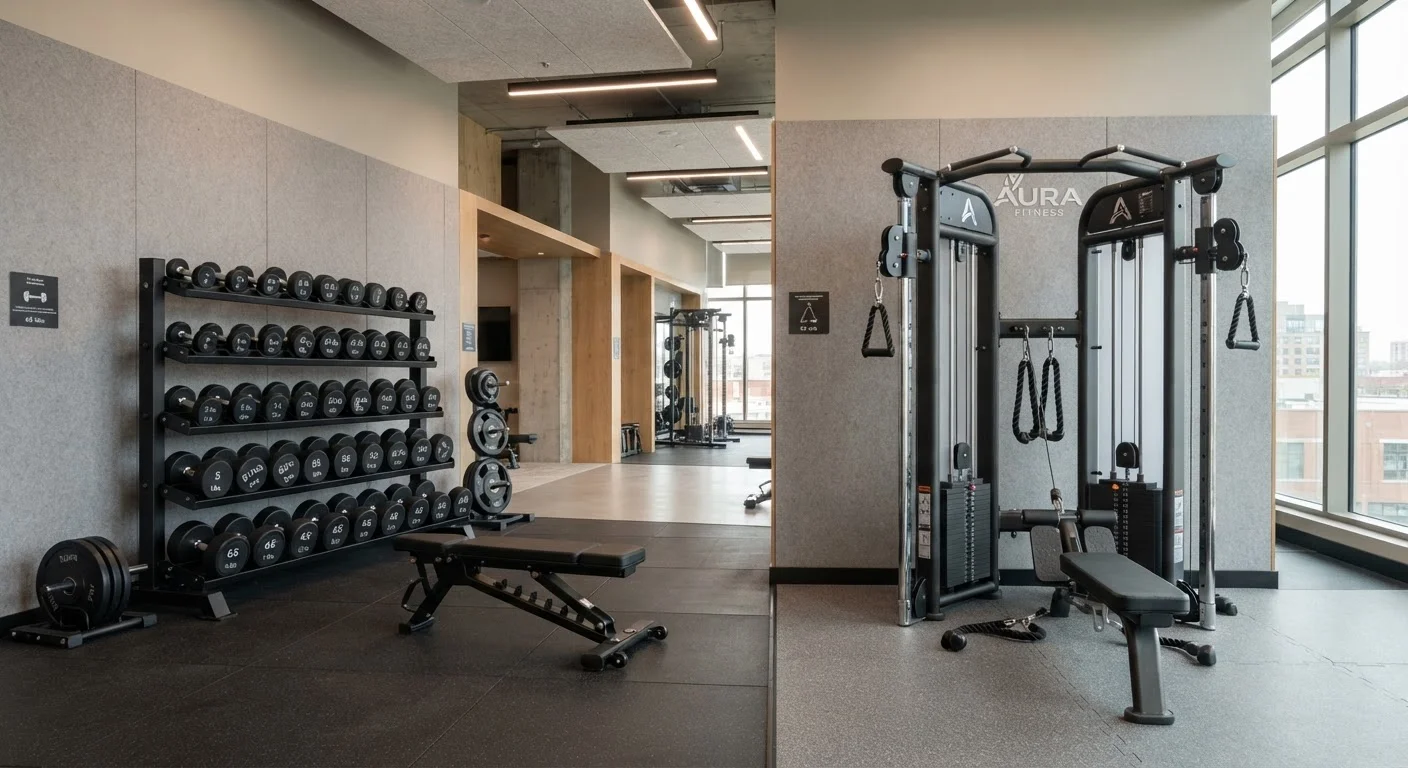
Option A
Free Weights
The versatile, functional movement tool.
Best for: Lifters who want to build full-body coordination, core stability, and transferable strength across multiple muscle groups.
Option B
Resistance Machines
The guided, controlled strength-building option.
Best for: Beginners, those recovering from injury, or anyone targeting a specific muscle group with reduced injury risk.
What Separates Free Weights from Machines
Free weights — dumbbells, barbells, kettlebells, and similar tools — allow movement in any direction. That freedom is intentional: your muscles, joints, and stabilizing tissue all share the work of controlling the load. Resistance machines, by contrast, move along a fixed path determined by the equipment's design. A leg press, cable row, or chest fly machine guides you through a predetermined arc, reducing the coordination demand.
This isn't simply a matter of one being harder than the other. The two tools create different training stimuli. Free weights recruit more accessory and stabilizing muscles because nothing is constraining your movement. Machines isolate a primary muscle group more precisely because the machine absorbs much of the stabilization work. Understanding this difference is the starting point for deciding which belongs in your routine — and when. For a broader orientation to resistance training concepts, see our guide for beginners.
The Case for Free Weights
Research consistently shows that free-weight exercises activate a wider network of muscles per movement. A barbell squat, for instance, recruits the quadriceps, hamstrings, glutes, lower back, and core simultaneously, while a leg extension machine narrows that focus almost entirely to the quadriceps. This multi-muscle engagement is one reason free weights are often associated with functional strength — the kind that transfers to carrying groceries, climbing stairs, or recovering your balance.
Free weights also carry a higher learning curve. Proper form on a barbell deadlift or overhead press requires time to develop, and performing these movements with poor mechanics under load increases injury risk. This does not make free weights inherently dangerous, but it does mean technique must come before load. Starting with lighter weights and progressing gradually is sound practice regardless of fitness level.
| Criterion | Free Weights | Resistance Machines |
|---|---|---|
| Stabilizer muscle engagement | High — multiple muscles share load | Low — machine controls movement path |
| Learning curve | Steeper — technique takes time | Lower — guided range of motion |
| Injury risk (with poor form) | Higher if technique breaks down | Lower due to fixed movement arc |
| Muscle isolation | Less precise — multiple muscles involved | More precise — targets one muscle group |
| Equipment cost and space | Generally lower — versatile tools | Higher — each machine is single-purpose |
| Functional carryover | Strong — mirrors real-world movement | More limited — controlled environment |
| Suitability for rehab | Depends on injury and movement | Often preferred for controlled loading |
Cost and space efficiency are additional practical advantages. A pair of adjustable dumbbells can replicate dozens of exercises, making free weights the more accessible option for home training. For more on environment trade-offs, see exercising at home vs. at a gym.
The Case for Resistance Machines
Machines are not a beginner's crutch to be abandoned once someone gains experience. They offer genuine, lasting value for specific purposes. Their fixed movement path reduces the cognitive and neuromuscular load of each exercise, which has real benefits: beginners can focus on feeling the target muscle rather than worrying about balance; experienced lifters can safely train to near-failure with lower risk of form breakdown; and those recovering from injuries can load muscles in a controlled way without stressing adjacent tissue.
Machines also allow meaningful loading in situations where free-weight alternatives are impractical. Seated cable rows, lat pulldowns, and leg curls let you train muscles through ranges of motion that would require significant skill or a training partner to replicate safely with free weights.
Machine Fit Matters More Than People Think
Resistance machines are designed to accommodate a range of body sizes, but they are not one-size-fits-all. Using a machine set to the wrong position can place joints under awkward loads that increase rather than reduce injury risk. Before beginning a set, take a moment to adjust the seat height, backrest, and pad position so your joints are aligned with the machine's pivot points. Most gyms have staff who can walk you through this — it is worth asking.
It is worth noting that machines vary considerably in design quality. A well-engineered machine will place joints in biomechanically sound positions; a poorly designed one may not. Adjusting seat height, pad position, and range-of-motion stops to fit your body before each use is important regardless of the equipment.
Putting Both to Work: Practical Considerations
For most people, the most useful question is not which to choose but how to sequence them. A common and well-supported approach is to use free-weight compound movements — squats, presses, rows, hinges — as the structural foundation of a workout, then use machines to finish with targeted isolation work. This takes advantage of the multi-muscle coordination of free weights when energy is highest, and the focused isolation of machines when fatigue is setting in.
~80%
More muscle activation in stabilizers
Research published in the Journal of Strength and Conditioning Research found free-weight exercises elicit significantly greater stabilizer muscle activation compared to machine equivalents.
2x
Exercises per piece of equipment
A single barbell or pair of dumbbells can effectively replicate many times the exercise variety of a single-purpose resistance machine.
Your specific goals matter too. Someone prioritizing general health and functional fitness may lean toward free weights. Someone rebuilding a knee after surgery will rightly spend more time on machines under clinical guidance. Someone focused purely on muscle hypertrophy may benefit from both equally. Consistency over time is what drives progress — the specific tool matters far less than whether you use it regularly with good form and appropriate progression. And if you encounter strong opinions about which is the one right approach, fitness myths examined with evidence is a useful read.
This article is for general informational purposes only and does not constitute medical or professional fitness advice. Always consult a qualified healthcare provider or certified fitness professional before starting or modifying an exercise program, particularly if you have an existing health condition or injury.
The content on this site is for informational purposes only and is not a substitute for professional advice. Always consult a qualified professional for guidance specific to your situation.