

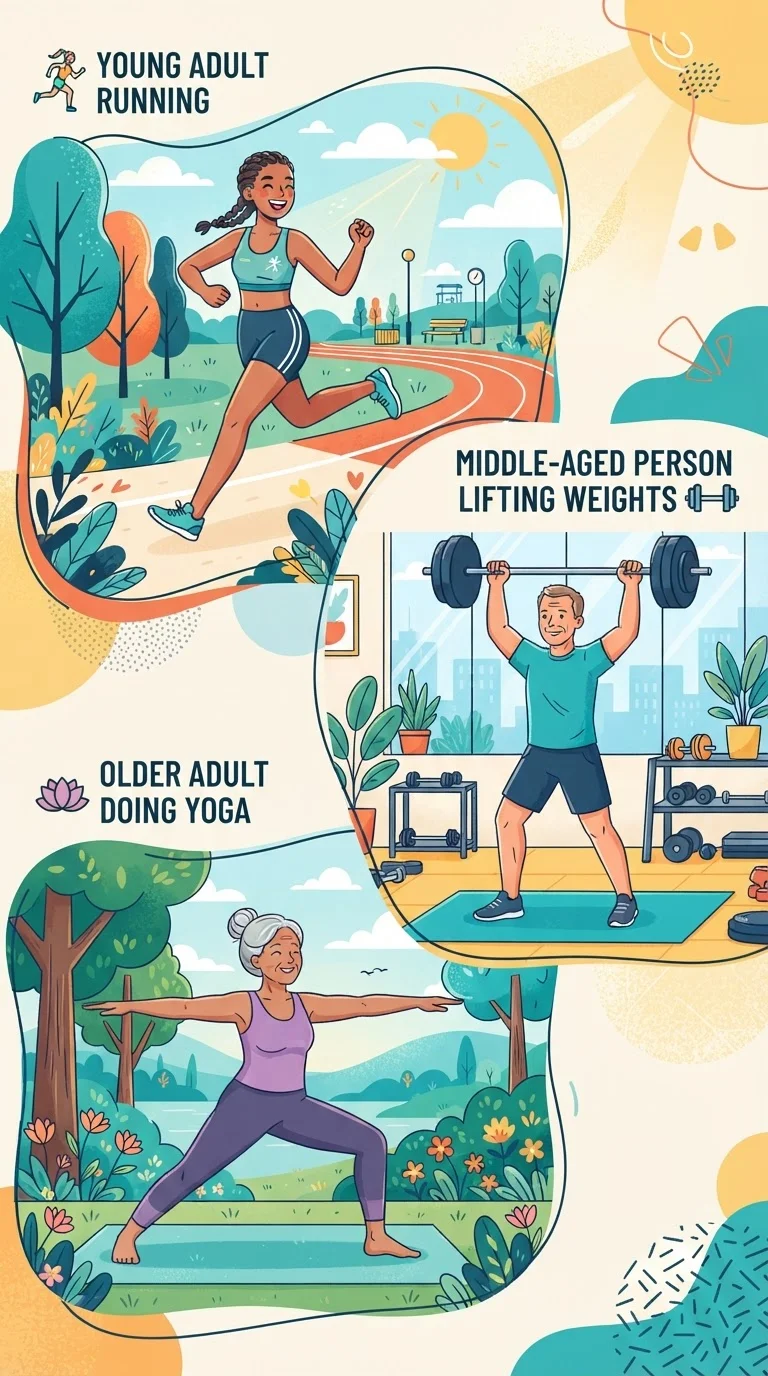
Why Exercise Needs Change With Age
The human body undergoes continuous physiological change from early adulthood onward. Muscle fiber composition shifts, hormonal output fluctuates, bone density peaks and then gradually declines, and recovery capacity adjusts at a cellular level. These aren't signs of decline to be feared — they're normal biological processes that inform how exercise should be structured at each life stage.
Understanding these shifts allows people to stay active in ways that support their health rather than work against it. A 25-year-old and a 65-year-old can both be highly fit — they just need different tools to get and stay there. This article provides a general overview of how exercise priorities tend to evolve across the adult lifespan. It is educational in nature and is not a substitute for guidance from a qualified healthcare or fitness professional.
150 min
Weekly aerobic activity recommended for adults
According to the CDC's Physical Activity Guidelines for Americans, adults should target at least 150 minutes of moderate-intensity aerobic activity per week.
3–8%
Muscle mass lost per decade without resistance training
Research published in Current Opinion in Clinical Nutrition and Metabolic Care estimates adults lose roughly 3–8% of muscle mass per decade beginning in their 30s.
2x/week
Minimum strength training sessions recommended
The CDC recommends muscle-strengthening activities targeting all major muscle groups on at least two days per week for adults of all ages.
Your 20s: Building the Foundation
The twenties represent a physiological window of relative advantage: peak muscle mass potential, high bone density, robust hormonal support, and faster recovery times. This is an ideal period to build aerobic fitness, develop strength, and establish exercise habits that can carry forward for decades.
The CDC's Physical Activity Guidelines for Americans recommend that adults aim for at least 150 minutes of moderate-intensity aerobic activity — or 75 minutes of vigorous-intensity activity — per week, plus muscle-strengthening activities on two or more days. In your 20s, many people can comfortably meet and exceed these benchmarks.
That said, the biggest fitness risk in this decade is often inconsistency. Life transitions — college, career changes, relationships — can disrupt routines. Establishing exercise as a non-negotiable habit during this period pays long-term dividends. Understanding what cardio and strength training each deliver can help 20-somethings design a balanced routine rather than defaulting to just one mode.
In your 20s, treat your exercise routine like a savings account — small, consistent deposits compound dramatically over time. Even three 30-minute sessions a week establishes the neurological and physiological habits that make fitness easier to maintain later.
Exercise adherence research consistently shows that people who establish routines in early adulthood are more likely to remain active into middle age and beyond.
In your 40s, add at least one dedicated mobility session per week — not as a warmup, but as a standalone practice. Hip flexors, thoracic spine mobility, and hamstring flexibility all tend to tighten with desk work and are worth addressing proactively.
Mobility limitations in midlife often precede injury; addressing them before they become problems is more effective than rehabilitation after the fact.
Your 30s and 40s: Protecting What You've Built
Muscle mass begins declining — a process called sarcopenia — as early as the mid-30s, at roughly 3–8% per decade without resistance training intervention, according to research published in Current Opinion in Clinical Nutrition and Metabolic Care. This is also when career demands, parenting responsibilities, and general life complexity often crowd out workout time.
In this decade, consistency and strategic programming matter more than intensity. Strength training moves from optional to essential. Two to three sessions per week targeting major muscle groups can significantly slow age-related muscle loss. Aerobic fitness remains important for cardiovascular health, metabolic function, and stress management.
Recovery also takes longer than it did in the 20s. Overtraining or ignoring minor pain can lead to injuries that sideline people for weeks. Paying attention to sleep, adequate protein intake, and rest days is not laziness — it's smart training. Nutritional needs also shift during this period, making it worth revisiting dietary patterns alongside any exercise changes.
Don't Ignore Persistent Pain in Your 30s and 40s
Muscle soreness after a challenging workout is normal, but joint pain, sharp discomfort, or pain that persists beyond a few days is not something to train through. In midlife, minor injuries can become chronic problems if overlooked. If you experience recurring pain during or after exercise, consult a sports medicine physician or physical therapist before continuing.
Your 50s and 60s: Shifting Priorities
By the 50s, hormonal shifts — declining estrogen in women around menopause, gradually decreasing testosterone in men — accelerate changes in body composition and bone density. This makes both resistance training and weight-bearing exercise particularly valuable for maintaining bone health and metabolic rate.
Balance and flexibility training become explicit priorities in this decade. Falls are a leading cause of injury among older adults, and evidence supports that targeted balance exercises — such as single-leg stands, tai chi, and stability work — can meaningfully reduce fall risk. Incorporating low-impact exercise formats such as swimming, cycling, and yoga can maintain cardiovascular fitness while reducing joint stress.
People in their 50s and 60s should also be attentive to how exercise interacts with any chronic conditions they may be managing. Before significantly changing an exercise program in this stage, consulting a physician or certified exercise physiologist is advisable. Mental and physical health are closely intertwined at this stage — see our companion piece on how mental well-being needs shift across the lifespan.
Make Balance Training a Weekly Habit in Your 50s
Simple exercises like standing on one leg while brushing your teeth, or heel-to-toe walking along a straight line, can be worked into daily routines without requiring gym time. The National Institute on Aging notes that balance exercises help older adults maintain stability and reduce fall risk. Consistency with small efforts matters more than occasional elaborate routines.
65 and Beyond: Moving for Longevity and Independence
Physical activity remains one of the most evidence-supported strategies for healthy aging in adults 65 and older. The CDC recommends that older adults follow the same general aerobic and muscle-strengthening guidelines as younger adults, with the addition of activities that specifically target balance — three or more days per week — to prevent falls.
Goals shift meaningfully in this stage. Rather than performance or aesthetics, exercise often centers on maintaining functional independence: the ability to carry groceries, climb stairs, rise from a chair, and move through daily life without assistance. Activities like walking, water aerobics, resistance band training, and chair yoga can all support these goals at varying fitness levels.
The idea that it's too late to start exercising is not supported by evidence. Research consistently shows that even older adults who begin resistance or aerobic training later in life experience measurable improvements in strength, balance, and cardiovascular markers. Starting somewhere — even with short, gentle walks — is far more beneficial than remaining sedentary.
Always Consult a Professional Before Starting
Adults over 65, and anyone with cardiovascular disease, diabetes, osteoporosis, or other chronic conditions, should discuss exercise plans with a healthcare provider before beginning. A qualified exercise physiologist or physical therapist can design a program appropriate to individual health status and fitness level. This general guidance does not replace personalized professional assessment.
Principles That Apply at Every Age
While specific needs shift by decade, several principles hold true across the lifespan:
- Consistency beats intensity. A sustainable moderate routine produces better long-term outcomes than sporadic high-intensity efforts followed by weeks off.
- Variety supports whole-body fitness. Combining aerobic activity, strength training, and flexibility or balance work addresses multiple health domains simultaneously.
- Listen to your body. Pain — distinct from normal muscle fatigue — is a signal, not something to push through.
- Exercise supports mental health. Regular movement is associated with reduced risk of depression and anxiety across age groups, according to research reviewed by the NIH.
- Nutrition and exercise interact. Adequate protein, hydration, and overall dietary quality influence how well the body adapts to and recovers from physical activity. Our Nutrition & Diet hub offers further guidance on eating well across life stages.
“The greatest myth about exercise and aging is that it's too late to start. The research is clear: the body responds to physical training at virtually every age, and even modest increases in activity produce meaningful health benefits.”
— Robert Sallis, Family and Sports Medicine Physician, Founding Member of the Exercise is Medicine initiative
This article is for general informational and educational purposes only. It does not constitute medical or fitness advice. Consult a qualified healthcare professional before starting, modifying, or stopping any exercise program, particularly if you have a chronic condition, injury, or are over 50.
The content on this site is for informational purposes only and is not a substitute for professional advice. Always consult a qualified professional for guidance specific to your situation.