

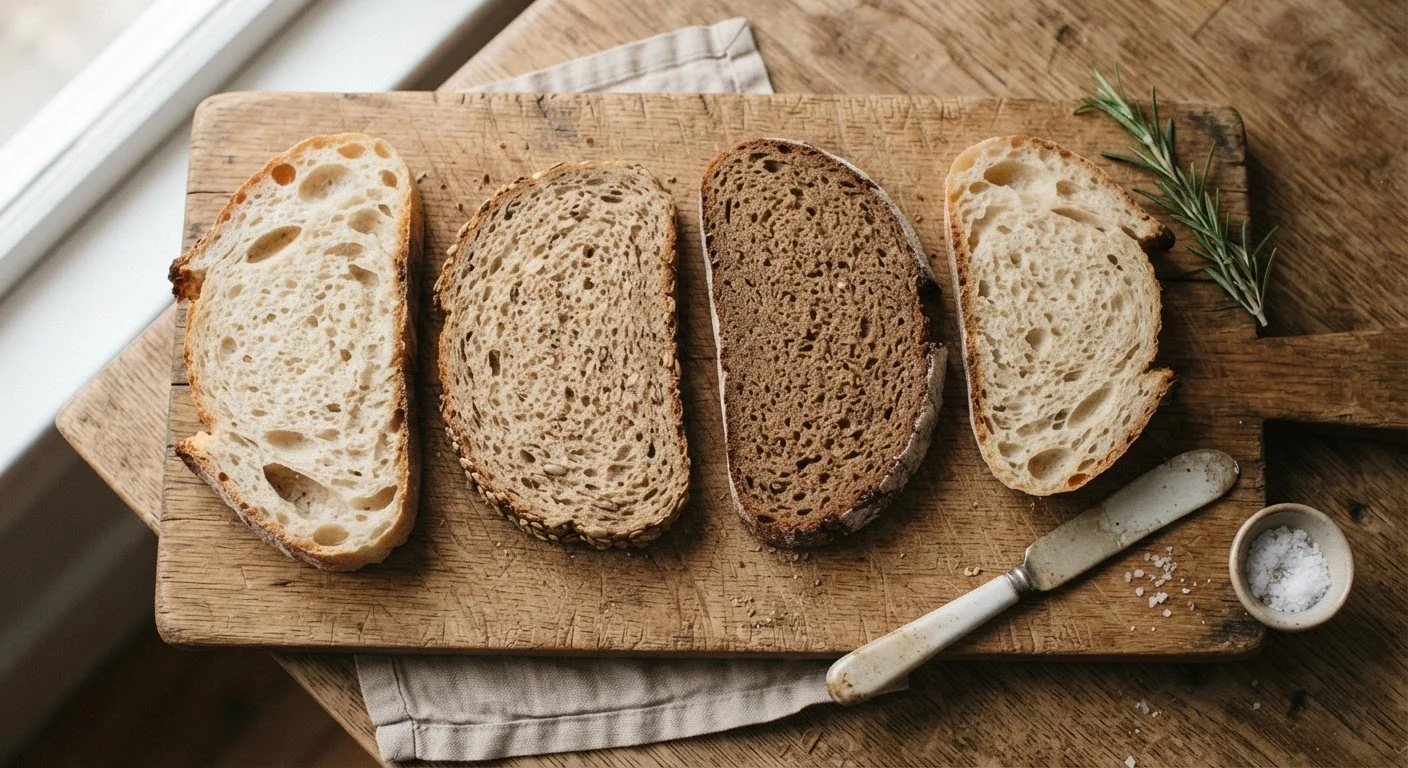
Why Bread Labels Are So Misleading
Standing in the bread aisle, most shoppers assume that darker bread equals healthier bread. It's an intuitive shortcut — but it's one that food labeling often exploits rather than corrects. Terms like "multigrain," "made with whole wheat," "stone-ground," and "natural wheat" are legally permitted on packaging even when the primary flour is refined white flour with very little whole grain present.
This matters because the nutritional difference between a true whole-grain bread and a refined-grain product marketed to look similar is meaningful. Whole grains retain the bran (outer layer), germ (nutrient-rich core), and endosperm (starchy interior). Refining strips away the bran and germ, removing fiber, B vitamins, iron, and other nutrients. Some of these are added back through enrichment, but the fiber — among the most consequential elements for digestive health and satiety — largely is not.
Learning to read past the front-of-package marketing is a skill worth developing. Our guide to reading a Nutrition Facts label walks through the full panel in plain language if you want a broader foundation.
Common Myths — Corrected
Below are the most persistent misconceptions about whole-grain bread, paired with the evidence-based facts that replace them.
Myth
Brown bread is always whole grain.
Fact
Color is not a reliable indicator. Many brown breads get their color from molasses, caramel coloring, or cocoa — not from whole-grain flour.
Food manufacturers sometimes add small amounts of molasses or artificial coloring to refined white bread dough to produce a darker, more "natural-looking" loaf. The result looks nutritionally comparable to whole-grain bread but may have nearly identical fiber and nutrient content to standard white bread. Always check the ingredient list rather than relying on color as a proxy for quality.
Myth
"Multigrain" means the bread contains whole grains.
Fact
Multigrain only means more than one type of grain was used — those grains can all be refined.
A bread labeled multigrain could contain refined wheat flour, refined oat flour, and refined barley flour — technically multiple grains, none of them whole. The FDA does not require any of those grains to be unrefined for a product to use the "multigrain" label. Look for the word "whole" before each grain name in the ingredient list to confirm you're getting the full kernel.
Myth
"Wheat bread" is the same as "whole wheat bread."
Fact
All bread is technically made from wheat. "Wheat bread" without the word "whole" typically refers to a refined product.
This is one of the most common labeling traps. In U.S. food labeling conventions, "wheat bread" or "wheat flour" on an ingredient list simply means the flour came from wheat — which includes standard refined white flour. Only the phrase "whole wheat flour" signals that the complete grain kernel was used. When a label says "made with whole wheat," that phrase alone doesn't specify how much whole wheat is present; it could be a minor percentage of the total flour blend.
Myth
"Stone-ground" or "ancient grain" breads are automatically nutritious whole-grain options.
Fact
Stone-ground describes a milling method, and ancient grain refers to grain variety — neither term confirms whole-grain content.
Stone grinding is a traditional milling process, but flour can still be sifted to remove bran and germ after stone grinding, yielding a refined product. Similarly, grains like spelt, einkorn, or emmer — often marketed as ancient grains — can be milled into refined flour. These ingredients may offer other nutritional nuances worth exploring, but the same rule applies: check whether the word "whole" precedes the grain name in the ingredient list.
Myth
High fiber content on the label confirms a bread is whole grain.
Fact
Fiber can be added to refined-grain breads through isolated fiber sources, which doesn't replicate the full nutritional profile of intact whole grains.
Ingredients like inulin, chicory root fiber, oat fiber, or pea fiber are sometimes added to refined bread products to boost the fiber number on the Nutrition Facts panel. While added fiber is not harmful, research suggests the matrix of nutrients and compounds present in naturally fiber-rich whole grains — including phytochemicals, vitamins, and minerals — may contribute to health outcomes beyond what isolated fiber alone provides. A high fiber count is a positive sign, but verify it comes from whole-grain sources rather than isolated additives.
How to Actually Identify Whole-Grain Bread
The most reliable method is simple: read the ingredient list, not the front of the package. The first ingredient should be a whole grain — typically listed as whole wheat flour, whole oat flour, whole rye, or another grain preceded by the word "whole." If the first ingredient is "enriched wheat flour," "unbleached flour," or simply "wheat flour," the product is predominantly refined grain regardless of what the front label claims.
~5%
Americans meeting whole-grain intake recommendations
According to USDA dietary intake data, only a small fraction of American adults consistently meet the Dietary Guidelines recommendation to make at least half of all grains whole grains.
3g+
Fiber per serving in a true whole-grain bread slice
A slice of bread made primarily from whole wheat flour typically provides at least 2–3 grams of dietary fiber, compared to roughly 0.5–1 gram in most refined white bread slices.
It's also worth scanning for added sugars in the ingredient list. Some whole-grain breads add significant sweeteners to improve palatability, which affects the overall nutritional picture. For a deeper look at how added sugars differ from naturally occurring ones, see our piece on added sugar versus natural sugar.
Finally, consider how bread fits into your overall eating pattern. Choosing whole grains consistently — rather than occasionally — is what the evidence supports. Our article on building a balanced plate explores how grain choices fit within broader dietary principles that hold up across different eating styles.
Don't Rely on Health Claims Alone
Front-of-package claims like "good source of fiber," "heart healthy," or "made with whole grains" are marketing statements that meet specific but sometimes low regulatory thresholds. They are not a substitute for reading the ingredient list. Always flip the package and confirm "whole" appears before the primary grain ingredient.
This article is for general informational and educational purposes only and does not constitute medical or dietary advice. Consult a registered dietitian or qualified healthcare professional for guidance tailored to your individual health needs.
The content on this site is for informational purposes only and is not a substitute for professional advice. Always consult a qualified professional for guidance specific to your situation.