

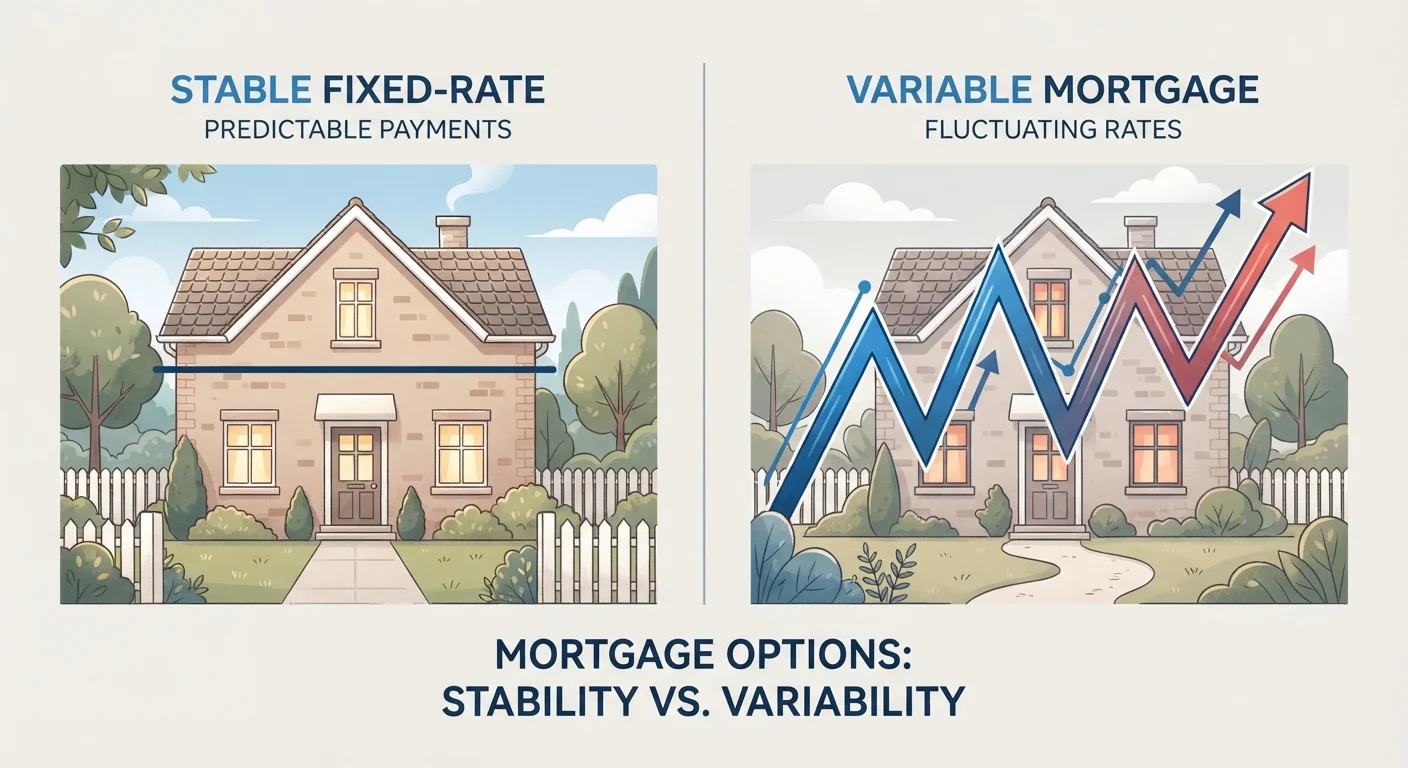
Option A
Fixed-Rate Mortgage
The predictable, long-term stability choice.
Best for: Buyers who plan to stay in their home for many years and want consistent monthly payments regardless of market conditions.
Option B
Adjustable-Rate Mortgage (ARM)
The flexible, potentially lower-cost alternative.
Best for: Buyers who expect to move or refinance within a few years and are comfortable with the possibility of rate changes after an initial fixed period.
How Each Mortgage Structure Works
A fixed-rate mortgage carries the same interest rate for the life of the loan — typically 15 or 30 years. Every monthly principal-and-interest payment is identical, making it straightforward to incorporate into a household budget. This is closely related to the broader concept of fixed costs; for context on how fixed versus variable expenses affect financial planning, see our explainer on fixed vs. variable expenses.
An adjustable-rate mortgage (ARM) begins with a fixed introductory rate for a set period — commonly 5, 7, or 10 years — then resets periodically based on a published market index plus a lender-set margin. ARM products are typically labeled to reflect this structure: a 5/1 ARM, for example, has a fixed rate for five years, then adjusts annually. Rate changes are subject to caps that limit how much the rate can move per adjustment and over the loan's lifetime, but within those limits, your payment can rise meaningfully.
| Criterion | Fixed-Rate Mortgage | Adjustable-Rate Mortgage (ARM) |
|---|---|---|
| Interest Rate | Locked for entire loan term | Fixed initially, then adjusts periodically |
| Monthly Payment Stability | Completely predictable | Can rise or fall after initial period |
| Initial Rate | Typically higher at origination | Typically lower during fixed period |
| Rate-Change Risk | None — borrower is fully protected | Rate adjusts with market index after fixed period |
| Rate Caps | Not applicable | Per-adjustment and lifetime caps apply |
| Best Holding Period | Long-term (10+ years) | Short-to-medium term (under 7 years) |
| Budgeting Simplicity | High — payment never changes | Moderate — payment may change at each reset |
| Common Loan Terms | 15 or 30 years | 5/1, 7/1, or 10/1 ARM structures |
The Rate Environment Factor
The relationship between fixed and adjustable rates shifts depending on broader interest rate conditions. When prevailing rates are high, the gap between a fixed rate and an ARM's initial rate tends to be wider, making ARMs more tempting. When rates are low, fixed-rate loans may already be competitively priced, narrowing the advantage of taking on adjustment risk.
Critically, no one can reliably predict the direction of interest rates, and what seems like a favorable ARM environment at origination may look different years later. This uncertainty is fundamental to the trade-off — an ARM transfers a portion of interest-rate risk from the lender to you as the borrower.
30 years
Most common fixed-rate mortgage term in the US
The 30-year fixed-rate mortgage has historically been the dominant loan product for American homebuyers, according to data from the Federal Reserve and Freddie Mac.
2–3%
Typical initial rate discount of ARMs vs. fixed
The size of the initial rate gap between ARMs and fixed-rate mortgages varies with market conditions and is not guaranteed to persist.
5–6%
Typical lifetime rate cap above initial ARM rate
Most ARMs include a lifetime cap limiting how high the rate can rise above the original starting rate, though specific terms vary by lender and product.
Comparing Key Dimensions Side by Side
Beyond rate structure, several practical dimensions separate fixed and adjustable mortgages. Monthly payment stability is the most visible difference, but the impact on long-term cost, refinancing strategy, and qualifying criteria also matter.
Because ARMs start with a lower rate, some buyers qualify for a larger loan amount under initial ARM terms than they would with a fixed-rate product — though lenders are required to qualify borrowers at higher stress-test rates to account for future adjustments. This nuance is worth discussing with a licensed mortgage professional before drawing conclusions about purchasing power.
The decision also connects to your overall financial strategy. If you're weighing how this mortgage fits into broader savings or debt priorities, our guide on paying extra toward your mortgage versus investing the difference explores that downstream question in detail.
ARM Caps: What They Do and Don't Protect
Adjustable-rate mortgages include rate caps that limit how much the interest rate can change at each adjustment and over the life of the loan. A common cap structure is 2/2/5: the rate cannot rise more than 2% at the first adjustment, 2% at each subsequent adjustment, and 5% total above the starting rate. While these caps provide meaningful protection, they do not eliminate payment risk — a 5% increase above an initial rate would still represent a substantial jump in monthly cost. Always model the worst-case payment scenario before committing to an ARM.
Making the Decision
The core question is how long you realistically plan to stay in the home. Buyers who are confident they will sell or refinance before an ARM's adjustment period begins may capture genuine savings. Those with longer, less certain timelines generally benefit from the protection a fixed rate provides.
Personal risk tolerance matters equally. Even if the financial math slightly favors an ARM, the psychological burden of watching rates rise — and budgeting for a payment that may increase — is a real cost that fixed-rate predictability eliminates.
If you're still weighing whether buying makes sense at all, our article on renting vs. buying a home covers the broader financial and lifestyle factors involved in that earlier decision.
This article is for general informational purposes only and does not constitute personalized financial or mortgage advice. Consult a licensed mortgage professional or financial adviser before making decisions based on your individual circumstances.
The content on this site is for informational purposes only and is not a substitute for professional advice. Always consult a qualified professional for guidance specific to your situation.