

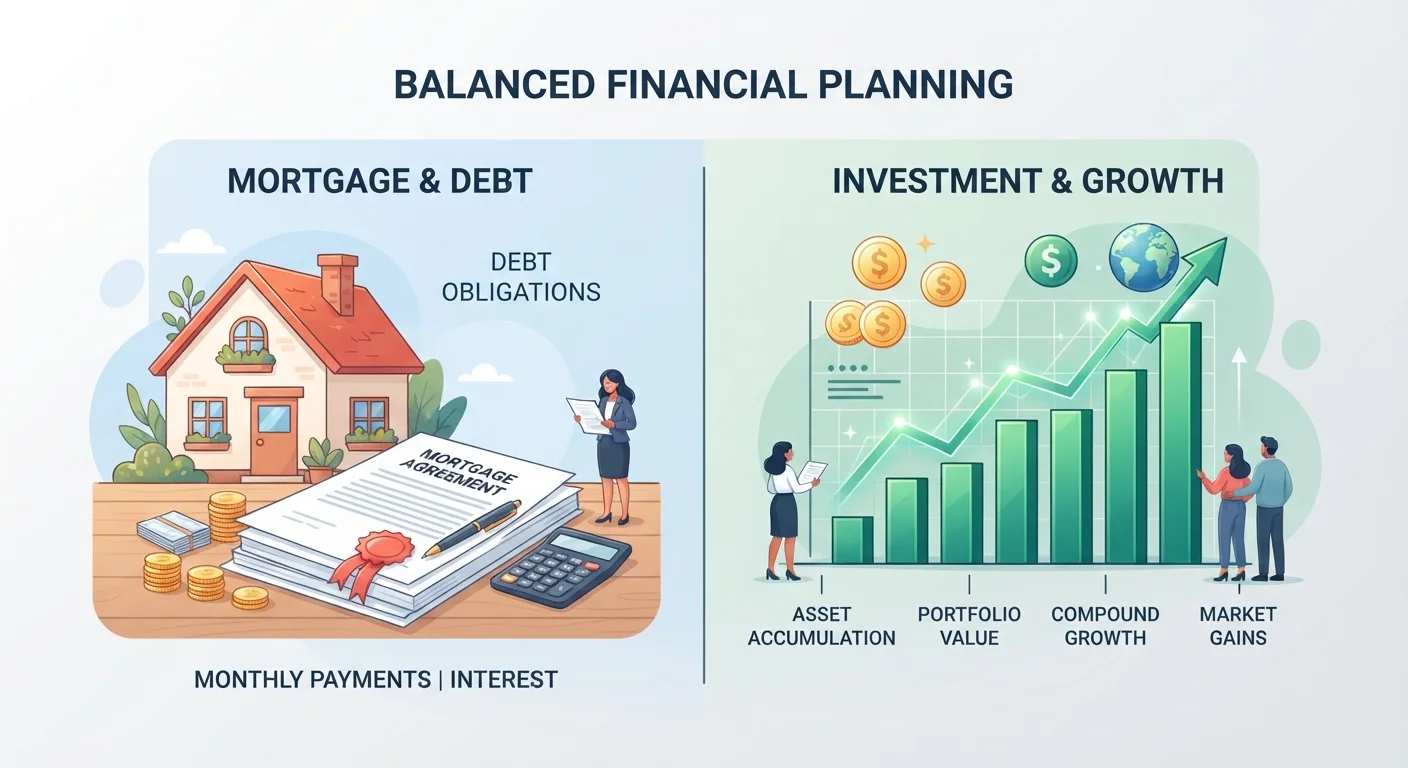
Option A
Extra Mortgage Principal Payments
The guaranteed, low-risk path to debt elimination.
Best for: Homeowners who prioritize financial certainty, are risk-averse, or carry a higher mortgage interest rate.
Option B
Investing the Difference
The growth-oriented approach leveraging market returns over time.
Best for: Financially stable individuals with emergency savings, low mortgage rates, and a long investment horizon.
The Core Question: What Does Your Extra Dollar Actually Earn?
When you have a modest surplus each month — after covering essentials and an emergency fund — the choice between paying down your mortgage and investing is fundamentally a question of where that dollar works hardest. The answer isn't universal, but the framework for thinking through it is.
Every extra dollar applied to your mortgage principal earns a guaranteed, risk-free return equal to your loan's interest rate. If your mortgage carries a 6.5% rate, you effectively earn 6.5% on that payment by avoiding future interest. No market needed, no volatility involved.
Redirecting those dollars to a diversified investment portfolio introduces a different dynamic. Historically, broad U.S. equity indexes have delivered average annual returns in the range of 7–10% over long periods — but those returns are neither guaranteed nor linear. Markets decline, sometimes sharply, and short-term results can diverge dramatically from long-term averages. For a deeper look at how compounding shapes long-term growth, see how compound interest builds wealth over time.
The comparison between your mortgage rate and expected investment returns is the starting point — not the finish line. Several other factors determine which path, or blend of paths, fits your situation.
| Criterion | Extra Mortgage Payments | Investing the Difference |
|---|---|---|
| Return | Guaranteed, equals mortgage rate | Variable, market-dependent |
| Risk level | None (contractual debt reduction) | Low to high depending on asset mix |
| Liquidity | Low — equity is tied up in home | Higher — most accounts accessible |
| Tax benefit | Limited (fewer itemize post-2017) | Tax-advantaged accounts available |
| Psychological benefit | High for debt-averse individuals | Lower; market swings add stress |
| Impact of timing | Greater benefit on early payments | Compounding rewards early investing |
| Best market environment | High interest rate environment | Low mortgage rate environment |
Factors That Tilt the Decision One Way or the Other
Your mortgage interest rate. This single number anchors the analysis. A 3% rate from a few years ago makes the investment case stronger; a 7% rate today raises the bar for investments to beat it on a risk-adjusted basis.
Tax-advantaged account access. Before weighing mortgage paydown against taxable investing, consider whether you've maxed out available tax-advantaged vehicles like a 401(k) or IRA. Employer matches — where a company contributes 50 cents or a dollar for every dollar you put in — represent an immediate return that typically dwarfs both the mortgage paydown benefit and expected market returns. Prioritizing those accounts first is a sound general principle, though individual circumstances vary.
Mortgage interest deductibility. The 2017 tax law changes reduced the share of homeowners who itemize deductions, meaning fewer people now receive a tax benefit from mortgage interest. If you take the standard deduction, your effective mortgage rate isn't reduced by a tax subsidy, which marginally strengthens the case for paying it down.
Your investment time horizon. The longer your runway, the more time market volatility has to smooth out. Someone with 25 years until retirement is better positioned to ride out downturns than someone with 5 years.
Emotional and psychological factors. The math doesn't fully capture the value of financial peace of mind. For some, carrying any mortgage debt creates ongoing stress; eliminating it is worth accepting a potentially lower financial return. That's a legitimate consideration, not a flaw in reasoning. Balancing debt paydown and saving simultaneously is also an option many households pursue successfully.
~7–10%
Historical average U.S. equity market annual return
Long-run estimates from broad index data; past performance does not guarantee future results and actual returns vary significantly year to year.
~30%
Share of U.S. taxpayers who itemize deductions
The Tax Policy Center estimates that the 2017 tax law changes significantly reduced the share of filers who itemize, limiting the mortgage interest deduction's reach.
50–100%
Typical employer 401(k) match rate on contributions
Many employers match contributions at 50 cents to one dollar per dollar contributed up to a defined cap — an immediate return available before other allocation decisions matter.
How Extra Mortgage Payments Actually Work
Making additional principal payments reduces the outstanding loan balance, which shrinks the interest calculated on future statements. Because mortgage interest is front-loaded — early payments are mostly interest — even relatively small extra payments in the early years of a loan can eliminate years of payments and save a meaningful amount in total interest.
For example, on a 30-year, $350,000 mortgage at 6.5%, paying an extra $200 per month toward principal could shave several years off the loan term and save tens of thousands of dollars in interest over the life of the loan. The exact figures depend on when extra payments begin and how consistently they're applied.
One important practical note: confirm with your lender that extra payments are applied to principal, not toward future scheduled payments. Specifying "apply to principal" in writing or through your lender's payment portal ensures the payment works as intended.
This article is for general informational purposes only and does not constitute personalized financial, tax, or investment advice. Consult a qualified financial adviser or tax professional before making decisions based on your individual circumstances.
Making a Decision That Fits Your Full Picture
Neither approach is objectively superior — the right answer depends on your mortgage rate, tax situation, existing savings, risk tolerance, and financial goals. A useful sequence for thinking it through:
- Ensure you have an adequate emergency fund (typically three to six months of essential expenses).
- Capture any available employer retirement match in full — that return is hard to beat.
- Evaluate your mortgage interest rate against realistic, risk-adjusted investment return expectations.
- Consider tax implications, including whether you itemize deductions.
- Assess your comfort with market risk and your investment time horizon.
Many households land on a hybrid strategy — directing a portion of their surplus toward extra mortgage payments and a portion toward investments. This approach hedges uncertainty, maintains momentum on both fronts, and can be adjusted as circumstances change. For broader context on the financial side of homeownership, exploring the rent-vs-buy trade-offs can also sharpen your thinking. And if you're weighing how to deploy a larger sum, the lump-sum vs. regular contributions comparison covers related ground.
A Note on Liquidity and Home Equity
Home equity — the portion of your home's value you own outright — is relatively illiquid. Unlike a brokerage or savings account, you cannot access it quickly without refinancing, selling the home, or taking out a home equity loan. If you accelerate your mortgage paydown, ensure you're not concentrating so much of your net worth in an illiquid asset that you lack flexibility for emergencies or opportunities.
This article is for general informational and educational purposes only. It is not personalized financial, investment, or tax advice. Speak with a licensed financial adviser or tax professional about decisions suited to your specific situation.
The content on this site is for informational purposes only and is not a substitute for professional advice. Always consult a qualified professional for guidance specific to your situation.