

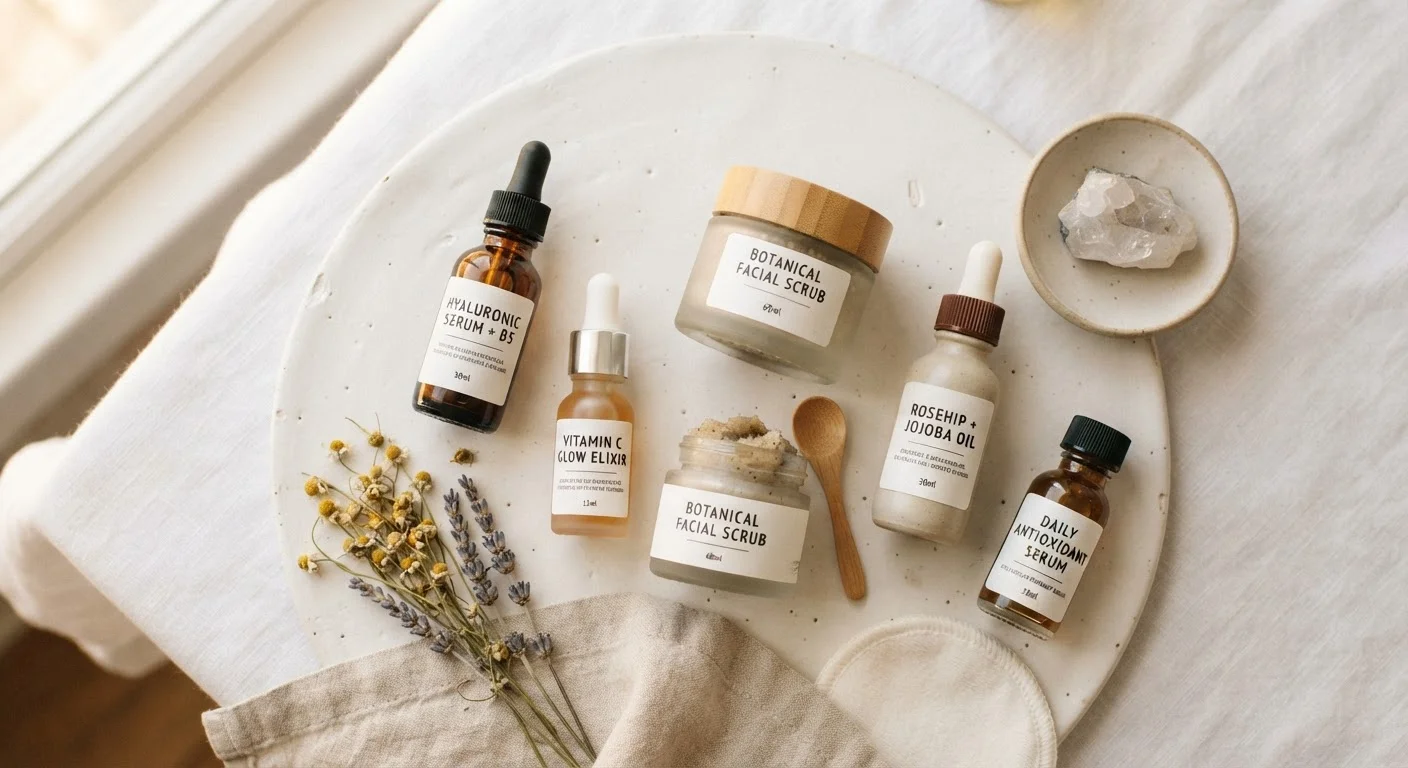
Option A
Chemical Exfoliants (AHAs & BHAs)
The science-backed, hands-off approach to skin renewal.
Best for: Best for those dealing with uneven tone, clogged pores, acne-prone skin, or sensitivity to abrasive textures.
Option B
Physical Scrubs
The tactile, immediately gratifying classic.
Best for: Best for those who prefer a tangible, wash-off routine and have resilient, non-sensitized skin.
How Each Method Actually Works
Exfoliation is the process of removing dead cells from the skin's outermost layer — the stratum corneum. The two main methods do this in fundamentally different ways, and understanding the mechanism helps explain why results (and risks) differ.
Chemical exfoliants use acids or enzyme compounds to dissolve the bonds that hold dead skin cells together. Alpha hydroxy acids (AHAs) — such as glycolic and lactic acid — are water-soluble and work primarily on the skin's surface, improving texture and tone. Beta hydroxy acids (BHAs), most commonly salicylic acid, are oil-soluble and can penetrate into pores, making them particularly relevant for oily or congested skin. No manual friction is involved; the chemistry does the work.
Physical scrubs rely on abrasive particles — sugar, salt, ground walnut shell, jojoba beads, or synthetic microbeads — applied with manual pressure to buff away dead cells. The effect is immediate and tangible, which is part of the appeal. However, the outcome depends heavily on particle shape, particle size, and how much pressure you apply.
| Criterion | Chemical Exfoliants | Physical Scrubs |
|---|---|---|
| Mechanism | Dissolves cell bonds chemically | Manually buffs away dead cells |
| Pore penetration | BHAs reach inside pores | Surface-level only |
| Consistency of effect | Predictable per concentration | Varies with pressure and technique |
| Irritation risk | Low to moderate (concentration-dependent) | Low to high (particle-shape-dependent) |
| Evidence base | Extensive clinical research | Limited formal research |
| Best skin types | Most types, especially oily/sensitive | Resilient, non-sensitized skin |
| Rinse-off required | Often leave-on formulas | Always rinse off |
What the Evidence Says About Safety and Effectiveness
The dermatology research base is considerably larger for chemical exfoliants than for physical scrubs. Studies on AHAs and BHAs have documented improvements in skin texture, pore appearance, and markers of photoaging (sun-related skin changes) with consistent use. These are well-characterized ingredients with established concentration guidelines.
Physical scrubs have a more complicated track record. The concern isn't scrubbing per se — it's particle irregularity. Jagged particles, like crushed walnut shell, can create micro-abrasions that aren't visible to the eye but may trigger inflammation over time, particularly in already-sensitive or acne-prone skin. Smooth, uniform particles (like round jojoba beads) are generally considered less damaging.
70%+
AHA users reporting improved texture
Multiple controlled studies on glycolic acid formulations have documented significant improvements in skin texture and tone with regular use over several weeks.
2x/week
Typical recommended exfoliation frequency
Dermatologists commonly suggest starting with once or twice weekly for both chemical and physical exfoliation to minimize barrier disruption.
~20%
Proportion of stratum corneum renewed monthly
The skin's natural cell turnover cycle slows with age, which is part of why exfoliation — done correctly — can support a more even, luminous appearance.
There's also a consistency variable: chemical exfoliants deliver a predictable amount of active ingredient per application, whereas the effect of a physical scrub varies with how hard you press, how long you scrub, and how your skin behaves that day. That unpredictability makes irritation harder to manage.
Worth noting: more exfoliation is never better. Over-exfoliating — whether chemical or physical — compromises the skin's moisture barrier and can lead to redness, flaking, and increased sensitivity. If you're considering adding a chemical exfoliant to a routine that already includes other active ingredients, our guide on skincare ingredients that don't play well together covers which combinations to avoid.
Matching the Method to Your Skin Type
There's no universal winner here — context matters a great deal.
- Oily or acne-prone skin: BHAs are frequently recommended by dermatologists because salicylic acid targets excess oil and pore congestion at the source. Physical scrubs can spread bacteria across the face if active breakouts are present, which may worsen acne. For more on acne-related misconceptions, see our piece on acne myths the science has debunked.
- Dry or sensitive skin: Low-concentration lactic acid (an AHA) is generally considered gentler and can also offer mild hydrating properties. Physical scrubs carry a higher risk of irritation for this group.
- Resilient, normal skin: Either method can work well when used appropriately. Physical scrubs with smooth, uniform particles, applied with light pressure once or twice a week, are unlikely to cause problems.
- Darker skin tones: Post-inflammatory hyperpigmentation (darkening after irritation) is a real risk. Chemical exfoliants used at appropriate strengths are generally preferred over potentially abrasive scrubs.
Frequency matters too. Most dermatologists suggest starting with one to two times per week regardless of method, then adjusting based on how your skin responds. This is general guidance — consult a board-certified dermatologist for a plan tailored to your specific skin concerns.
Sun Sensitivity After Chemical Exfoliation
AHAs in particular can increase photosensitivity, meaning your skin may burn more easily in sunlight after use. Dermatologists consistently recommend applying a broad-spectrum SPF daily when using any chemical exfoliant — this is especially important if you exfoliate in the morning. Physical scrubs don't carry the same photosensitivity effect, but daily SPF is a sound habit regardless of your routine.
This article is for general informational and educational purposes only and does not constitute medical or dermatological advice. Consult a qualified healthcare professional for guidance specific to your skin.
The content on this site is for informational purposes only and is not a substitute for professional advice. Always consult a qualified professional for guidance specific to your situation.