

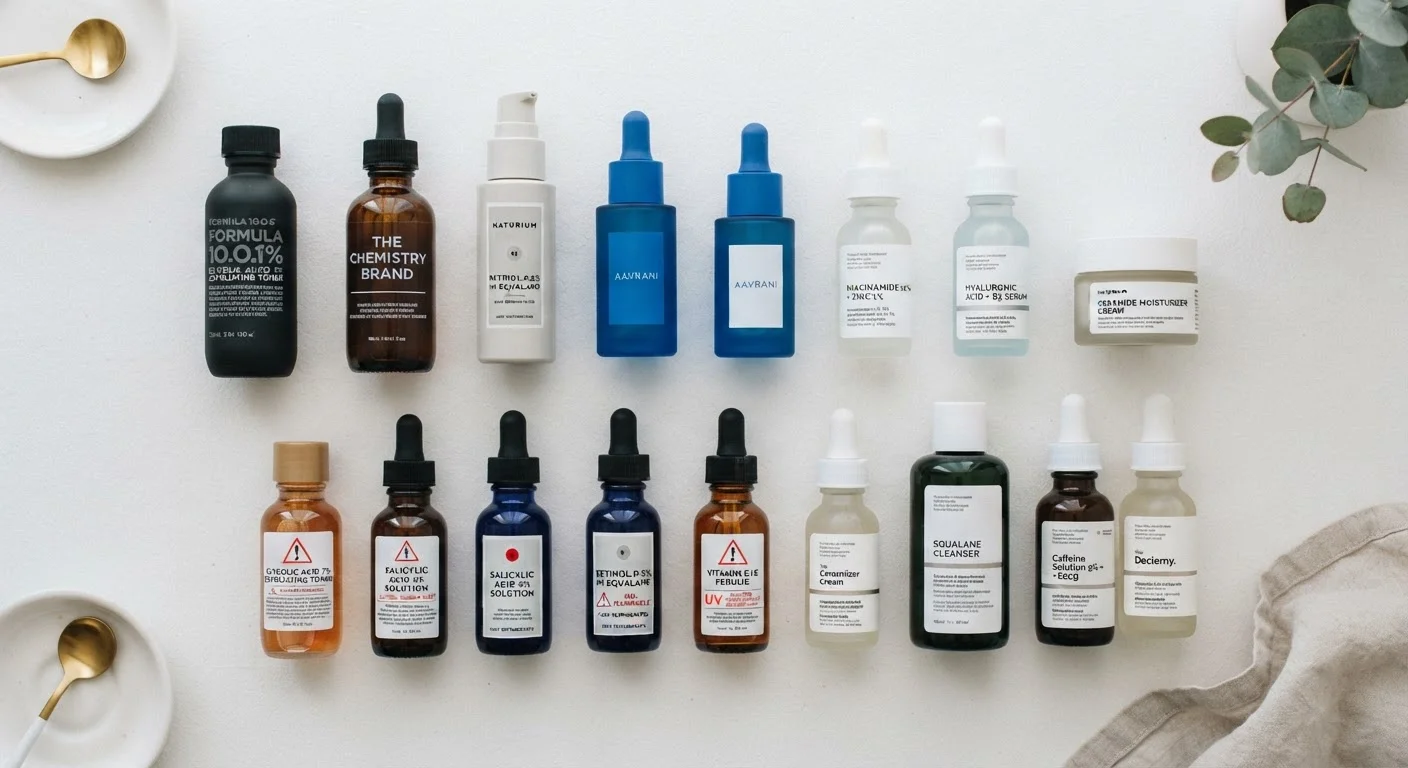
Why Ingredient Conflicts Are More Common Than You Think
Building a skincare routine feels like assembling a team — each player has a job, and ideally they all work together. But some actives compete, neutralize each other, or simply create more irritation than benefit when used in combination. The frustrating part? Most of us don't realize the conflict is happening until our skin breaks out, flakes, or stings with a product we've trusted for months.
This isn't about fear — it's about being strategic. Understanding a few basic chemistry principles and timing rules lets you keep all your favorite actives in rotation without the drama. Think of it as scheduling, not sacrificing. For a deeper look at how your skin's protective layer factors into all of this, see what your skin barrier actually does.
Layering retinol and AHAs or BHAs in the same routine.
Why it happens: Both are powerhouse actives with visible results, so it's tempting to use them together for faster turnover. Most products don't warn against combining them.
Mixing vitamin C (L-ascorbic acid) with niacinamide immediately in the same step.
Why it happens: Both ingredients are popular brightening agents, and it seems logical to combine ingredients with similar goals. Many multi-ingredient serums blur this line.
Using benzoyl peroxide and retinoids in the same routine.
Why it happens: Both are go-to acne treatments, and people dealing with breakouts often reach for every effective tool at once. The oxidizing effect of benzoyl peroxide is not widely communicated on packaging.
Applying exfoliating acids immediately before or after vitamin C serums.
Why it happens: Vitamin C is often marketed as a morning active, and so are many toners containing AHAs or BHAs. It's easy to use both in the same AM routine without realizing the pH mismatch.
Combining multiple exfoliating actives in the same session.
Why it happens: With so many exfoliating products on the market — toners, serums, masks, peels — it's easy to unknowingly stack several in one routine, especially if ingredient lists aren't checked closely.
How to Schedule Actives So They Actually Work
The good news: most ingredient conflicts are solved with timing, not elimination. The simplest approach is the AM/PM split — use vitamin C in the morning under sunscreen, and reserve retinoids, AHAs, or BHAs for your evening routine. This separation covers the majority of common conflicts in one move.
For actives that conflict even when separated by hours (like retinol and strong exfoliating acids), consider alternating nights. Use your AHA or BHA on Monday, Wednesday, and Friday; use retinol on Tuesday, Thursday, and Saturday. Your skin gets the benefit of both without continuous overlap.
~70%
Consumers who layer multiple actives daily
A survey by the International Dermal Institute found that a large majority of skincare users apply three or more active-ingredient products in a single routine.
30–60 sec
Recommended wait time between serum layers
Dermatologists generally advise allowing each serum layer to absorb briefly before applying the next to reduce pilling and potential interactions.
Layering order matters too. As a general rule, apply products from thinnest to thickest consistency, and give water-based serums 30–60 seconds to absorb before following up with a heavier formula. If you're building your routine from scratch, this morning routine walkthrough is a practical starting point. And if decoding all those ingredient names still feels overwhelming, reading a skincare label can help you understand exactly what you're working with.
Prescription Actives Need Professional Guidance
If you're using any prescription-strength retinoids, antibiotics, or other dermatologist-prescribed treatments, do not attempt to pair or schedule them alongside OTC actives without professional input. Interactions can range from reduced efficacy to significant skin damage. Always loop in your dermatologist before adding new actives to a prescription regimen.
The content on this site is for informational purposes only and is not a substitute for professional advice. Always consult a qualified professional for guidance specific to your situation.