

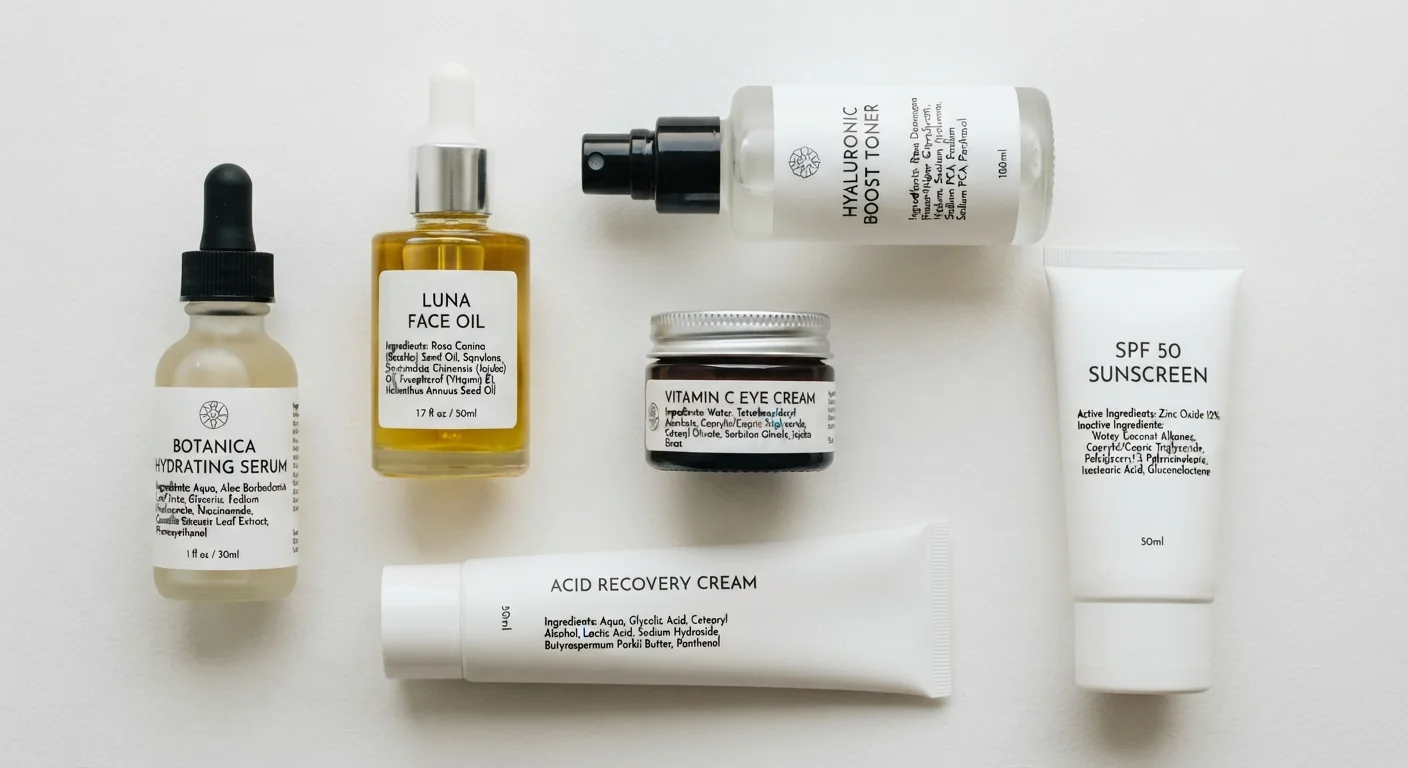
Summary
18 items · 15–30 minutes
Why Ingredient Lists Are Worth Your Time
Skincare marketing is loud. Words like "brightening," "firming," and "barrier-restoring" cover every front panel — but the ingredient list on the back is where the real story lives. In the U.S., the FDA requires cosmetic ingredient lists to follow the INCI system (International Nomenclature of Cosmetic Ingredients), a globally standardized naming convention that uses Latin botanical names and chemical descriptors. This means that once you learn a handful of INCI names, you can read almost any product label, anywhere.
Think of the ingredient list as a recipe written in a specific order: by law, ingredients are listed from highest to lowest concentration. That rule holds for everything above 1% — once you dip below that threshold, brands can list remaining ingredients in any order they choose. This single fact changes how you interpret a label entirely.
If you've ever wondered whether a product is as vitamin C-packed as the packaging implies, or whether a "soothing" formula hides known irritants, this checklist gives you a practical framework to find out. For a parallel exercise in label literacy, see how pet food ingredient lists work — the concentration-order rule applies there too.
Before You Start
Decoding the Order
Identifying Key Ingredient Categories
Checking for Personal Sensitivities
Evaluating Marketing vs. Reality
What to Watch For: Common Flags and Context
No ingredient is universally good or bad — context matters enormously. Alcohol, for example, gets a bad reputation, but fatty alcohols like cetyl alcohol and stearyl alcohol are emollients that soften skin. Ethanol (denatured alcohol), by contrast, can be drying for some people when used in high concentrations. Knowing the difference is part of reading labels like a pro.
"Fragrance" Hides a Lot
In U.S. cosmetic labeling, "fragrance" or "parfum" is a legally protected trade secret term that can represent a blend of dozens of individual chemicals. Brands are not required to disclose these components. If you have a history of sensitive or reactive skin, patch-testing any new fragranced product is a sensible precaution — and consulting a dermatologist is worthwhile if you experience repeated unexplained reactions.
Fragrance — listed as "fragrance," "parfum," or sometimes "aroma" — is a catch-all term that can represent dozens of undisclosed compounds. It's one of the most common sources of contact dermatitis, according to dermatologists. If your skin is sensitive or reactive, it's worth prioritizing fragrance-free formulas. Similarly, preservatives like methylisothiazolinone (MI) and methylchloroisothiazolinone (MCI) are effective but have higher rates of sensitization than alternatives like phenoxyethanol.
Once you're comfortable reading skincare labels, you can apply that knowledge to specific product categories. Our guide to night creams, sleeping masks, and overnight serums explains what you should actually find in each formula. And if you spot vitamin A derivatives on a label, sorting out retinol from retinoids will help you understand what you're actually getting. Finally, knowing what's in each product matters even more once you learn about ingredients that don't play well together.
Sunscreens Follow Different Rules
In the U.S., sunscreens are regulated as over-the-counter drugs, not cosmetics. This means their active ingredients (the UV filters) must be listed separately in a "Drug Facts" box, with their percentage concentrations included. If a product claims SPF protection, look for this Drug Facts panel — the standard cosmetic ingredient list alone won't show you the sunscreen actives or their levels. For a deeper breakdown of what SPF numbers actually mean, see our guide on sunscreen ratings decoded.
The content on this site is for informational purposes only and is not a substitute for professional advice. Always consult a qualified professional for guidance specific to your situation.