

Why Tire Maintenance Matters More Than You Think
Your tires are the only part of the car that actually touches the road. That single fact makes tire health one of the most consequential — and most overlooked — aspects of vehicle ownership. Proper inflation, adequate tread, and timely rotation affect braking distance, handling in wet conditions, fuel economy, and how long the tires themselves last.
Whether you're planning a long road trip or just commuting daily, starting with good tire habits pays off in safety and savings. If you're new to owning a vehicle, pairing tire awareness with a broader maintenance mindset will serve you well — see our first-year ownership guide for more foundational tips.
11%
Fuel economy loss from underinflated tires
The U.S. Department of Energy estimates underinflation by just 1 PSI across all four tires can reduce fuel economy by about 0.2% per PSI.
2/32"
Legal minimum tread depth in most U.S. states
Most states set the legal minimum at 2/32 of an inch, though safety experts commonly recommend replacement at 4/32" for wet-road performance.
1 PSI
Pressure drop per 10°F temperature fall
Tire pressure drops approximately 1 PSI for every 10-degree Fahrenheit decrease in ambient temperature, per general automotive engineering guidelines.
Tire Pressure: The Easiest Win in Car Care
Tire pressure is measured in PSI (pounds per square inch). Every vehicle has a manufacturer-recommended PSI range printed on a sticker inside the driver's door jamb — not on the tire sidewall, which shows the tire's maximum pressure, a different figure. Driving on underinflated tires increases rolling resistance, which wastes fuel and generates excess heat. Overinflation reduces the contact patch with the road, making handling less predictable.
Check pressure when tires are cold — meaning the car has been parked for at least three hours or driven fewer than a mile. A quality tire pressure gauge costs just a few dollars and takes less than two minutes to use. Most gas stations also have air compressors available.
Check Pressure When Tires Are Cold
Always take pressure readings before driving or at least three hours after the vehicle has been parked. Driving heats the air inside the tire, causing pressure to rise — a warm reading will be artificially high and won't reflect the actual baseline. This small timing habit makes all your pressure readings more accurate and useful.
Pressure naturally drops about 1 PSI for every 10°F decrease in outside temperature, so monthly checks are especially important heading into fall and winter.
Tread Depth and When to Replace
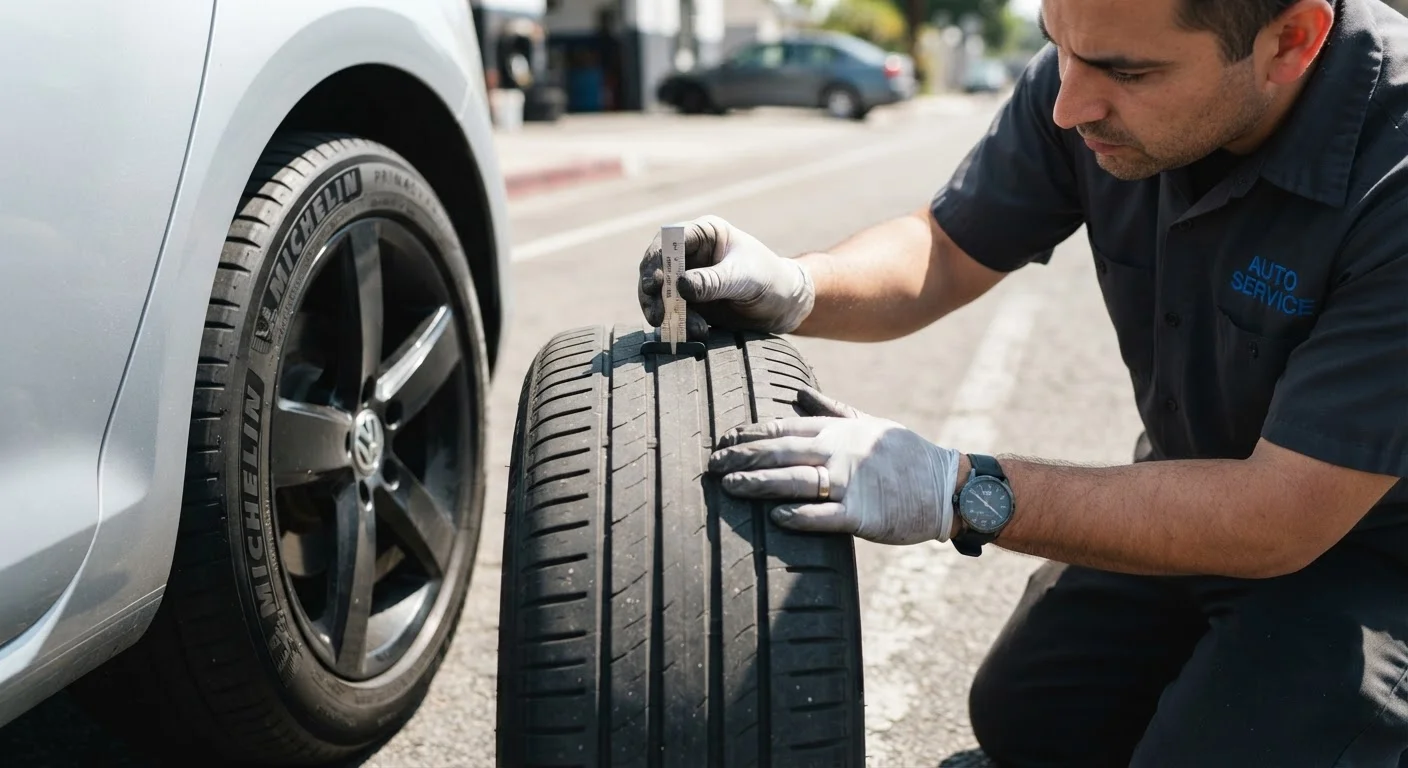
Tread channels water away from the contact patch, which is what keeps a tire from hydroplaning on wet roads. New tires typically start with 10/32" to 11/32" of tread. The legal minimum in most U.S. states is 2/32", but many safety organizations recommend replacing tires at 4/32" for meaningful wet-weather performance.
The penny test is a quick check: insert a penny into a tread groove with Lincoln's head pointing down. If you can see all of Lincoln's head, the tread is at or below 2/32" — time to replace. The quarter test (using Washington's head) signals 4/32", which is a more conservative and safety-minded threshold.
Bulges and Sidewall Damage Mean Replace Now
A bulge or bubble in the tire sidewall indicates internal structural damage — the tire's reinforcing cords have broken. This is not a repairable condition. A tire in this state can fail suddenly at highway speeds. If you spot a sidewall bulge, have the vehicle inspected by a mechanic before driving it further than necessary.
Beyond depth, inspect tires visually for cracking on the sidewalls, bulges, or uneven wear patterns. Uneven wear often signals an alignment or inflation issue that should be addressed before putting new tires on. If any of this is unclear, a licensed mechanic can assess the tires quickly during a routine service visit.
Rotation, Balancing, and Alignment
Tires wear at different rates depending on their position. Front tires on front-wheel-drive vehicles wear faster because they handle both steering and power delivery. Rotating tires — moving them to different positions on the vehicle — evens out that wear and extends overall tire life. Most manufacturers recommend rotation every 5,000 to 7,500 miles, often timed with oil changes.
Wheel balancing ensures the weight of the wheel-and-tire assembly is evenly distributed. An unbalanced wheel causes vibration, usually felt in the steering wheel at highway speeds. Alignment refers to the angles at which tires meet the road. Misalignment — often caused by hitting a pothole or curb — causes uneven wear and pulls the car to one side. Both balancing and alignment should be performed by a qualified mechanic.
Set a recurring monthly calendar reminder just to check tire pressure — pairing it with a fixed date (like the first of the month) makes it a habit rather than an afterthought.
Pressure loss happens gradually and is easy to miss by feel alone until the tire is significantly underinflated, by which point wear and fuel economy have already been affected.
When you rotate tires, take a moment to photograph each tire's wear pattern before the swap. Comparing photos over time can reveal alignment or suspension issues early.
Uneven wear is one of the clearest early signals of alignment problems, and catching it before you've worn through a second set of tires saves money and improves safety.
For a deeper look at how mileage affects the full vehicle, our guide on extending your car's life past 150,000 miles covers how consistent tire care fits into long-term reliability.
Seasonal Tire Considerations
All-season tires are designed for moderate conditions, but they have real limitations in extreme climates. In regions with sustained snow and ice, dedicated winter tires — made from a softer rubber compound that stays pliable in freezing temperatures — provide substantially better grip. All-season tires harden in extreme cold, reducing traction even without snow on the ground.
Conversely, summer heat causes tire pressure to rise, and prolonged high temperatures accelerate rubber degradation. Parking in the shade, checking pressure more frequently in hot months, and avoiding overloading the vehicle all help. Our seasonal car prep guide walks through maintenance checks by season in more detail.
Building a Simple Tire Care Routine
Consistency beats perfection. A simple monthly habit — check pressure, do a quick visual inspection, note the mileage for rotation tracking — keeps most tire problems from becoming expensive surprises. Before any significant drive, it's worth a 30-second walkaround to look for obvious issues like low sidewalls or debris lodged in the tread.
If you're mapping out a longer trip, tire prep should be on the checklist before you leave. Our road trip planning guide includes vehicle prep as part of the full pre-departure process. For questions about which tasks you can realistically handle yourself versus when to call in a pro, see our breakdown of DIY vs. professional car maintenance.
Tire Age Matters, Not Just Tread
Even tires with adequate tread depth can become unsafe after roughly six years due to rubber oxidation and micro-cracking. Check the DOT code on the tire sidewall — the last four digits indicate the week and year of manufacture (e.g., 2319 means the 23rd week of 2019). Many manufacturers and safety groups recommend replacing tires regardless of tread depth after six to ten years from the manufacture date.
This article is for general informational purposes only. For tasks involving vehicle safety systems, always consult a qualified mechanic. Verify any specifications against your vehicle's owner's manual.
The content on this site is for informational purposes only and is not a substitute for professional advice. Always consult a qualified professional for guidance specific to your situation.