

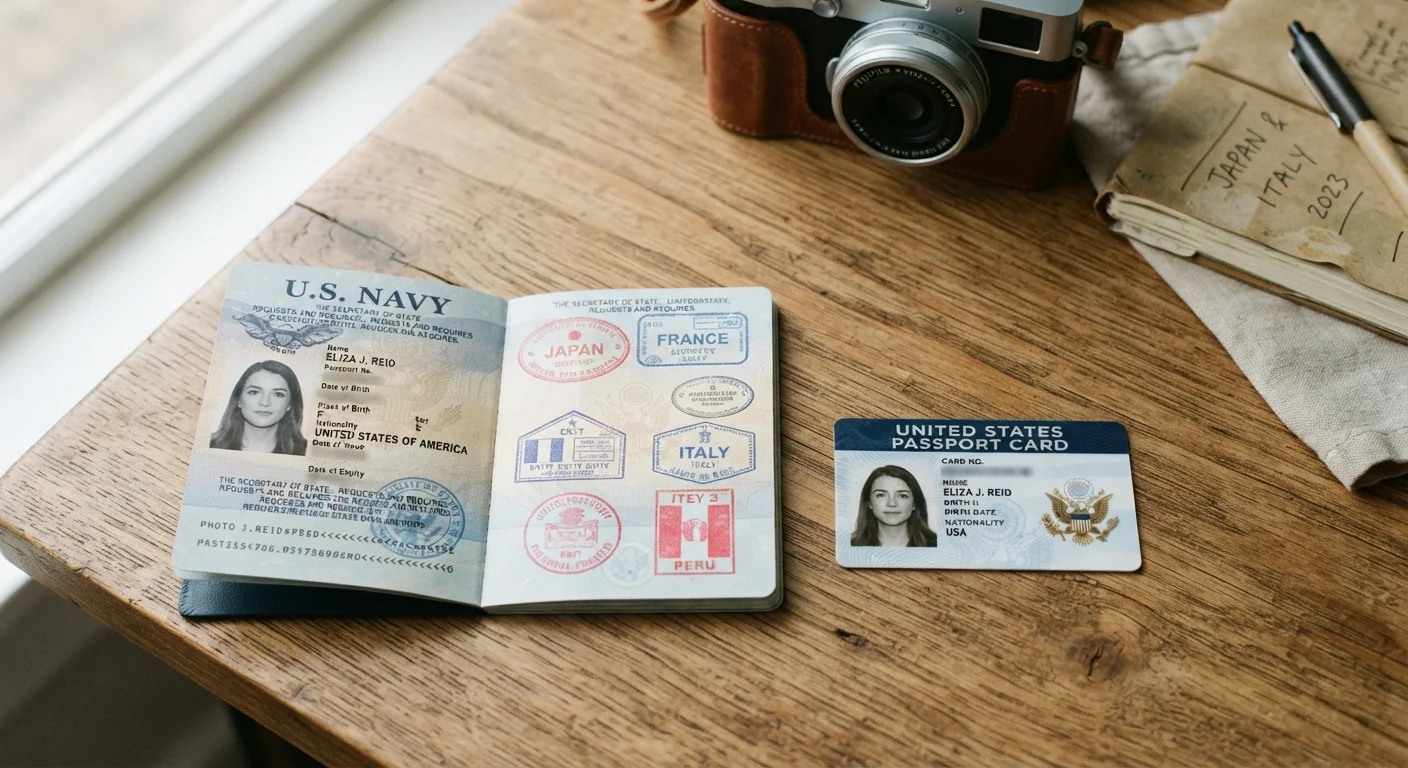
Option A
U.S. Passport Book
The all-access travel credential for Americans going anywhere.
Best for: Anyone flying internationally or traveling beyond Canada, Mexico, and the Caribbean.
Option B
U.S. Passport Card
The wallet-sized option for frequent land and sea border crossers.
Best for: Americans who regularly drive or take ferries between the U.S., Canada, Mexico, and the Caribbean.
What's the Real Difference?
At first glance, the U.S. passport book and passport card seem like two versions of the same thing. Both are issued by the U.S. Department of State, both prove your citizenship and identity, and both require the same application forms and processing times. But their accepted uses couldn't be more different, and choosing the wrong one for a trip can mean getting turned away at check-in.
The passport book is the traditional navy booklet most Americans picture when they hear "passport." It's accepted for all international travel — air, land, and sea — to any country in the world. The passport card is a wallet-sized card valid only for land border crossings and sea ports of entry within the Western Hemisphere: Canada, Mexico, Bermuda, and the Caribbean. It cannot be used to board an international flight, period.
For a deeper look at all the documents Americans may need when heading abroad, see our guide to international travel documents.
| Criterion | Passport Book | Passport Card |
|---|---|---|
| International air travel | ✓ Accepted worldwide | ✗ Not accepted |
| Land border crossings (Canada/Mexico) | ✓ Accepted | ✓ Accepted |
| Sea ports of entry (Caribbean/Bermuda) | ✓ Accepted | ✓ Accepted |
| Relative cost (adult, new application) | Higher fee | Lower fee |
| Physical size | Standard booklet | Wallet-sized card |
| Valid for 10 years (adults) | ✓ Yes | ✓ Yes |
| RFID for expedited border lanes | Limited | ✓ Designed for it |
Cost, Processing, and Practicality
The cost gap between the two is meaningful. As of current U.S. Department of State fee schedules, a new adult passport book costs more than double what a passport card costs — and you can apply for both simultaneously on the same application to save on acceptance fees. Renewal fees follow a similar pattern.
~2x
Cost difference: book vs. card
According to U.S. Department of State fee schedules, a new adult passport book costs roughly twice as much as a passport card.
10 years
Validity period for both documents (adults)
Both the passport book and passport card are valid for 10 years for adults 16 and older, and 5 years for children under 16.
4
Destinations/regions where the card is accepted
The passport card is valid only for travel to Canada, Mexico, Bermuda, and the Caribbean via land or sea entry points.
Processing times are the same for both documents, typically ranging from several weeks to a few months depending on demand and whether you opt for expedited service. One practical advantage of the card: it fits in a wallet. Travelers who drive to Mexico or Canada frequently appreciate not carrying a full booklet for routine crossings. That said, the card's RFID chip is designed for land ports — border officers can read it from a distance to speed up vehicle lanes.
One important note: the card is not a substitute for a Real ID-compliant driver's license for domestic air travel. Those are separate requirements entirely.
Real ID and Passport Cards Are Not the Same
A passport card does not satisfy the Real ID requirement for domestic U.S. flights. Starting May 7, 2025, the TSA requires a Real ID-compliant driver's license or another acceptable federal ID (like a passport book or card) for domestic air travel. Check your state's DMV for Real ID compliance status, and confirm current TSA requirements at tsa.gov before you fly.
When to Carry Both — and When One Is Enough
For most Americans, the passport book alone covers every scenario. If there's any chance you'll board an international flight — even a last-minute trip or a cruise that departs from a non-U.S. port — the book is the only document that will work.
Carrying both documents makes the most sense for a specific type of traveler: someone who lives near the Mexican or Canadian border and crosses regularly by car or ferry, but also takes international flights a few times a year. In that case, the card handles daily or weekly land crossings without wear-and-tear on the book, and the book stays safely at home or in carry-on luggage for flights.
If you're renewing your passport anyway, adding a card to the same application is a relatively low additional cost that buys genuine flexibility. But if you're applying for the first time on a budget and your travel plans are limited to flying internationally, skip the card and put your money toward the book.
Always verify current entry requirements, fees, and processing times directly with the U.S. Department of State and any destination country's official immigration authority before you travel, as these details can change.
The content on this site is for informational purposes only and is not a substitute for professional advice. Always consult a qualified professional for guidance specific to your situation.