

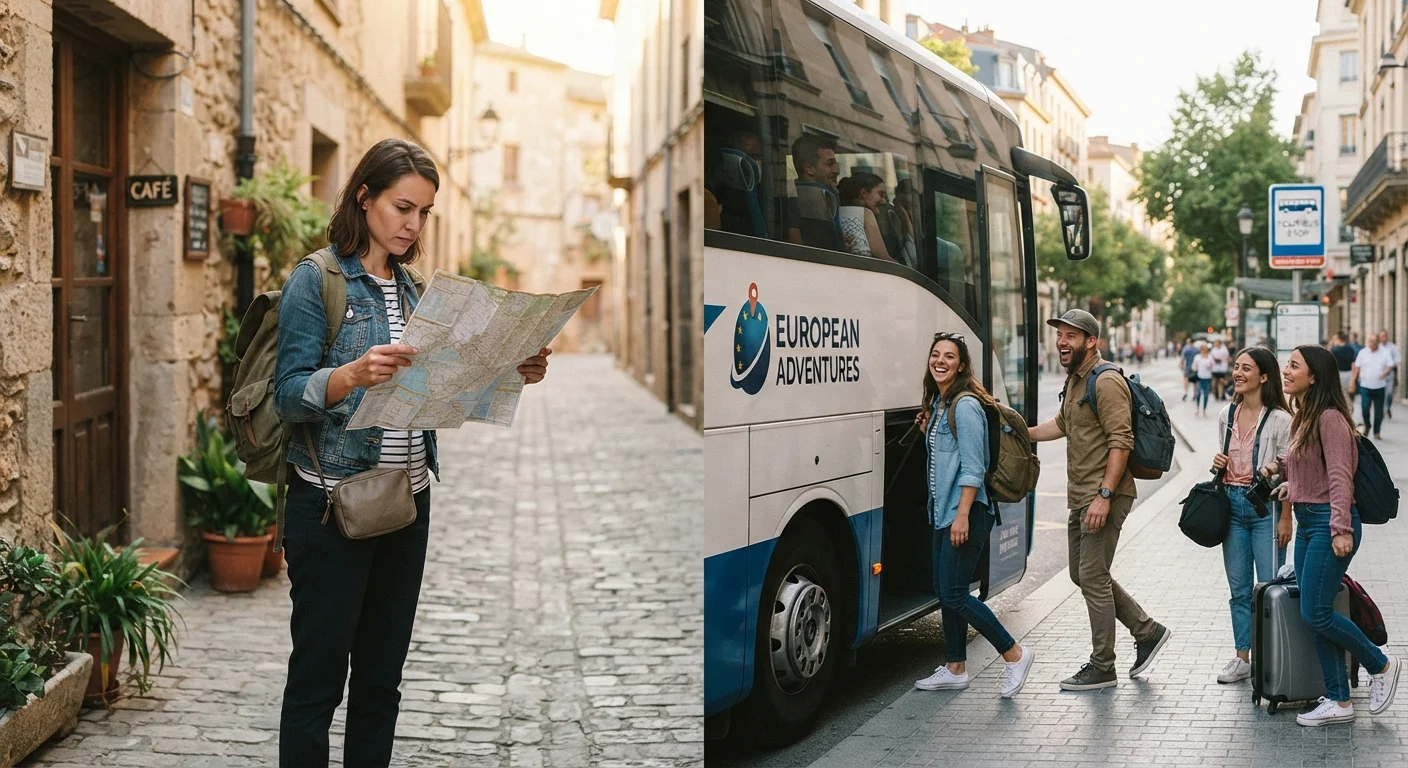
Option A
Solo Independent Travel
The freewheeling, self-directed approach.
Best for: Travelers who value flexibility, spontaneity, and deeply personal itineraries on their own schedule.
Option B
Guided Group Tours
The structured, social, all-in-one experience.
Best for: Travelers who want logistics handled for them and enjoy sharing the journey with a ready-made community.
The Core Trade-Off: Freedom vs. Simplicity
At its heart, the solo-vs-group decision comes down to one question: do you want to design the experience, or do you want to be inside it?
Independent travel hands you a blank canvas. You book your own flights, choose your own accommodations, and build an itinerary that reflects exactly what excites you — whether that's spending four days in a single neighborhood or zigzagging across a country by train. The payoff is a trip that feels genuinely yours. The cost is real: you carry the full weight of research, reservation management, and in-the-moment problem solving. A missed train is your problem to solve, solo.
Group tours flip the equation. A tour operator — and often a local guide — absorbs the logistical complexity. Transfers, accommodations, entrance tickets, and guided commentary are typically bundled into a single package. You show up, follow the itinerary, and let someone else worry about the details. For first-time international travelers in particular, this structure can be genuinely reassuring. See our ground-up international trip planning guide if you're still figuring out the fundamentals before you commit to either style.
| Criterion | Solo Independent Travel | Guided Group Tours |
|---|---|---|
| Flexibility | Total — change plans any time | Low — fixed itinerary |
| Logistics burden | High — self-managed | Low — handled by operator |
| Social experience | Organic, unpredictable | Built-in group dynamic |
| Cost predictability | Variable — depends on choices | High — bundled package price |
| Local immersion | Deep, self-directed | Curated, guide-led |
| Pace | Entirely your own | Group-determined |
| Best for complex destinations | Requires more research | Operator handles complexity |
Cost: More Complicated Than You'd Think
Many travelers assume solo travel is always cheaper — that's not universally true. Solo travelers often pay single-occupancy surcharges at hotels, lose access to group rates, and can't split transportation costs. On the flip side, you control every dollar: cook your own meals, sleep in hostels, travel by local bus. Budget solo travel in affordable regions can be extraordinarily economical.
Group tours charge a package price that typically includes accommodation, transport, guided excursions, and sometimes meals. That bundled price can represent solid value in destinations where independent logistics are genuinely complex or expensive — remote safari regions, for example, or destinations with limited public transit. In popular European cities, the calculus often favors going independent.
~50%
American adults who traveled solo at least once
A 2023 Statista consumer survey found roughly half of U.S. adults reported taking at least one solo trip in their lifetime, reflecting growing interest in independent travel.
15–20%
Typical single-supplement cost on group tours
Industry sources commonly cite single-occupancy surcharges of 15–20% above per-person double-occupancy rates on many escorted tour packages.
When budgeting either approach, factor in the costs that often get overlooked: travel insurance (strongly recommended for both styles — see our travel insurance explainer for what coverage actually includes), visa fees, and the timing of your trip. Our guide to peak vs. shoulder season travel shows how timing alone can shift costs dramatically for either travel style.
Safety, Comfort, and Personal Factors
Safety is a genuinely practical consideration, not a reason to stay home. Solo travelers — particularly those new to a destination — benefit enormously from thorough pre-trip research: understanding local scams, knowing which neighborhoods to avoid after dark, and keeping digital copies of key documents. Being your own navigator means being your own safety net.
Group tours offer a built-in buffer. A guide who knows the destination, a vetted itinerary that avoids common pitfalls, and fellow travelers to notice if something's wrong all add layers of practical security. This is worth weighing seriously if you have health considerations that benefit from structured support. Our article on planning a trip around health needs offers a general framework — and always consult your doctor before any international trip, regardless of which travel style you choose.
You Don't Have to Choose Forever
Many experienced travelers treat solo travel and group tours as complementary tools rather than competing philosophies. You might travel independently to a familiar region while joining a small-group day tour for a specific excursion — a cooking class, a guided hike, a wine region circuit — that benefits from local expertise. Thinking of them as a spectrum rather than an either/or opens up much more creative trip design.
Comfort with ambiguity is the underrated factor. Group tours eliminate uncertainty almost entirely; you know where you'll sleep, what you'll see, and when you'll eat. Solo travel means living with open loops — and for many travelers, that open-ended quality is precisely the point.
The content on this site is for informational purposes only and is not a substitute for professional advice. Always consult a qualified professional for guidance specific to your situation.