

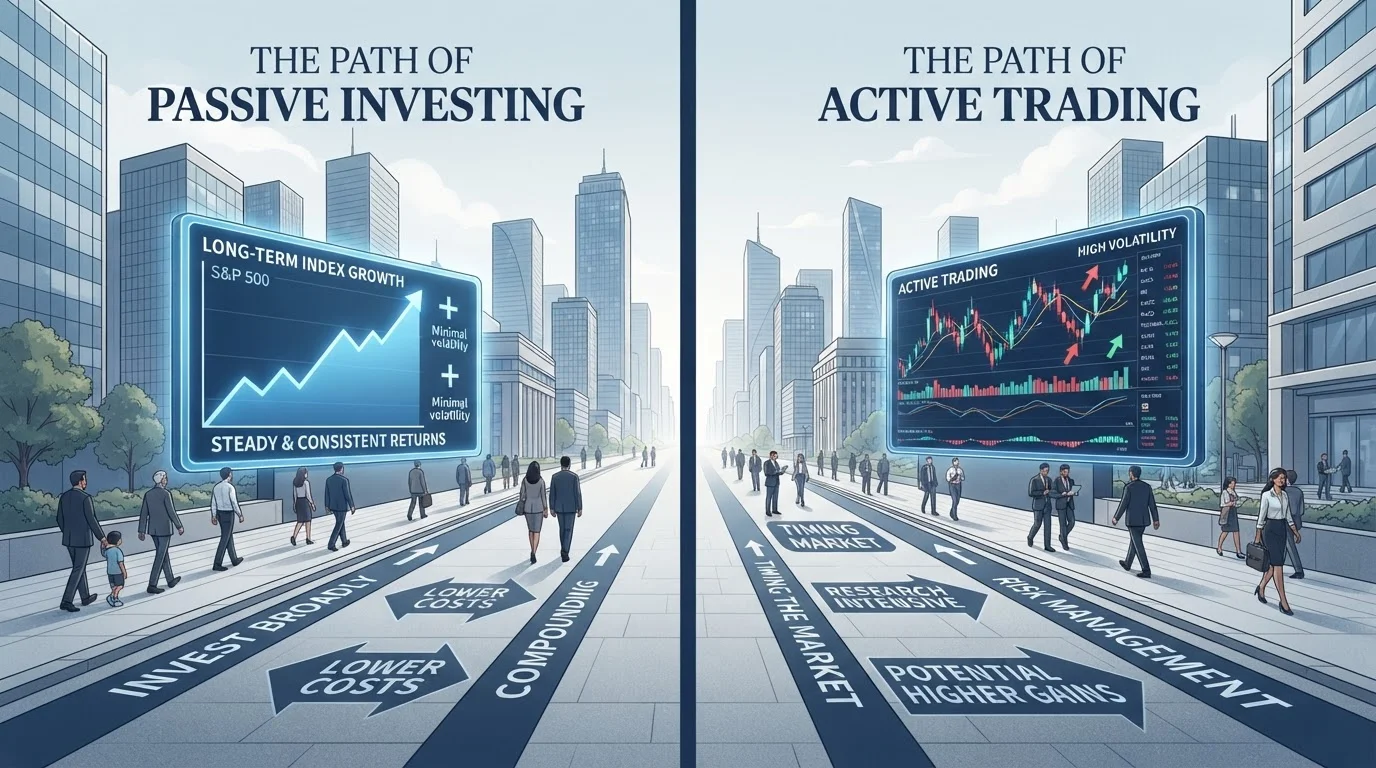
Option A
Index Funds
The passive, low-cost market-tracking approach.
Best for: Investors seeking broad market exposure, lower fees, and a long-term buy-and-hold strategy.
Option B
Actively Managed Funds
The hands-on, manager-driven selection strategy.
Best for: Investors willing to pay higher fees for the potential to outperform the market through professional stock selection.
How Each Approach Works
An index fund is designed to replicate the performance of a specific market benchmark - such as the S&P 500 or the total U.S. bond market. The fund buys and holds the same securities as the index it tracks, in the same proportions. No manager is making active buy or sell decisions; the portfolio simply mirrors its benchmark. This passive structure keeps trading activity low and operating costs minimal.
An actively managed fund, by contrast, employs a portfolio manager - or a team of analysts - whose job is to research securities and make deliberate investment decisions in pursuit of returns that exceed a benchmark. The manager can shift allocations, react to market events, and express a particular investment thesis. This ongoing decision-making requires more resources, which is reflected in higher fees.
Understanding how fees compound over time is critical. See our guide to expense ratios and hidden investment costs for a detailed look at what those differences mean over decades.
| Criterion | Index Funds | Actively Managed Funds |
|---|---|---|
| Management Style | Passive - tracks an index | Active - manager selects securities |
| Typical Expense Ratio | Often below 0.10% | Often 0.50%-1.00%+ |
| Trading Frequency | Low - only when index changes | High - ongoing buying and selling |
| Tax Efficiency | Generally higher | Often lower due to turnover |
| Long-Term Benchmark Outperformance | Matches benchmark by design | Majority underperform after fees |
| Transparency | High - holdings mirror index | Varies - disclosed periodically |
| Minimum Investment | Often low or none | Varies; sometimes higher minimums |
What the Performance Data Shows
One of the most debated questions in investing is whether active managers reliably add value. The evidence, compiled from decades of fund performance data, is sobering for active management advocates. S&P Dow Jones Indices publishes its SPIVA (S&P Indices Versus Active) report regularly, which tracks how actively managed funds perform relative to their benchmark index after fees. Across most categories and most time periods measured, the majority of active funds underperform their respective index benchmarks over 10- and 15-year horizons.
This doesn't mean active management is worthless in every context. Some managers have demonstrated skill over shorter periods, and certain asset classes - particularly less-liquid or less-efficient markets - may offer more opportunity for skilled selection. But for mainstream equity categories, consistent long-term outperformance after fees is rare and difficult to predict in advance.
~85%
Active large-cap funds underperforming S&P 500 over 15 years
According to S&P Dow Jones Indices' SPIVA U.S. Scorecard, roughly 85% of active large-cap U.S. equity funds have underperformed the S&P 500 over 15-year periods in recent reports.
0.03%-1.00%+
Expense ratio range: index vs. active funds
Morningstar data illustrates the wide gap in annual fees between passive index funds and the broader active fund universe, a difference that compounds significantly over time.
It's also worth separating myth from reality here. Many investors assume that market timing or selecting top-performing managers is achievable with the right research. Our article on common investing myths addresses why this belief often doesn't hold up to scrutiny.
Costs, Tax Efficiency, and Practical Considerations
Expense ratios - the annual fee expressed as a percentage of assets - differ sharply between the two fund types. Broad index funds often carry expense ratios well below 0.10%, while actively managed funds frequently range from 0.50% to over 1.00% annually. On a $100,000 portfolio, that difference can translate to hundreds of dollars per year - and those costs compound right alongside your returns, only in reverse.
Tax efficiency is another practical consideration. Because index funds trade infrequently, they generate fewer taxable capital gains distributions compared to actively managed funds, which may buy and sell holdings regularly. In a taxable brokerage account, this distinction can meaningfully affect your after-tax returns over time.
Holding Both Types Is Common
Many investors don't choose exclusively between index funds and actively managed funds - they hold both within a diversified portfolio. For example, a core position in a broad index fund might be complemented by a small allocation to an active fund targeting a specific market segment. How you combine different fund types is part of a broader asset allocation decision, not a binary choice.
Neither fund type is inherently immune to market risk. Both index funds and actively managed funds can lose value - they simply attempt to generate returns differently. Diversification within either vehicle does not eliminate market risk; it manages it. For guidance on how to balance different asset types relative to your stage of life, consider our overview of asset allocation across different life stages.
This article is for general informational and educational purposes only and does not constitute personalized investment, tax, or legal advice. Consult a qualified financial professional before making decisions about your own investments.
The content on this site is for informational purposes only and is not a substitute for professional advice. Always consult a qualified professional for guidance specific to your situation.