

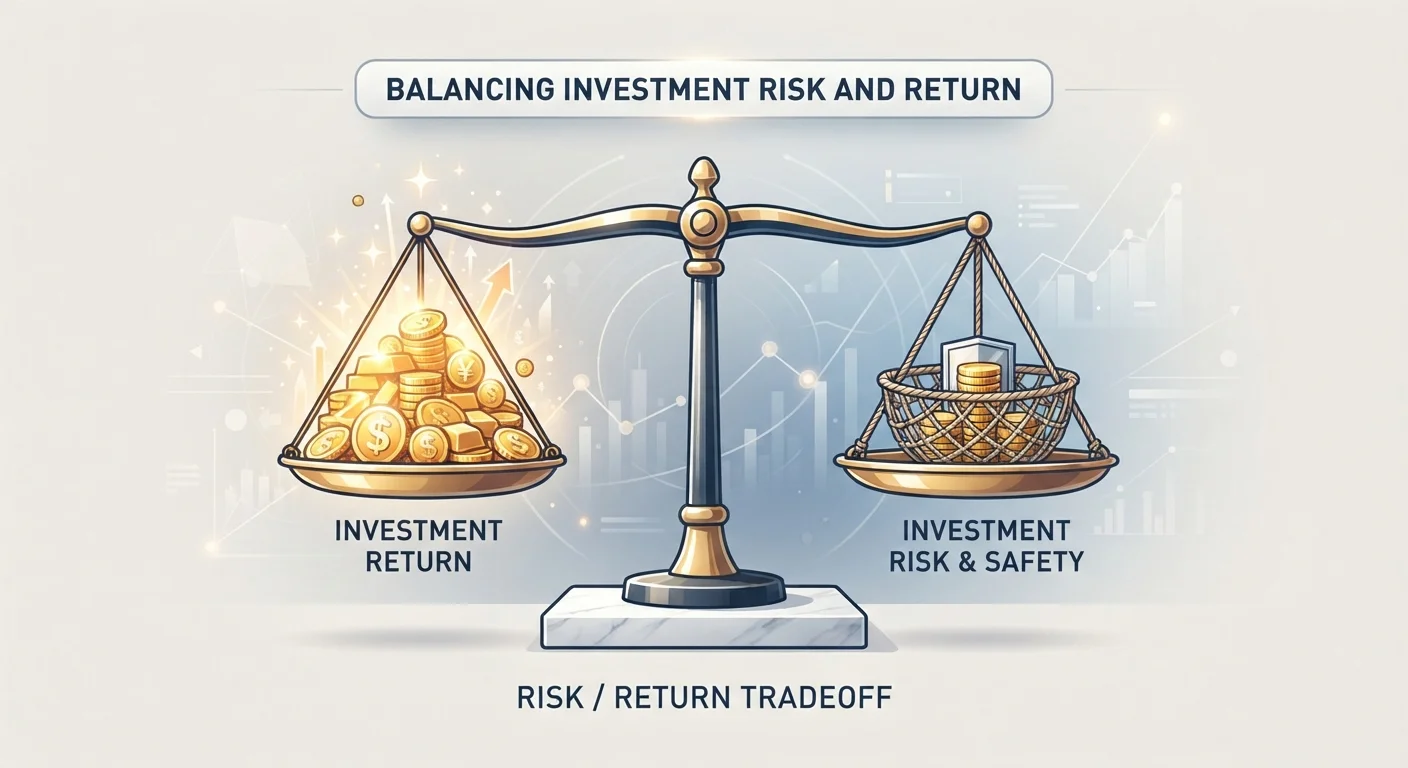
The Core Principle Every Investor Needs to Understand
In investing, risk and return are inseparable. This isn't a theory — it's a structural feature of how financial markets work. When you put money into any investment, you are accepting some probability that you could lose part or all of it. In exchange for accepting that uncertainty, markets offer the possibility of a return.
The greater the uncertainty, the higher the potential reward a market must offer to attract investors willing to take on that risk. This is why a speculative startup stock might promise dramatic gains while a short-term U.S. Treasury bill offers modest, predictable returns. Neither is inherently right or wrong — they simply reflect different points on the risk-return spectrum.
Many new investors make the mistake of focusing exclusively on the upside of an investment. Understanding what can go wrong before you start is just as important as understanding what can go right.
~10%
Average annual return of U.S. stocks historically
The S&P 500 has historically averaged roughly 10% annually before inflation — but individual years have ranged from steep losses to gains exceeding 30%, illustrating the volatility inherent in equities.
~2–3%
Typical return range for short-term government bonds
Lower-risk investments like short-term U.S. Treasury securities have historically offered much more modest returns, reflecting their reduced risk profile compared to equities.
Over 50%
S&P 500 peak decline during the 2008–2009 crisis
During the 2008 financial crisis, U.S. equity markets lost more than half their value at peak — a concrete reminder that higher expected returns come with real downside risk.
Types of Investment Risk You Should Know
Risk in investing isn't one-dimensional. Several distinct types of risk can affect your portfolio, and recognizing them helps you make more informed decisions.
- Market risk: The chance that the overall market declines, pulling your investments down with it regardless of their individual quality.
- Inflation risk: The possibility that your returns don't keep pace with rising prices, eroding your purchasing power over time.
- Concentration risk: When too much of your money is tied up in a single asset, sector, or geography — a loss there hits harder.
- Liquidity risk: The risk that you can't sell an investment quickly without accepting a significant loss in value.
- Credit risk: Relevant to bonds and lending — the chance that a borrower defaults and can't repay.
Each type of risk calls for a different response. For example, concentration risk can be addressed through diversification, while inflation risk might be considered when choosing between asset classes. Spreading risk across different investments is one of the most accessible tools available to everyday investors.
Match Risk to Your Actual Time Horizon
Before choosing an investment, identify when you'll genuinely need the money. Short-term goals — like a down payment in two years — generally call for lower-risk options. Long-term goals like retirement can typically support more volatility. Mismatching risk to timeline is one of the most common and costly planning errors.
How Risk Tolerance Shapes Your Investment Approach
Risk tolerance describes how much volatility and potential loss you can realistically absorb — both financially and emotionally. It's shaped by several factors:
- Time horizon: The longer you have before you need the money, the more short-term fluctuations you can typically endure.
- Financial cushion: Investors with a solid emergency fund and stable income can usually afford to take more risk with their invested capital.
- Emotional response to loss: Some people lose sleep over a 10% portfolio drop; others see it as an opportunity. Honest self-assessment matters here.
Risk tolerance isn't fixed for life. It can — and often should — shift as your circumstances change. Someone nearing retirement typically moves toward more conservative allocations, not because markets are any different, but because their ability to recover from losses has narrowed.
What the Risk-Return Relationship Means in Practice
Understanding this concept intellectually is one thing — applying it to real decisions is another. Before putting money into any investment, it's worth asking: Am I comfortable with the range of outcomes this investment could produce, including the worst-case scenario?
It also helps to be skeptical of anything that appears to offer strong returns with minimal risk. Many popular investing myths are built on the idea that there's a shortcut around this trade-off. There isn't one.
Finally, remember that costs also matter alongside risk. Fees reduce the returns you actually keep, which changes the effective trade-off you're making. Investment fees can compound against you just as powerfully as returns compound for you.
“The essence of investment management is the management of risks, not the management of returns.”
— Benjamin Graham, Author of 'The Intelligent Investor' and pioneering figure in value investing
This article is for informational and educational purposes only and does not constitute personalized financial or investment advice. Consider consulting a qualified financial professional before making investment decisions.
Frequently Asked Questions
Consistently high returns without proportionate risk is not a realistic expectation in legitimate investing. If an opportunity promises above-market returns with little or no risk, that is a major warning sign — often associated with fraud or misleading marketing. Genuine high-return investments carry genuine risk of loss.
No investment is entirely risk-free, but U.S. Treasury securities are widely considered the closest benchmark. They carry very low default risk because they are backed by the federal government. However, they still carry inflation risk — meaning their returns may not keep pace with rising prices over time.
A longer time horizon generally allows investors to weather short-term losses and wait for markets to recover. A 25-year-old saving for retirement can typically tolerate more volatility than someone who needs funds in three years. Matching your investment risk to your actual timeline is a key planning principle.
Not necessarily. Keeping all savings in low-yield accounts may feel safe but carries inflation risk — the real value of your money can shrink over time. Taking no investment risk at all is itself a financial decision with consequences. The goal is appropriate risk, not zero risk.
Volatility refers to how much an investment's value fluctuates over time. A highly volatile investment may swing dramatically in price within a short period. It matters because large swings can trigger emotional decisions — like selling at a loss during a downturn — that undermine long-term outcomes.
The content on this site is for informational purposes only and is not a substitute for professional advice. Always consult a qualified professional for guidance specific to your situation.