

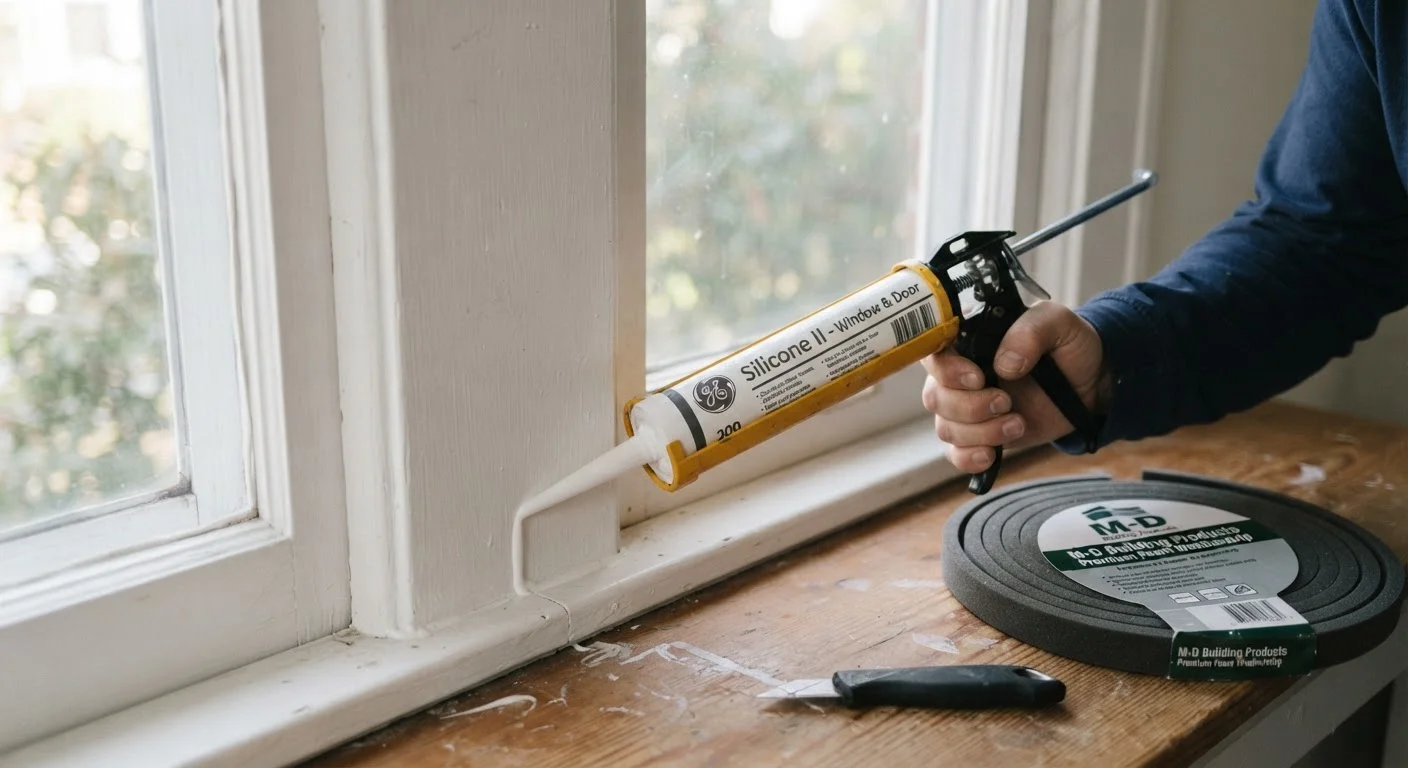
Option A
Caulk
The permanent, flexible filler for stationary gaps.
Best for: Best for sealing fixed cracks and joints where two surfaces don't move relative to each other.
Option B
Weatherstripping
The compressible seal built for moving parts.
Best for: Best for doors and operable windows that open and close repeatedly, requiring a seal that flexes without breaking.
Understanding What Each Product Is Designed to Do
Both caulk and weatherstripping block airflow, reduce energy loss, and keep moisture at bay — but they are engineered for fundamentally different conditions. Mixing them up is one of the most common and costliest mistakes homeowners make during air-sealing projects.
Caulk is a flexible sealant applied as a paste that cures into a semi-rigid, adhesive bead. Once set, it bonds permanently to both surfaces of a joint. That permanence is its strength — and its limitation. Silicone caulk remains flexible after curing and handles temperature swings well, making it the standard choice for exterior joints. Latex (acrylic) caulk is easier to paint and clean up with water, suited to interior gaps where movement and moisture are minimal. For context on when a stronger air barrier is needed in walls or attic spaces, see our overview of spray foam insulation trade-offs.
Weatherstripping is a compressible or sliding material — foam tape, V-strip vinyl, felt, rubber gaskets, or door sweeps — installed along the moving edges of doors and operable windows. It creates a seal only when the door or window is closed and releases that compression each time you open it. This ability to compress and recover repeatedly is what makes it right for moving parts.
| Criterion | Caulk | Weatherstripping |
|---|---|---|
| Best application | Stationary joints and cracks | Moving edges of doors and windows |
| Bond type | Adheres permanently to both surfaces | Compresses and releases repeatedly |
| Typical lifespan | 5–20 years depending on product and exposure | 1–10 years depending on material and use |
| Exterior suitability | Yes (silicone or exterior-grade latex) | Yes, with UV-resistant materials |
| Fails when used on | Surfaces that move or compress repeatedly | Rigid, fixed joints needing adhesive bond |
| Skill level required | Low to moderate (nozzle control matters) | Low (measure, cut, and press or screw in) |
| Reversibility | Removable but requires effort and prep | Generally easy to remove and replace |
Where to Use Caulk and Where It Falls Short
Reach for caulk when the gap you're sealing sits between two surfaces that never move relative to each other. Prime applications include:
- The joint where window or door frames meet interior drywall or exterior siding
- Gaps where baseboards meet the floor on exterior walls
- Penetrations where pipes, wires, or ducts pass through framing or exterior walls
- Seams between the house foundation and wood framing (sill plate area)
- Around attic hatches on the frame, not the hatch itself
Where caulk fails is equally important to understand. Apply it to the closing edge of a door stop — the surface that contacts a door every time it shuts — and the repeated impact will fracture the cured bead within weeks. Similarly, using standard interior latex caulk in a bathroom's wet zone without the correct formulation leads to premature failure. Our article on why bathroom caulk fails explains the correct product selection and application technique for damp interior joints.
25–30%
Home heating/cooling energy lost through air leaks
The U.S. Department of Energy estimates that air leakage through gaps, cracks, and openings accounts for roughly 25–30% of a typical home's heating and cooling energy use.
$200–$600
Estimated annual savings from thorough air sealing
Energy savings from comprehensive air sealing and insulation projects can vary widely; the DOE has cited figures in this range for typical homes, though actual results depend on climate, home size, and existing conditions.
Choosing the Right Weatherstripping for the Job
Weatherstripping is not a single product — it's a category, and choosing within it matters for longevity. The main types and their appropriate uses:
- Foam tape (open- or closed-cell): Inexpensive and easy to apply, but low durability. Best on rarely used doors or low-friction applications.
- V-strip (tension seal) vinyl or metal: Durable and nearly invisible once installed. Works well along the sides of doors and double-hung windows where the strip springs back to fill a gap.
- Door sweeps: Attach to the bottom of a door to seal the threshold gap. Automatic door sweeps lift when the door opens, extending their lifespan considerably.
- Compression strips (rubber or vinyl bulb): Mounted on door stops, they compress when the door closes. Well-suited to entry doors with high traffic.
- Felt strips: Low cost but absorb moisture and degrade relatively quickly; generally appropriate only for interior or very low-use doors.
Regardless of type, weatherstripping should be replaced when it no longer springs back to its original shape, shows visible cracking, or when you can see daylight around a closed door or feel a draft with a hand held near the frame.
Air Sealing and Ventilation Go Together
Sealing a home tightly reduces energy loss but can also reduce fresh-air exchange if ventilation is not adequate. In modern construction, building codes typically require mechanical ventilation when air sealing reaches certain levels of tightness. Before undertaking a comprehensive sealing project — particularly in older homes — consider a professional energy audit, which can identify both the highest-priority sealing locations and whether existing ventilation needs upgrading. Never seal combustion appliances such as furnaces or water heaters into airtight spaces without verifying proper combustion air supply with a qualified technician.
The content on this site is for informational purposes only and is not a substitute for professional advice. Always consult a qualified professional for guidance specific to your situation.