

Our Verdict
Spray foam insulation is a high-performance choice that delivers measurable air-sealing and thermal benefits — but those gains come at a real cost in dollars, flexibility, and complexity. It rewards careful planning and professional execution, but it is not the right fit for every home or every budget.
Homeowners with older, drafty houses who plan to stay long-term and can absorb higher upfront costs will see the most return on spray foam investment.
What Spray Foam Actually Does
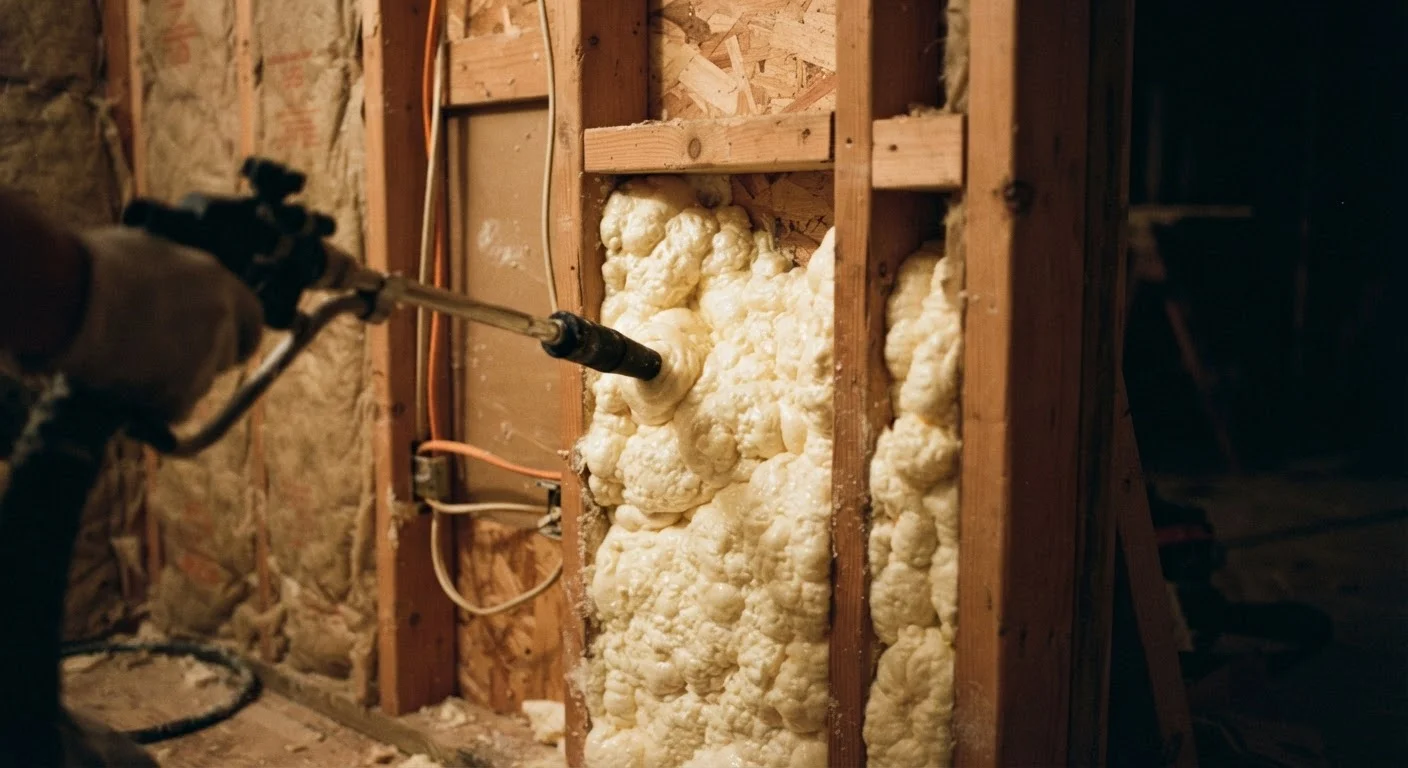
Spray polyurethane foam (SPF) is a two-component material that expands on contact to fill cavities, cracks, and irregular surfaces. It functions simultaneously as insulation and an air barrier — a combination that most traditional insulation materials cannot replicate on their own.
There are two primary types. Closed-cell foam is dense, rigid, and moisture-resistant, with an R-value typically around R-6 to R-7 per inch. Open-cell foam is lighter and softer, with an R-value closer to R-3.5 per inch, and it allows some moisture vapor to pass through. The right choice depends on your climate, the specific area being insulated, and your moisture management goals.
For existing homes, spray foam is most commonly applied in attics, crawl spaces, rim joists, and around penetrations — areas where air leakage tends to be highest. It can also be injected into existing wall cavities using specialized equipment, though this application is more limited and less common.
The Real Advantages
Superior air sealing alongside thermal insulation
Spray foam expands to fill irregular gaps and acts as both an insulator and an air barrier, something batt insulation cannot do without separate sealing steps.
High R-value per inch, especially closed-cell
Closed-cell foam delivers roughly R-6 to R-7 per inch, making it effective in tight spaces where thicker traditional insulation wouldn't fit.
Long service life once properly installed
Cured spray foam does not settle, sag, or shift over time the way blown-in cellulose or loose-fill fiberglass can, maintaining its performance for decades.
Moisture resistance in closed-cell applications
Closed-cell foam's low permeability makes it suitable for crawl spaces, rim joists, and below-grade areas where water vapor infiltration is a concern.
Can add structural rigidity to wall cavities
Closed-cell foam bonds to framing and sheathing, which has been shown in some studies to modestly increase wall racking strength.
The most significant advantage spray foam holds over alternatives like fiberglass batts or blown-in cellulose is its ability to act as both insulation and an air seal simultaneously. The U.S. Department of Energy has consistently identified air leakage as a major driver of home energy waste, and spray foam addresses that problem at the source. Homeowners in cold climates especially tend to notice reductions in drafts and heating load after treatment.
Closed-cell foam also adds structural rigidity to framed cavities and resists moisture infiltration, which can be particularly useful in crawl spaces or coastal climates prone to humidity. In attic applications, encapsulating the roof deck with closed-cell foam can shift the thermal boundary and protect HVAC equipment from extreme temperatures.
For homeowners comparing air-sealing options, it helps to understand where spray foam fits relative to simpler interventions. See our guide to caulk vs. weatherstripping for how those lower-cost tools handle common gaps before committing to foam.
The Real Disadvantages
Significantly higher upfront cost than alternatives
Spray foam typically costs several times more per square foot than fiberglass batts or blown-in cellulose, making payback periods longer and the investment harder to justify in lower-energy-cost regions.
Permanent and extremely difficult to remove
Once cured, foam bonds tightly to framing and other materials. Future electrical, plumbing, or renovation work in foamed areas becomes more labor-intensive and potentially destructive.
Moisture risk if wrong type is used
Open-cell foam is vapor-permeable and can trap condensation against roof decking or sheathing in cold climates if vapor management isn't properly designed.
Off-gassing risk from improper installation
Off-ratio or poorly mixed foam can emit chemical odors and remain problematic long after installation, requiring professional remediation in serious cases.
Not suitable as a DIY project
Precise temperature, mixing ratios, and application technique are required for foam to cure correctly; errors are difficult to detect and costly to fix.
May complicate future roof or attic inspections
When spray foam is applied to the underside of roof decking, standard visual inspection for deck deterioration becomes more difficult, which can obscure early signs of rot or damage.
The cost gap between spray foam and conventional insulation is substantial and should not be underestimated. Homeowners should obtain detailed quotes from licensed contractors and model the payback period against their actual energy bills before proceeding.
Reversibility is perhaps the least-discussed drawback. Spray foam bonds permanently to framing, sheathing, and electrical components. If a contractor needs to rewire a wall or a plumber needs access to a pipe, foam removal becomes a labor-intensive and sometimes destructive process. This matters for older homes where future renovation is likely.
Open-cell foam, while less expensive, is vapor-permeable — which creates moisture risk in certain climates if not paired with an appropriate vapor retarder. Applying open-cell foam in a cold-climate attic without understanding vapor dynamics can trap condensation against the roof deck, potentially leading to wood rot over time. Always work with an installer who understands your regional climate and building science principles.
Open-Cell vs. Closed-Cell: Climate Matters
In hot, humid climates, open-cell foam is sometimes used in attics but requires careful vapor management. In cold climates, closed-cell foam is generally the safer choice for roof deck applications because it limits moisture migration. The International Residential Code and local building codes may also specify minimum requirements for vapor retarders depending on your climate zone. Always confirm the appropriate product with a contractor familiar with your region's specific conditions.
Installation Risks and What to Watch For
Spray foam is not a DIY project for most homeowners. The two-component chemicals must be mixed and applied at precise ratios and temperatures. Off-ratio foam — foam that didn't cure correctly — can remain tacky, emit odors for extended periods, and fail to achieve its rated R-value. This has been a documented consumer complaint with certain products and installations.
Ventilation during and after application is critical. Occupants and pets should vacate the home during spraying and for a period afterward as directed by the installer. The curing window varies by product and conditions, so ask your contractor for specific guidance and confirm it in writing.
Choosing a contractor with verifiable experience in spray foam — and one who pulls the necessary permits — significantly reduces these risks. Ask to see past projects, request references, and confirm they're using products listed by a recognized testing body. Cutting corners on installation costs often creates problems that cost more to remediate than the original savings justified.
If you're also considering upgrades to how your home manages energy, our overview of smart thermostat trade-offs covers another common home efficiency decision worth pairing with insulation improvements.
25–40%
Typical home energy lost through air leakage
The U.S. Department of Energy estimates that air infiltration accounts for 25–40% of energy used for heating and cooling in a typical home.
R-6 to R-7
R-value per inch for closed-cell foam
Closed-cell spray polyurethane foam consistently achieves among the highest R-values per inch of any commonly available insulation material.
The content on this site is for informational purposes only and is not a substitute for professional advice. Always consult a qualified professional for guidance specific to your situation.