

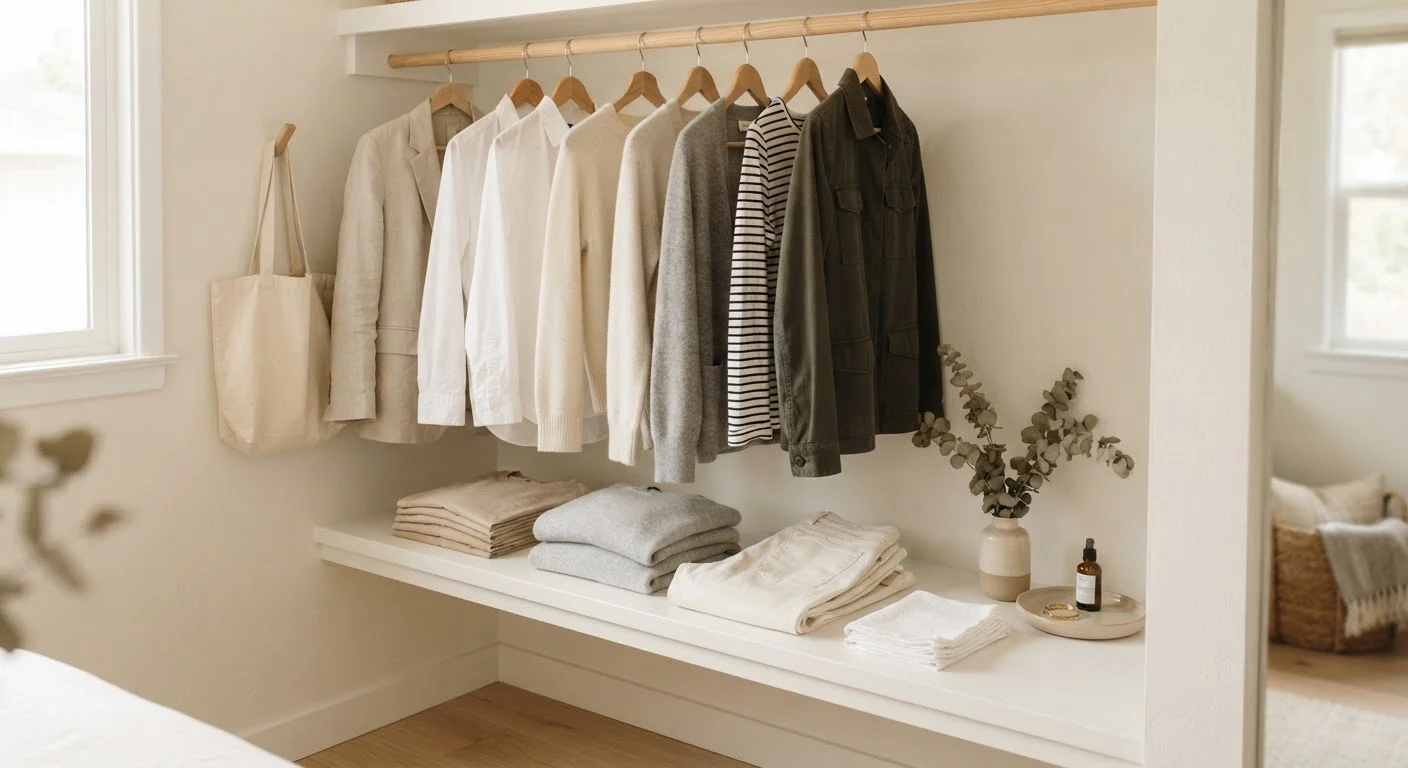
Why More Clothes Often Means Fewer Outfits
It sounds counterintuitive, but a crowded closet frequently makes getting dressed harder, not easier. When nothing clearly goes together, every morning becomes a small problem-solving session. Research in decision-making consistently shows that more options don't reliably lead to better choices — they tend to create paralysis and dissatisfaction instead.
Outfit-building is a skill, not a volume game. A wardrobe of 15 pieces that mix freely can produce exponentially more combinations than 40 pieces that don't connect. If you're building from almost nothing, this combinatorial thinking should guide every addition from the start. And if your closet has grown over time without a clear strategy, the steps below will help you extract far more from what you already own.
What you will need
How to Build More Outfits From What You Already Own
The goal here isn't to reduce your wardrobe for its own sake — it's to understand what you have well enough to use it fully. Think of it like a culinary approach: a skilled cook with a few quality ingredients makes more interesting meals than someone with a disorganized pantry full of things that don't combine.
Full-length mirror
Lets you evaluate complete outfit combinations from head to toe before committing.
Notebook or phone notes app
Helps you record outfit combinations you discover so you can repeat them easily.
Hangers (uniform style)
Keeping clothes visible and consistent on hangers helps you see all options at once.
Lay out everything you actually wear
Pull out only the pieces you reach for regularly — not aspirational items or things that need tailoring. Lay them flat or hang them where you can see all of them at once. Categorize loosely: tops, bottoms, outerwear/layers, shoes. This visual inventory is the foundation. You can't combine what you can't see.
Identify your anchor pieces
Anchor pieces are bottoms and neutral-toned tops that pair with almost everything else — think dark jeans, a well-fitted chino, a solid white or gray crewneck. These are your combination multipliers. If you're unsure what makes a piece truly versatile, our article on what makes a piece genuinely adaptable breaks down the specific qualities to look for — cut, color, weight, and texture.
Map combinations systematically
Take one bottom and pair it with every top you own. Note which combinations actually work — meaning they fit well, the colors don't fight, and the formality levels match. Then repeat with your next bottom. This sounds tedious, but most people finish in under twenty minutes and are surprised by pairings they'd never considered. Jot down anything new that works.
Add layering as a variation tool
A single outfit can become two or three by adding or removing a layer. An open button-down over a t-shirt reads differently than the same t-shirt worn alone, or the same button-down tucked in as a standalone top. Experiment with how outerwear, cardigans, and lightweight jackets transform the silhouette and tone of a base combination.
Use accessories to shift the read
The same jeans-and-top combination can skew casual, polished, or elevated depending on what you add. A belt changes the waistline silhouette. A scarf adds color or texture without permanently altering the outfit. Shoes do more heavy lifting than most people realize — the same top and bottom pair with sneakers, loafers, or ankle boots communicates three different contexts. For a deeper look at this, see our guide on how accessories shift an outfit's tone without overwhelming it.
Note and repeat what works
Keep a short running list — even three or four combinations per week — of outfits you put together and felt good in. Over a month, you'll have a reliable rotation you can come back to without re-solving the same problem daily. This also makes it obvious which pieces are doing most of the work and which are taking up space without contributing.
Fit Matters More Than You Think
Even a creative combination falls flat if the pieces don't fit well. Before assuming a combination doesn't work, check whether the issue is actually fit — a too-long hem, a boxy shoulder, or a waistband that gaps. A small alteration can rescue pieces you'd otherwise sideline. See our take on fit vs. style for more on why this is often the deciding factor.
Once you've mapped your combinations, don't stop there. Seasonal transitions are a natural moment to revisit this process — our guide on refreshing your closet between seasons shows how to stretch what you own across changing weather without starting over.
If you're also thinking about what new pieces to add, dressing well on a tight budget outlines principles that help you stay selective rather than reactive when shopping. And understanding the balance between neutral and statement pieces will make every combination feel more intentional.
The content on this site is for informational purposes only and is not a substitute for professional advice. Always consult a qualified professional for guidance specific to your situation.