

Why Style Rules Exist — and Why They Often Misfire
Fashion rules were never handed down from some authoritative style institution. Most emerged as shorthand — quick guidelines that simplified complex decisions for a mass audience. The trouble is, shorthand loses nuance. What started as a useful nudge became a rigid law that leaves real people second-guessing perfectly good outfits.
Stylists and fashion educators frequently point out that the most well-dressed people aren't rule-followers — they're rule-understanders. They know why a principle exists, which means they also know when it's irrelevant to them. That's the mindset shift this article is designed to help you make.
Whether you're trying to build a more intentional wardrobe or just stop overthinking every outfit, knowing which rules to trust — and which to toss — is genuinely liberating. For a deeper look at how fit interacts with style choices, see fit vs. style guidance that puts priorities in order.
Myth
You should never mix prints — it always looks chaotic and hard to pull off.
Fact
Mixing prints works well when you vary scale and share at least one common color between patterns.
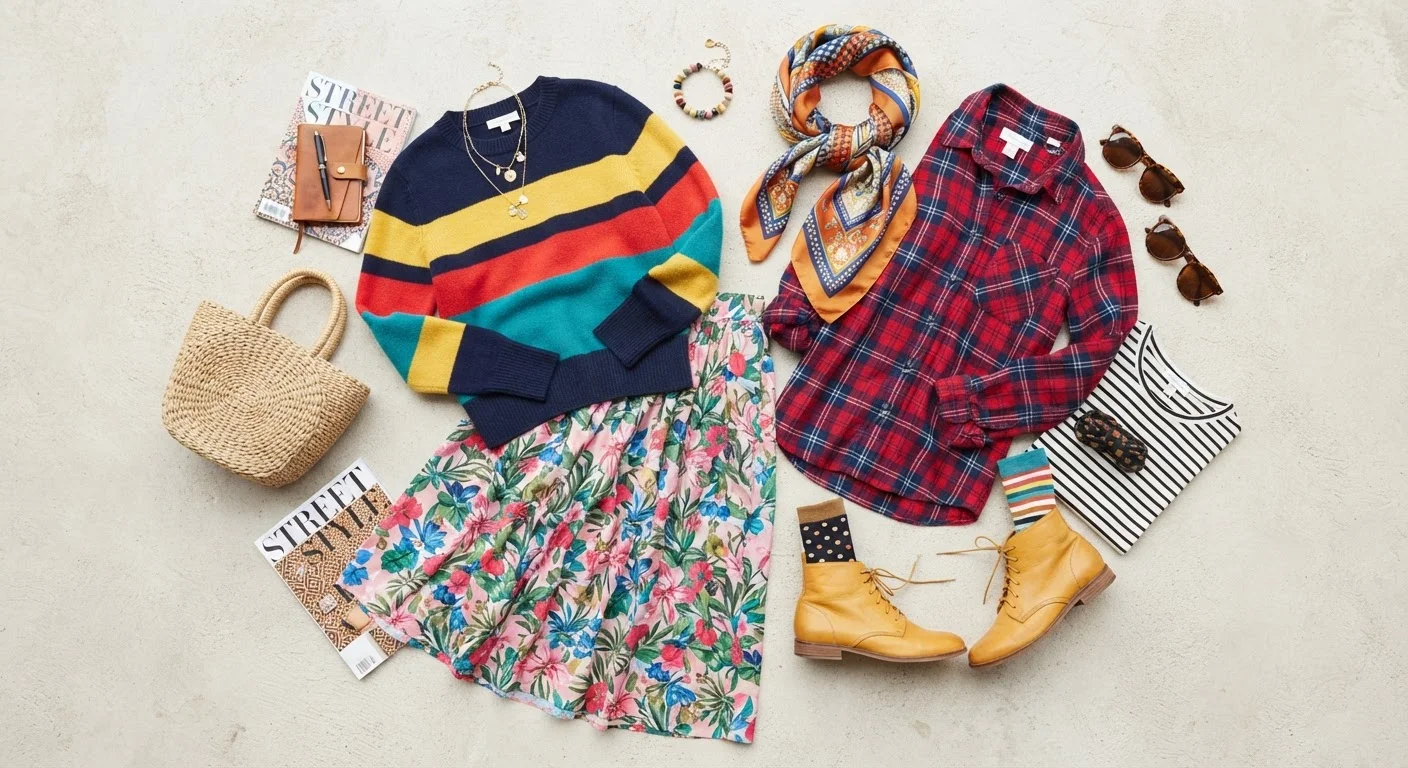
The fear of mixing prints keeps many people stuck in single-pattern outfits that feel safe but flat. The actual principle stylists use is straightforward: pair a larger, bolder print with a smaller, more subtle one, and anchor them with a shared color. A wide floral and a thin stripe in matching tones, for example, read as intentional rather than accidental. The rule against mixing prints was always more of a caution for beginners — not a permanent ban.
Myth
Black and navy should never be worn together — they clash awkwardly.
Fact
Black and navy can be paired effectively, especially when the tones are clearly differentiated and textures vary.
This rule has a kernel of logic: if two very similar dark shades are worn together, they can look like a mismatched accident rather than a deliberate combination. But when the colors are clearly distinct — a deep navy blazer over true black trousers, for instance — the pairing reads as sophisticated. Adding texture contrast (matte vs. sheen, knit vs. woven) makes the combination even more intentional. Many European style traditions treat navy-and-black as a classic combination.
Myth
You must always tuck in your shirt to look polished and put-together.
Fact
Whether to tuck depends on the garment's cut, the occasion, and the proportions of the overall outfit.
Shirts designed with a straight, even hem are typically meant to be worn untucked. Shirts with a curved or longer back hem are cut for tucking. Forcing either into the wrong configuration tends to look awkward — not polished. A half-tuck (tucking only the front center of the shirt) is a widely used styling technique that adds structure without rigidity. The collar and neckline also play a role; what happens at the collar affects how the whole outfit reads.
Myth
Wearing all one color from head to toe looks boring or like you didn't try.
Fact
Monochromatic dressing is a sophisticated technique that creates a streamlined, intentional silhouette.
A single-color outfit done in varied textures and slightly different tones — known as tonal dressing — is one of the more elevated approaches in everyday style. It elongates the body visually and removes the mental load of color-matching entirely. The key is texture variation: a cream linen trouser with an ivory ribbed knit and a sand-colored leather belt reads as layered and intentional, not lazy. Many professional stylists use this approach as a default for clients who want to look polished with minimal effort.
Myth
Horizontal stripes make you look wider and should be avoided if you're self-conscious about your size.
Fact
Research on visual perception shows the effect of stripes is more nuanced and context-dependent than a simple 'avoid' rule suggests.
The idea that horizontal stripes universally add visual width has been questioned by vision science research. Studies on the Helmholtz illusion have found that under many conditions, a figure dressed in horizontal stripes can actually appear taller and slimmer than the same figure in a solid color — a finding that complicates the old rule considerably. Stripe width, contrast, and garment fit all influence the effect. More broadly, body-shape dressing rules are guidelines to consider, not mandates to follow — wear what makes you feel confident and comfortable.
What to Do Instead of Following Rules Blindly
Rather than memorizing a list of rules, consider a few practical principles that hold up across body types, budgets, and occasions.
85%
People who dress for confidence report higher self-esteem
A study published in the journal Social Psychological and Personality Science found that clothing choices and feelings of 'enclothed cognition' meaningfully affect self-perception and confidence.
1 in 3
Shoppers regret purchases driven by trend pressure
Consumer behavior surveys consistently show that trend-driven or rule-driven purchases — rather than personal-fit purchases — account for a large share of wardrobe regret and unworn clothing.
- Proportion over prescription. Any outfit works better when volume is balanced — a loose top pairs well with a slimmer bottom, and vice versa. This isn't about hiding your shape; it's about visual harmony.
- Contrast creates interest. Whether it's pattern mixing or pairing unexpected colors, contrast is what makes an outfit feel intentional rather than accidental. Balancing neutrals with statement pieces is one reliable way to do this without going overboard.
- Fit is the great equalizer. A well-fitted inexpensive garment almost always outperforms an ill-fitting expensive one. Tailoring basics to your actual body is one of the highest-return moves in dressing well.
Body-shape advice is another area loaded with well-meaning but often outdated rules. If you've been confused by conflicting guidance, understanding what that advice actually means can help you filter out what's useful from what's noise.
Don't Let Rules Drive Unnecessary Spending
Style rules are sometimes amplified by marketing that frames 'the right look' as requiring new purchases. Before buying anything to 'fix' a rule violation in your wardrobe, consider whether the item you already own actually works fine. Many wardrobes are cluttered with rule-driven purchases that were never worn. Thoughtful styling of what you already have almost always outperforms reactive shopping.
The goal isn't to dress for a rulebook — it's to dress for yourself with enough knowledge to make intentional choices. And if your wardrobe feels limited, know that getting more outfits from fewer clothes is more about strategy than spending.
The content on this site is for informational purposes only and is not a substitute for professional advice. Always consult a qualified professional for guidance specific to your situation.