

Our Verdict
There is no single childproofing checklist that serves every family equally. The hazards that demand the most urgent attention shift dramatically from infancy through the school years - and families with children at multiple stages face the added challenge of managing competing safety needs at once. A layered approach that combines physical barriers, age-appropriate education, and consistent supervision offers the strongest overall protection.
| Best for | Recommended |
|---|---|
| Families with infants (0-12 months) | Passive physical safeguards - safe sleep setup, furniture anchoring, outlet covers, and constant proximity supervision |
| Families with toddlers (1-3 years) | Active barriers - stair gates, cabinet locks, water safety measures, and poison storage overhaul |
| Families with school-age children (4-10 years) | Education-forward safety - teaching hazard recognition, fire escape plans, and kitchen and tool safety |
| Mixed-age households | Layered strategy combining physical hardware, high-shelf storage, and ongoing family safety conversations |
Why Developmental Stage Changes Everything
A home that is reasonably safe for a seven-year-old can be genuinely dangerous for an eight-month-old - and vice versa. Children's physical abilities, cognitive understanding, and impulse control change so rapidly in the first decade of life that the hazards posing the greatest threat shift almost year by year. Understanding why a risk is age-specific helps parents prioritize limited time and resources more effectively than any generic checklist.
According to the Centers for Disease Control and Prevention (CDC), unintentional injury is the leading cause of death for children in the United States across all age groups past infancy, with falls, drowning, and poisoning consistently ranking among the top causes. The specific mechanism of injury, however, varies sharply by age - which is why tailoring your home's safety setup to your child's current stage matters so much.
Our room-by-room childproofing guide explores the hazards most commonly missed beyond the basics, and pairs well with the stage-by-stage framework below.
Infant Safety (0-12 Months): Passive Protection First
Infants cannot move away from danger on their own, which means the environment itself must be made safe before they arrive home. The highest-priority hazards at this stage are suffocation, unsafe sleep, falls from elevated surfaces, and ingestion of small objects.
- Safe sleep environment: The American Academy of Pediatrics (AAP) recommends placing infants on a firm, flat surface on their backs, in their own sleep space, free of loose bedding, bumpers, pillows, and soft toys. Room-sharing (without bed-sharing) is associated with a reduced risk of sudden infant death syndrome (SIDS) in published research.
- Fall prevention: Never leave an infant unattended on a changing table, sofa, or bed - even before they can roll. Falls from furniture are among the most common infant injuries treated in emergency rooms.
- Small object and choking hazards: Coins, button batteries, small toy parts from older siblings, and even certain foods pose serious choking risks. Conduct a floor-level sweep of every room the infant accesses.
- Window and blind cord safety: Anchor furniture away from windows; use cordless blinds or secure cords out of reach to eliminate strangulation risk.
Multi-Age Households: Layer Your Strategy
When infants and toddlers share a home with older children, safety hardware must account for the youngest and most vulnerable family member - not the average. Store older children's small-part toys in dedicated rooms or on high shelves with closures that infants cannot access. Involve school-age kids in safety conversations so they understand why certain rules exist and become allies in keeping younger siblings safe.
If your household also includes older children, their toys - especially those with small parts, magnets, or button batteries - should be stored in areas completely inaccessible to infants. See our notes on child safety locks and cabinet latches for realistic expectations about what hardware can and cannot do.
Toddler Safety (1-3 Years): Securing a Mobile Explorer
The transition to walking and climbing transforms a child's risk profile almost overnight. Toddlers are fast, fearless, and unable to reliably associate actions with consequences. The priority at this stage shifts from passive protection to active barriers.
| Infants (0-12 mo) | Toddlers (1-3 yr) | School-Age (4-10 yr) | |
|---|---|---|---|
| Top hazard category | Suffocation & unsafe sleep | Falls, poisoning & drowning | Burns, cuts & unsupervised exploration |
| Mobility level | Immobile to rolling/crawling | Walking, climbing, running | Full mobility, can bypass barriers |
| Primary safety approach | Passive environmental control | Active physical barriers | Education plus supervision |
| Key hardware needed | Firm sleep surface, cord anchors | Stair gates, cabinet locks, pool fence | Smoke alarms, fire escape plan, locked tool storage |
| Supervision intensity | Constant, within arm's reach | Very high, especially near water | Moderate with consistent rules |
| Cognitive safety role | None - fully dependent | Limited rule-following only | Can learn and apply safety reasoning |
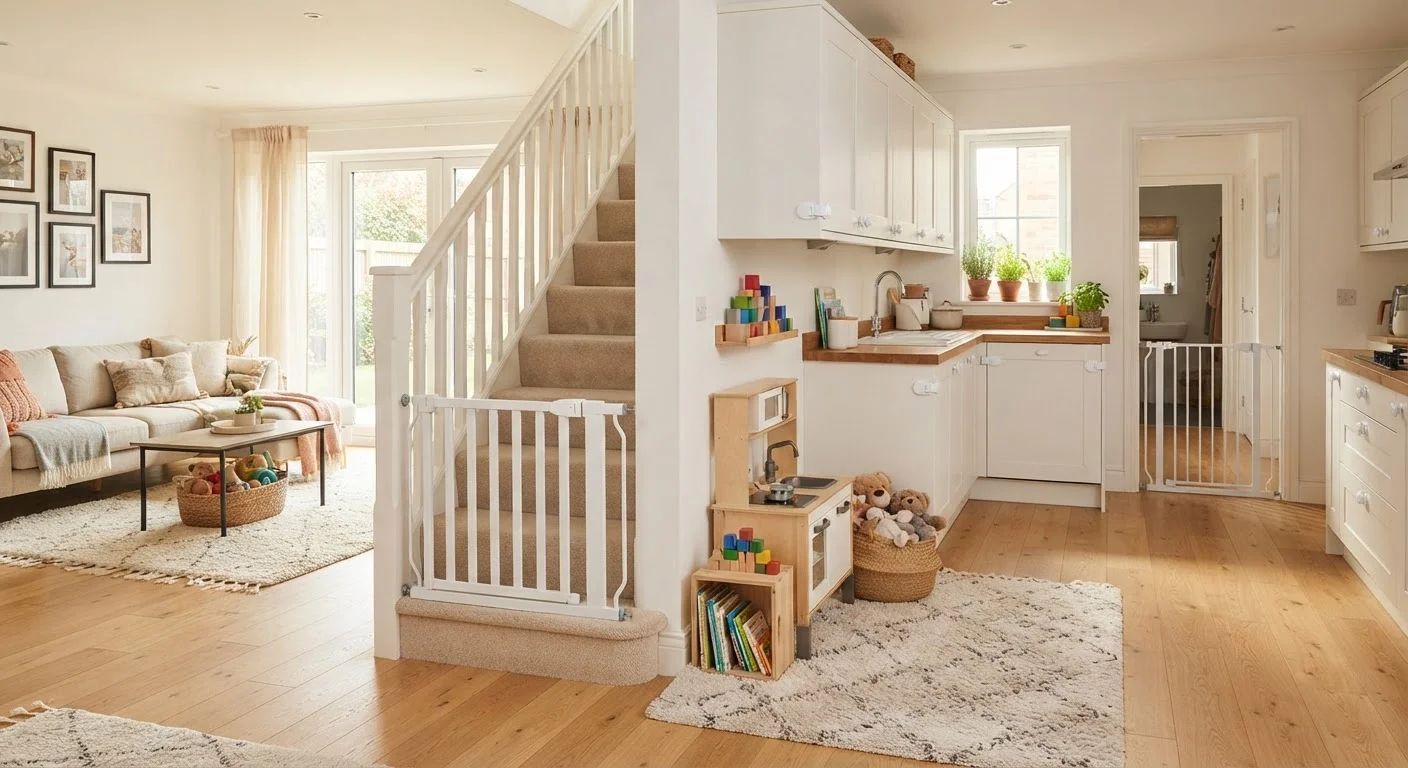
- Stair gates: Use hardware-mounted (not pressure-mounted) gates at both the top and bottom of all staircases. Pressure-mounted gates can be pushed out by a determined toddler and should never be used at the top of stairs.
- Poisoning prevention: The CDC reports that approximately 300 children under age five are treated in emergency departments daily for medication-related poisonings. Keep all medications, cleaning products, and supplements in locked, high cabinets - not just out of sight. Child-resistant packaging is not child-proof.
- Water safety: Drowning can occur in as little as one inch of water. Empty buckets and tubs immediately after use; use toilet seat locks; ensure that any backyard pool has a four-sided fence with a self-latching gate.
- Furniture tip-over prevention: Anchor all tall furniture - bookshelves, dressers, TVs - to wall studs. Tip-over incidents involving furniture and televisions send thousands of young children to emergency rooms each year.
Toddler behavior can be genuinely baffling as well as hazardous. Our piece on common mistakes parents make when responding to tantrums touches on how developmental stage shapes behavior - context that can help families stay patient while maintaining consistent safety boundaries.
School-Age Safety (4-10 Years): Education Alongside Barriers
By age four or five, many children can understand simple explanations of cause and effect. This cognitive leap means that safety education becomes a genuinely useful tool - but it does not eliminate the need for physical safeguards. School-age children can bypass latches and gates, reach higher surfaces, and use matches or kitchen appliances out of curiosity.
- Fire safety: Practice a home fire escape plan with children at least twice a year. Children old enough to understand should know two exit routes from every room and a designated outdoor meeting spot. Our guide to fire escape planning with young children or pets covers how to adapt standard advice for your specific household.
- Kitchen and tool hazards: Children in this age group may begin cooking or helping with household tasks. Supervise closely near stovetops and ovens; store sharp tools in locked or high drawers; keep knives out of reach even during meal prep.
- Online and indoor environment safety: Research increasingly links indoor air quality to children's respiratory health. Our article on indoor air quality and children's health summarizes what the science says about common household pollutants.
- Teaching hazard recognition: Rather than simply forbidding access to certain areas, help children identify why something is dangerous. Teaching home safety without causing fear offers age-appropriate approaches that build competence rather than anxiety.
A family emergency plan that includes school-age children as active participants - not just passengers - also builds genuine resilience. Children who understand what to do in an emergency are more likely to respond calmly and effectively.
This article is for general informational purposes only and is not a substitute for professional safety assessment, medical advice, or emergency guidance. Always consult qualified professionals and local safety authorities for decisions specific to your home and family.
The content on this site is for informational purposes only and is not a substitute for professional advice. Always consult a qualified professional for guidance specific to your situation.