

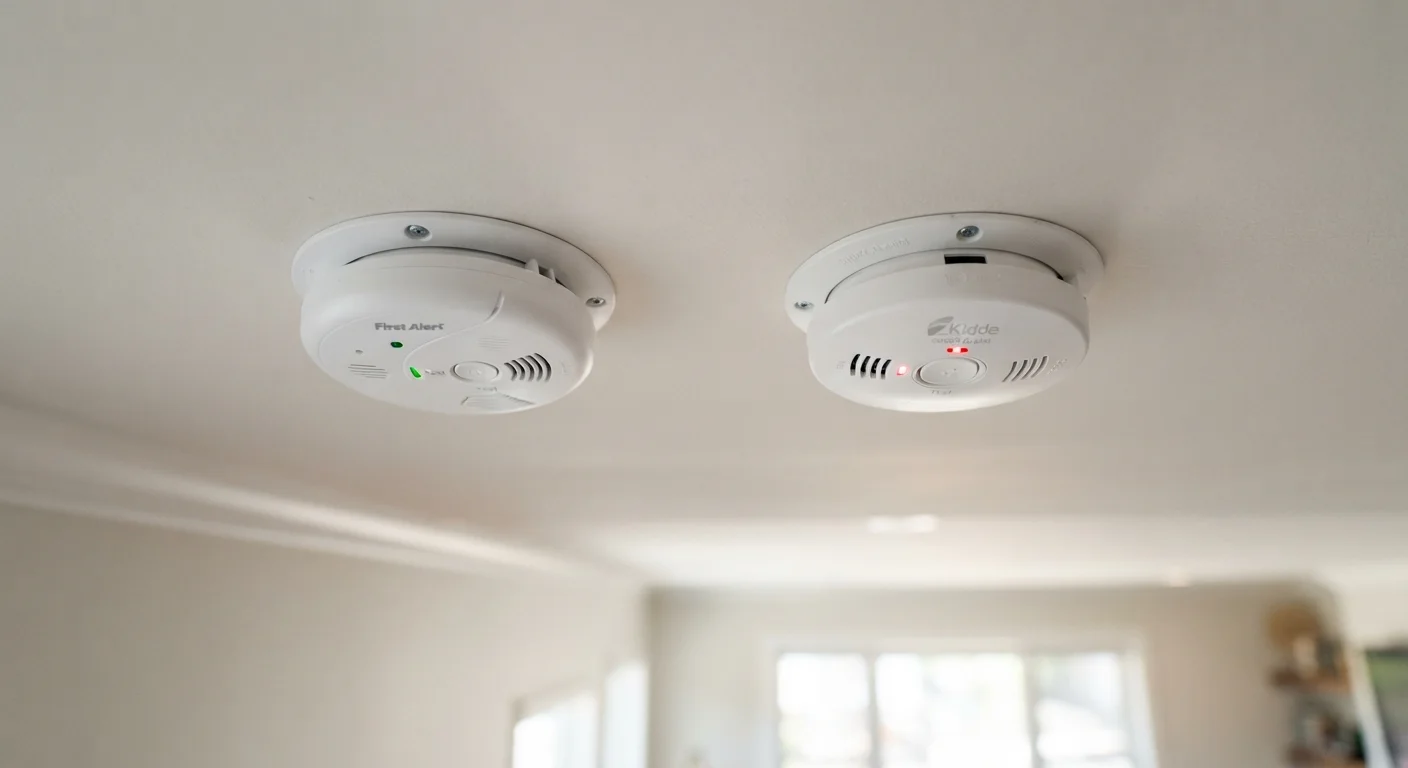
Option A
Ionization Smoke Detectors
The fast-responding alarm for fast, flaming fires.
Best for: Best for detecting rapidly developing, open-flame fires - common in living rooms, kitchens, and areas with paper or fabric.
Option B
Photoelectric Smoke Alarms
The early-warning alarm for slow, smoldering fires.
Best for: Best for detecting slow-burning, smoky fires that often start in bedrooms, walls, or furniture and smolder for hours before flaming.
How Each Technology Actually Works
Most people assume a smoke alarm is a smoke alarm - but the detector inside your ceiling could work in one of two fundamentally different ways, and that distinction has real safety implications for your household.
Ionization detectors contain a tiny, harmless amount of radioactive material (americium-241) that ionizes the air between two electrically charged plates, creating a small, continuous current. When smoke particles enter the chamber, they interrupt that current and trigger the alarm. This makes ionization detectors highly sensitive to the small combustion particles produced by fast, open flames.
Photoelectric alarms use a light source (typically an LED) aimed away from a sensor inside a detection chamber. When smoke drifts into the chamber, it scatters the light beam toward the sensor, triggering the alarm. This design is particularly effective at detecting the larger smoke particles produced by smoldering, low-oxygen fires - the kind that can burn for hours before producing visible flames.
Neither approach is universally superior. Each is optimized for a different type of fire, which is why fire safety professionals widely recommend combining both technologies in a home. For a broader look at how interconnected home safety systems work together, see our guide on testing smoke alarms, CO detectors, and GFCI outlets.
| Criterion | Ionization Detectors | Photoelectric Alarms |
|---|---|---|
| Detection method | Disrupted electrical current | Scattered light beam |
| Best fire type | Fast, flaming fires | Slow, smoldering fires |
| Nuisance alarm risk | Higher near kitchens | Lower near kitchens |
| Common placement | Living rooms, garages | Bedrooms, hallways |
| Smoldering fire response | Slower (minutes to hours) | Faster (significantly earlier) |
| Flaming fire response | Faster (30-90 sec advantage) | Slower response |
| Technology availability | Widely available | Widely available |
Where Each Alarm Type Performs Best - and Falls Short
Understanding each alarm's strengths helps you make smarter placement decisions throughout your home.
Ionization alarms can respond up to 30-90 seconds faster than photoelectric alarms in fast-flaming fire scenarios, according to research cited by the National Fire Protection Association (NFPA). However, they are also more prone to nuisance alarms from cooking steam or toast, which can lead some households to disable them - a serious safety risk.
Photoelectric alarms may be significantly faster - in some studies, by more than 15 minutes - at detecting smoldering fires, the type that most commonly injures and kills people in their sleep. Because they are less reactive to cooking, they tend to generate fewer false alarms near kitchens.
~3 of 5
Home fire deaths involving no working alarm
The NFPA reports that roughly three of every five home fire deaths occur in properties with no smoke alarms or non-functioning alarms.
10 years
Typical smoke alarm replacement interval
Most manufacturers and fire safety organizations recommend replacing smoke alarms every 10 years, regardless of apparent function.
~15 min
Photoelectric head-start on smoldering fires
Studies referenced by the NFPA have found photoelectric alarms can activate substantially earlier than ionization alarms in smoldering-fire scenarios.
Families with infants, toddlers, or elderly members face heightened risk from smoldering fires because evacuation takes longer. Our article on home safety for families with young children covers how to think about safety systems as your household's needs evolve.
It's also worth noting that smoke alarms and carbon monoxide detectors are distinct devices. Carbon monoxide - an odorless, colorless gas - requires its own dedicated detector. Learn more in our overview of carbon monoxide risks at home.
Combination Alarms: One Device, Two Technologies
Dual-sensor smoke alarms incorporate both ionization and photoelectric sensors in a single unit. They are widely recognized by fire safety organizations as an effective way to cover both smoldering and fast-flaming fire scenarios without installing two separate devices. Look for alarms that clearly indicate both sensor types are included, and verify they meet UL 217 certification standards, which set minimum performance requirements for residential smoke alarms in the United States.
Building a Smarter Smoke Alarm Strategy for Your Home
The NFPA recommends installing smoke alarms on every level of the home, inside each bedroom, and outside every sleeping area. Placement matters as much as alarm type.
- Bedrooms and hallways: Prioritize photoelectric detection here, where smoldering fires are the greater risk.
- Living rooms and garages: Ionization or dual-sensor alarms add coverage for fast-flaming fire scenarios.
- Kitchen-adjacent areas: Photoelectric alarms tend to generate fewer cooking-related false alarms; mount at least 10 feet from cooking appliances where possible.
- Dual-sensor (combination) alarms: These incorporate both technologies in one device and offer the most balanced coverage for households that want simplified installation.
Regardless of type, all alarms must be tested monthly by pressing the test button, and replaced according to the manufacturer's instructions - typically every 10 years. A detector that isn't maintained is not a safety device. See our smoke alarm testing guide for step-by-step maintenance tips.
This article provides general home safety information and is not a substitute for guidance from a licensed fire safety professional or your local fire marshal's office. Always consult local building codes and official fire safety guidelines when installing or upgrading smoke detection in your home.
The content on this site is for informational purposes only and is not a substitute for professional advice. Always consult a qualified professional for guidance specific to your situation.