

Start here
Why Furniture Tip-Overs Are a Serious Hazard
Next
Which Furniture Poses the Greatest Risk
Core concept
Understanding How Anchoring Works
Apply it
Assessing Your Home: Where to Start
Go further
Beyond Anchoring: Complementary Safety Habits
Why Furniture Tip-Overs Are a Serious Hazard
Most parents think about outlet covers and stair gates when childproofing begins - and both matter. But furniture tip-overs represent one of the most underestimated hazards in the American home. The U.S. Consumer Product Safety Commission has documented that furniture, televisions, and appliances tip over frequently enough to cause tens of thousands of emergency room visits each year, with young children bearing the greatest burden of harm.
What makes tip-overs especially dangerous is how fast they happen. A child climbing a dresser drawer, grabbing a shelf edge for balance, or simply pulling on an unsecured television stand can trigger a collapse in under a second - faster than a nearby adult can react. The weight of a standard dresser or bookcase can be catastrophic for a small child.
Understanding this risk is the first step. For a broader look at hazards families frequently miss, see our room-by-room childproofing guide.
Tip-over
When a piece of furniture falls forward or sideways - usually triggered by weight shifting toward the front - often caused by a child climbing or pulling on it.
Wall stud
A vertical wooden or metal framing member hidden behind drywall that provides a strong anchor point for screws or fasteners.
Anti-tip strap
A short, sturdy strap that connects the back of a piece of furniture to a wall stud, preventing the furniture from tipping forward under load.
Center of gravity
The point at which an object's weight is balanced. Tall furniture with heavy items near the top has a high center of gravity, making it easier to topple.
Stud finder
A handheld tool that detects the wooden framing studs behind drywall, helping you locate safe, load-bearing spots to drive screws.
Which Furniture Poses the Greatest Risk
Not all furniture carries equal danger. Risk generally increases with height, top-heaviness, and how likely a child is to interact with it. The categories that consistently appear in safety data include:
- Dressers and chests of drawers: Children treat open drawers like ladder rungs. Once two or three are open simultaneously, the center of gravity shifts forward dramatically.
- Bookshelves and storage units: Tall, narrow shelving units are inherently less stable, especially when loaded unevenly or left freestanding.
- Televisions on stands: Older tube-style TVs are heavier, but even flatscreen televisions can pull a media console forward when a child grabs the screen.
- Wardrobes and armoires: Large freestanding wardrobes are among the heaviest movable pieces in most bedrooms.
Furniture with a narrow base relative to its height is particularly prone to tipping - a physics concept called a high center of gravity. If the item would visibly wobble when you push gently at shoulder height, that is a warning sign worth acting on.
Never Rely on Furniture Weight Alone
Heavy furniture is not inherently safe furniture. A large, heavy dresser can still tip - and when it does, its mass makes the impact far more serious. Weight alone does not prevent tip-overs; only a proper wall anchor does. Do not skip anchoring for a piece simply because it feels solid when standing still.
Understanding How Anchoring Works
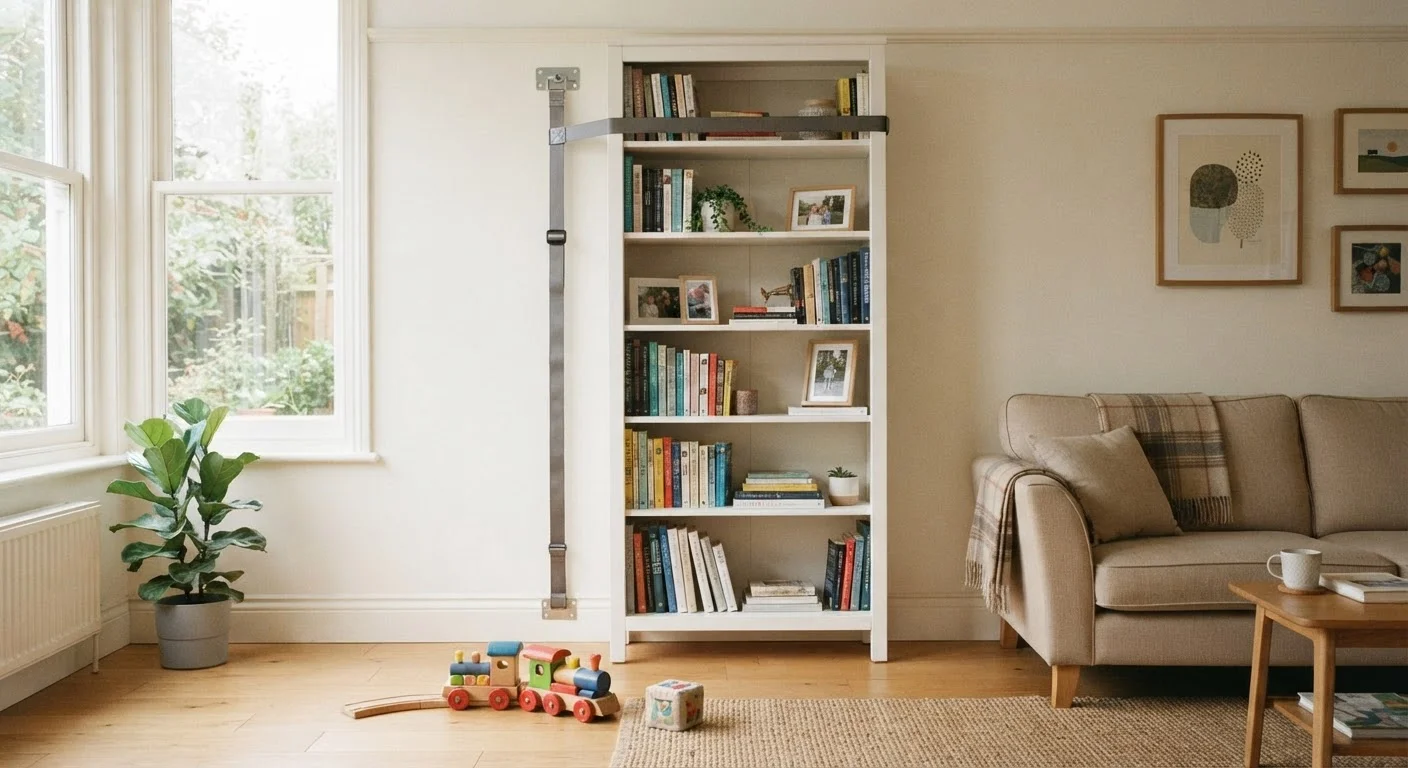
Furniture anchoring is the practice of physically connecting a piece of furniture to a structural element of your wall - most reliably, a wall stud - using straps, brackets, or L-bolts. The goal is to prevent the furniture from rotating forward and away from the wall when weight shifts toward its front.
The most common consumer solution is an anti-tip strap: a short length of metal-reinforced or heavy nylon webbing that attaches with a screw to the back of the furniture and a corresponding screw driven into a wall stud. When tension is applied - because the furniture starts to tip - the strap catches the load and holds.
Effectiveness depends on installation quality. Key principles include:
- Find the studs: Screws driven only into drywall will pull free under load. An inexpensive stud finder helps locate the wooden framing behind the wall surface.
- Use appropriate hardware: The screw gauge and strap material both matter. Follow the manufacturer's guidance, and do not substitute lighter hardware.
- Position the strap high: Attaching the strap near the top of the furniture provides more mechanical advantage against a forward tip than a mid-height attachment.
Test Before You Trust Any Anchor
After installing an anti-tip strap, apply firm forward pressure to the top of the furniture to verify the strap engages and holds. If the furniture moves more than a few millimeters, the anchor may not be seated in a stud. Re-check your stud location and reinstall before considering the job complete.
Assessing Your Home: Where to Start
A structured walkthrough is more effective than trying to keep a mental checklist. Move through each room and apply a simple test: place both hands on the top front edge of tall furniture and apply gentle forward pressure. Any noticeable movement deserves attention.
Prioritize rooms where children spend the most time - bedrooms especially, since most tip-over incidents occur there. Pay close attention to furniture placed on carpet, which reduces friction and can make pieces easier to destabilize.
As you assess, note:
- Whether the item is within reach of a crib, bed, or low surface a child could climb from
- Whether drawers or doors extend outward in a way that could shift the center of balance
- Whether heavy objects - like a television - are stored at height
Families with children at different developmental stages face distinct challenges. Our article on safety priorities by age group explains how risk profiles shift as children grow.
Beyond Anchoring: Complementary Safety Habits
Anchoring straps do the heavy lifting, but habits reinforce them. A few consistent practices meaningfully reduce tip-over risk:
- Keep drawers closed: Remind children - and practice yourself - to close each drawer before opening the next.
- Store heavy items low: Books, electronics, and other dense objects placed on lower shelves lower the overall center of gravity.
- Remove climbable furniture nearby: A step stool or small chair next to a bookcase gives a curious child a launching point. Relocating it reduces opportunity.
- Reassess after moving: Anchoring straps are attached to specific walls. Any time furniture is moved - even just repositioned - reinstall anchors in the new location.
Teaching children about furniture safety in age-appropriate ways can also help. Our guide on talking to kids about home hazards offers calm, effective approaches that inform without frightening.
Homes with pets face related considerations too - pet-proofing your home covers how animals interact with household hazards in ways owners often don't anticipate.
Renters: Check Before You Drill
If you rent your home, review your lease before installing any wall anchors. Many landlords will grant written permission for safety-related modifications, and some anchor products are designed to minimize wall damage. Getting approval in writing protects you at move-out and ensures the modification is done openly.
This article is for general informational purposes only and does not constitute professional safety, engineering, or home inspection advice. When in doubt about structural wall materials or installation specifics, consult a qualified contractor or certified childproofing specialist.
Frequently Asked Questions
According to the U.S. Consumer Product Safety Commission, furniture, TV, and appliance tip-overs send tens of thousands of children to emergency rooms each year. The majority of fatalities involve children under six. These incidents happen quickly and often silently, making prevention essential.
Many anchoring kits are designed for DIY installation, but locating wall studs correctly and choosing appropriate hardware for your wall type does require care. If you are unsure about your wall construction - particularly with older homes or unusual materials - consulting a handyperson or contractor is a sensible precaution.
Properly installed straps leave small fastener holes, similar to hanging a picture frame. The minor cosmetic impact is far outweighed by the safety benefit. Anchor points should always be driven into wall studs rather than drywall alone to ensure they hold under real load.
While young children are most vulnerable, tip-overs can injure older children, adults, and pets. Earthquake-prone regions add additional motivation to anchor heavy furniture regardless of who lives in the home. It is a durable safety measure that benefits everyone.
Many landlords permit minor wall fastening for safety reasons, but it is wise to check your lease and ask permission first. Some anchor systems are designed to minimize wall damage. Document everything in writing so there is no dispute at move-out.
A wall-mounted TV is generally more secure than one resting on a stand, provided the mount is correctly installed into studs or with appropriate anchors. The TV stand or media console beneath it, however, may still need its own anchoring strap if it is tall enough to tip.
The content on this site is for informational purposes only and is not a substitute for professional advice. Always consult a qualified professional for guidance specific to your situation.