

Why Plumbing Maintenance Deserves a Place on Your Routine
Most homeowners think about plumbing only when something goes wrong — a burst pipe, a flooded bathroom, or a water heater that suddenly stops working on a cold morning. By then, the repair bill is already climbing. The reality is that plumbing systems send signals long before they fail, and a handful of non-invasive maintenance habits can intercept those problems at a fraction of the eventual cost.
This isn't about tackling complex repairs yourself. As explored in our guide on DIY maintenance versus hiring a pro, the smartest approach is knowing which tasks fall within a careful homeowner's reach and which require a licensed plumber. Every task below sits firmly in the first category — observational, preventive, and low-risk. Together, they form the kind of foundational maintenance knowledge that protects your home's value and your household budget.
Locate and test your main water shut-off valve
Every homeowner should be able to find and operate the main water shut-off valve before an emergency makes them search for it under pressure. This valve — typically located near where the water line enters the home, in a basement, utility room, or crawl space — stops water flow to the entire house when turned off.
Test it once a year by turning it fully clockwise until it stops, then counterclockwise to reopen. Valves that haven't been operated in years can seize or fail to seat properly. If yours is stiff, won't turn, or leaks around the stem after testing, that's a job for a licensed plumber before the next emergency, not during one.
Finding your shut-off valve before a leak happens is one of the highest-value minutes you'll spend as a homeowner.
Flush your water heater to clear sediment
Sediment — primarily minerals that precipitate out of hard water — accumulates at the bottom of tank-style water heaters over time. This layer forces the heating element to work harder, reduces capacity, creates rumbling or popping sounds during heating cycles, and can accelerate tank corrosion.
Flushing annually is straightforward: connect a garden hose to the drain valve near the base, run the hose to a floor drain or outside, briefly open the valve to flush sediment, then close and refill. Always consult your water heater's documentation and turn off the power or gas before draining. If the drain valve leaks after flushing — a common sign of age — call a plumber rather than leaving it dripping.
Annual flushing can meaningfully extend a water heater's service life and maintain energy efficiency.
Inspect supply lines and visible pipe connections for moisture
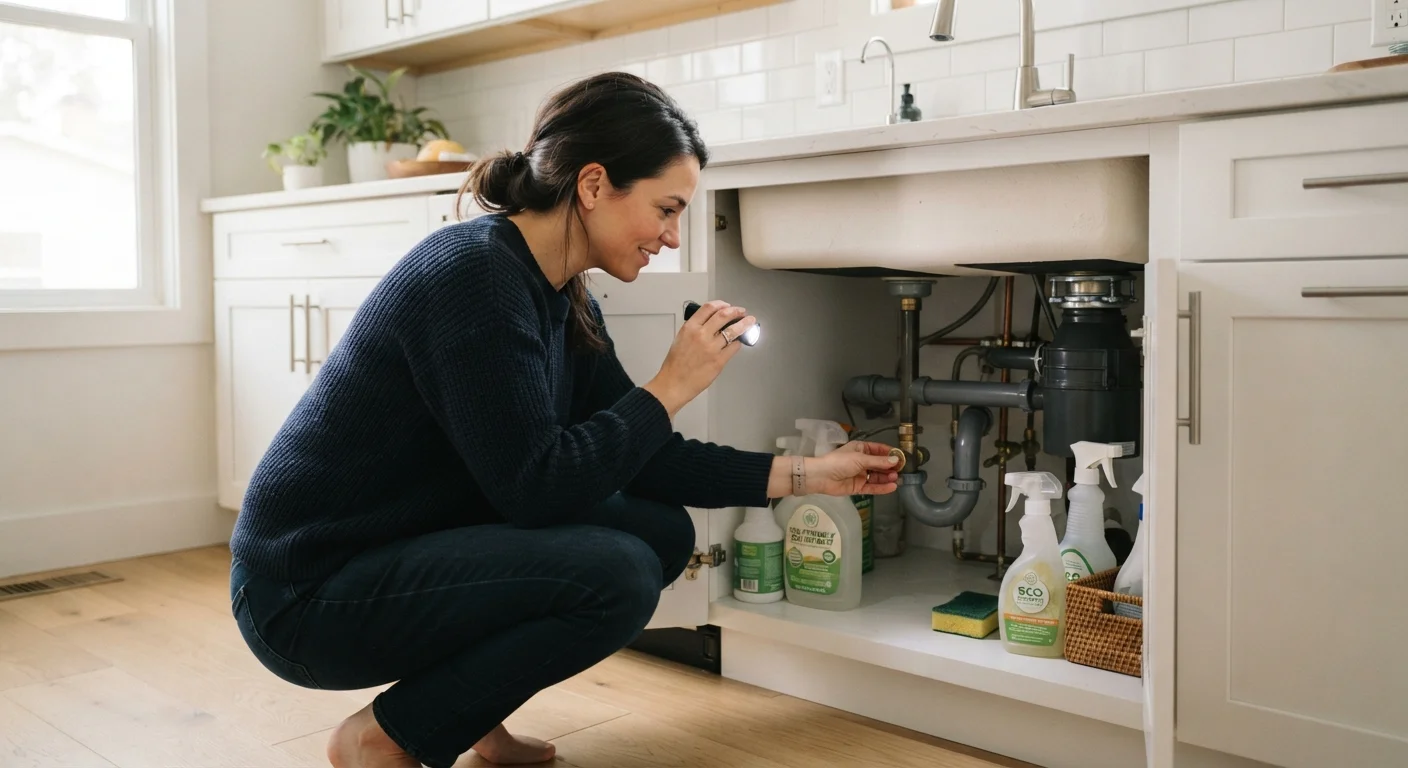
Supply lines connect shut-off valves to toilets, faucets, and appliances like dishwashers and washing machines. They are among the most common sources of slow, undetected leaks. Braided stainless steel lines are more durable than older rubber or plastic versions, but even quality lines should be inspected periodically.
Look for any discoloration, bulging, corrosion at fittings, or moisture on the exterior of the line. Run your hand along accessible pipes under sinks and behind appliances. A small drip that saturates a cabinet floor for months can cause significant mold and structural damage before it's noticed. Replacing a supply line is generally simple; discovering mold behind cabinetry is not.
A slow drip behind a cabinet can cause mold and structural damage long before you notice it.
Test toilet flappers and check for silent leaks
A toilet that runs intermittently — often called a phantom flush — is almost always a worn or warped flapper. The flapper is the rubber valve at the bottom of the tank that seals water until the flush handle is pressed. When it fails to seat properly, water trickles continuously from the tank into the bowl, triggering the fill valve to run again.
The dye test is the standard check: add a few drops of food coloring to the toilet tank and wait 15 minutes without flushing. If color appears in the bowl, the flapper is leaking. Flappers are inexpensive and widely available, and replacing one requires no special tools — though if the flush valve seat itself is damaged, a plumber should assess it. A running toilet can waste a substantial volume of water daily, making this a worthwhile check for your household budget as well.
The simple dye test reveals a leaking toilet flapper before it wastes thousands of gallons undetected.
Clear slow drains before they become blocked ones
A drain that's slow is telling you something. Hair, soap residue, and mineral buildup accumulate gradually and restrict flow before a complete blockage occurs. Addressing a slow drain early — typically with a drain snake or plunger — is far simpler than clearing a full obstruction, and it avoids the risk of chemical drain cleaners, which can damage older pipes and are a temporary fix at best.
Check bathroom sink and tub drains monthly for sluggish drainage. In the kitchen, avoid pouring fats or cooking oils down the drain regardless of water temperature — they solidify as they cool and narrow pipe diameter over time. Strainer inserts in shower and tub drains catch hair before it reaches the trap, a simple preventive step that costs very little.
Clearing a slow drain early costs nothing; clearing a full blockage can cost significantly more.
Check water pressure and install a pressure regulator if needed
Residential water pressure that's too high — generally above 80 psi (pounds per square inch) — stresses supply lines, appliance connections, and fixture washers, shortening their service life and increasing the risk of leaks. Pressure regulators (also called pressure-reducing valves, or PRVs) are installed where the main line enters the home and are designed to maintain a safe, consistent pressure range, typically 40–60 psi.
An inexpensive pressure gauge that threads onto any hose bib gives you an accurate reading in seconds. If your pressure reads consistently above 80 psi, or if you notice banging pipes (water hammer) when appliances cycle off, have a licensed plumber evaluate and adjust or replace the PRV. This is a professional installation, but knowing to check is the homeowner's role.
High water pressure is a silent stressor on every pipe and fitting in your home.
Keeping the Bigger Picture in View
Plumbing doesn't exist in isolation. Water that enters your home must also be managed outside it — poor grading, clogged gutters, and failing sump pumps can force water toward your foundation and ultimately stress your interior systems. Our companion piece on exterior water management covers that side of the equation.
Keep a Simple Plumbing Log
Record the date each time you perform a maintenance check, note anything unusual you observe, and log any repairs made. A brief written record helps you spot patterns — like a toilet that needs its flapper replaced every 18 months — and provides useful documentation if you ever sell the home or file an insurance claim. A basic notebook or a notes app works perfectly.
For a structured approach to timing all of these tasks, the annual home maintenance calendar organizes plumbing checks alongside every other seasonal task. And when you want to see your home the way a professional sees it, reading your home like a professional inspector explains what trained eyes look for in the very systems you're now learning to monitor.
This article is for general informational purposes only. Plumbing work involving gas lines, structural penetrations, or mains connections should be performed by a licensed professional. Always verify local permit and code requirements before undertaking any repair or modification.
The content on this site is for informational purposes only and is not a substitute for professional advice. Always consult a qualified professional for guidance specific to your situation.