

The Cuticle Is the Key
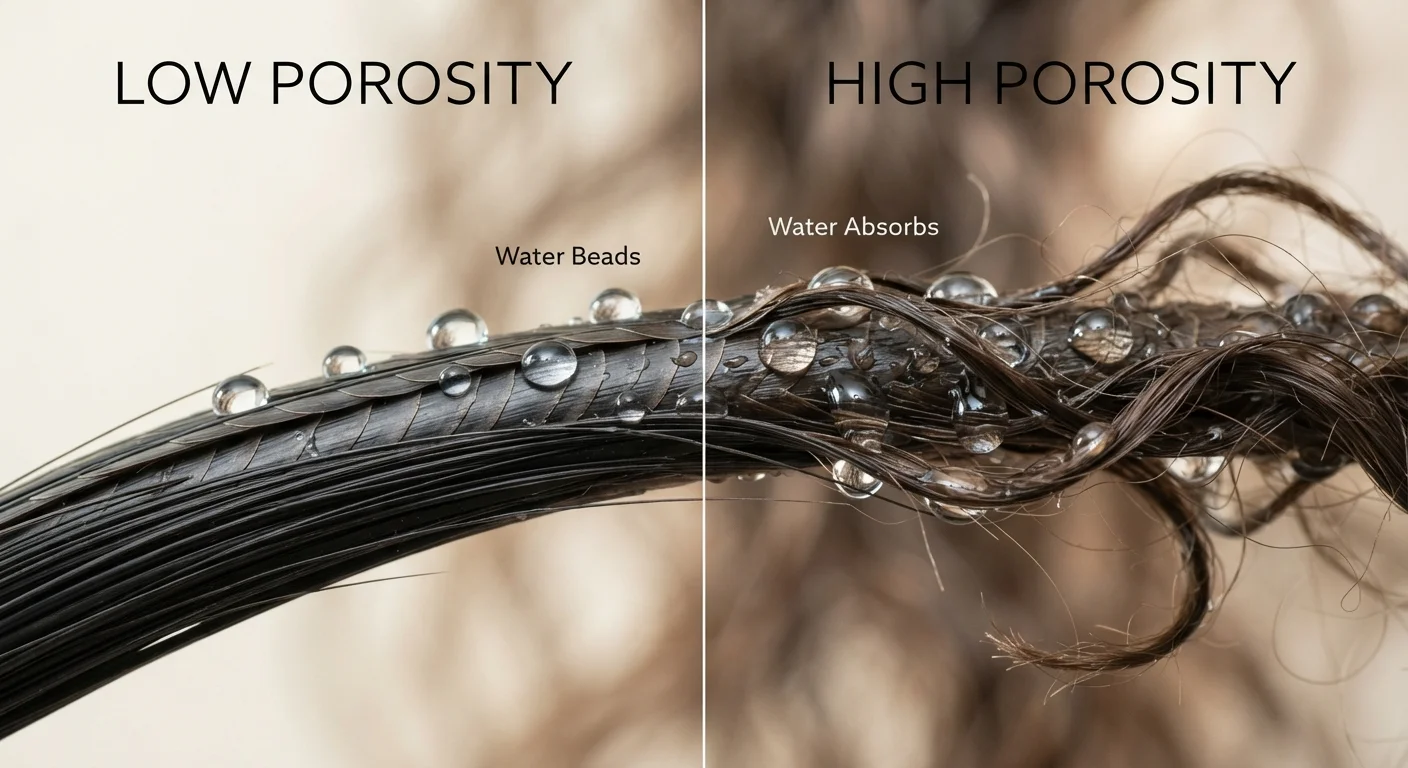
Every strand of hair is covered by a cuticle — a layer of overlapping, scale-like cells that protects the inner structure. How tightly those scales sit determines your porosity level. Think of it like roof shingles: flat, tight shingles keep the interior dry and stable, while loose or lifted ones let rain in and out unpredictably.
There are three general porosity categories most hair professionals work with:
- Low porosity: Cuticles lie very flat and tightly packed. Moisture struggles to penetrate, but once it's in, it stays. Products tend to sit on the surface rather than absorbing.
- Medium (normal) porosity: Cuticles allow moisture in and out at a balanced rate. This type generally responds well to a wide range of products and techniques.
- High porosity: Cuticles are raised, gapped, or uneven — often from chemical processing or heat damage. Moisture absorbs quickly but escapes just as fast, leaving hair prone to frizz and dryness.
Understanding where your hair falls on this spectrum is the foundation for choosing products and methods that actually make a difference. For a broader look at how porosity fits alongside curl pattern and strand thickness, see Hair Types Demystified.
~95%
Of hair damage affecting cuticle integrity
Research in hair science consistently identifies mechanical, thermal, and chemical damage as the primary causes of compromised cuticle structure and elevated porosity.
3 layers
Structural layers in each hair strand
Hair is composed of the cuticle (outer), cortex (middle), and medulla (inner core) — porosity specifically relates to the condition of the outermost cuticle layer.
How to Test Your Porosity at Home
You don't need a lab or a stylist to get a read on your porosity. Two simple observational methods can give you a reliable starting point.
The Float Test
Take a clean strand of hair — free of product — and drop it into a glass of room-temperature water. Watch it for two to four minutes. Hair that floats near the surface indicates low porosity; hair that sinks to the bottom quickly points to high porosity; hair that hovers in the middle suggests medium porosity.
The Spray Bottle Test
Spritz a small section of dry hair with water and watch what happens. If the water beads up and sits on the surface, your cuticles are tightly closed (low porosity). If the water is absorbed almost instantly, your cuticles are open (high porosity).
Get a Cleaner Read on the Float Test
For the most accurate result, use a strand collected after your last wash once your hair is fully dry and free of styling products. Residue from oils or creams can affect how the strand behaves in water and skew your reading.
Neither test is perfectly scientific, but used together they give you a practical working baseline. If you're rebuilding your entire routine from scratch, Building a Hair Care Routine From the Ground Up walks through how to layer these insights into a full care plan.
Adjusting Your Routine to Match Your Porosity
Once you know your porosity level, the product and technique choices that support it become much clearer.
Low Porosity Hair
The goal is getting moisture in. Applying products to damp hair (not soaking wet) and using gentle heat — like a warm towel or hooded dryer — helps open the cuticle enough to accept hydration. Lightweight, liquid-based conditioners and humectants like glycerin work well because they don't sit heavy. Avoid layering too many thick products, which can cause buildup fast.
High Porosity Hair
The goal is sealing moisture in after it's absorbed. Layering products in a leave-in, then cream, then oil sequence helps lock hydration in place. Heavier butters and oils — like shea or castor oil — act as sealants over the open cuticle. Rinsing with cool water at the end of a shower can also help temporarily close the cuticle and reduce frizz.
Medium Porosity Hair
This type has the most flexibility. A consistent routine with regular conditioning and occasional deep conditioning treatments generally keeps it balanced. The main watchpoint is preventing unnecessary damage that could shift your hair toward high porosity over time — something covered in depth in Heat Styling and Hair Damage.
“Porosity is probably the single most useful thing someone can understand about their hair. It explains why a product that works beautifully for a friend can feel completely wrong on your own strands.”
— Miko Branch, Co-founder of a natural hair care company and recognized hair care educator
When scanning ingredient lists for porosity-friendly options, Reading a Hair Product Ingredient List can help you decode what's actually in the bottle.
Porosity Can Vary Across Your Head
It's completely normal to have different porosity levels at your roots versus your ends — especially if you've had chemical treatments or significant heat styling. The ends are oldest and most exposed, so they're often higher porosity than new growth closer to the scalp. Testing a few strands from different sections gives you a more complete picture.
Frequently Asked Questions
Drop a clean, product-free strand into a glass of water and watch it for two to four minutes. If it floats, porosity is likely low; if it sinks quickly, it's likely high. You can also observe how long your hair takes to get fully wet in the shower — slow saturation points to low porosity, while hair that soaks through almost instantly suggests high porosity.
You can't permanently alter your hair's genetic porosity, but you can influence how open or closed the cuticle behaves. Reducing heat styling, limiting chemical treatments, and using pH-balanced products can help keep raised cuticles calmer over time. Once damage is done, the goal becomes managing it rather than reversing it.
Indirectly, yes. High-porosity hair tends to lose moisture faster, so it may benefit from more frequent light conditioning. Low-porosity hair is prone to product buildup, which can make less-frequent washing with a clarifying step more effective. Wash frequency also depends on scalp type, lifestyle, and hair texture.
Protein treatments are often recommended for high-porosity hair because they can temporarily fill gaps in the cuticle, improving strength and moisture retention. However, not every hair type responds well to heavy protein, so it's worth starting with a lighter formula and observing how your hair feels afterward. If your hair feels stiff or brittle, reduce frequency.
Not always. Some people have naturally high-porosity hair due to genetics, not damage. That said, chemical processing, heat styling, and sun exposure all raise porosity over time. The care strategies for both naturally high porosity and damage-induced high porosity are similar, so the distinction matters less for your routine than knowing how to respond to the behavior.
The content on this site is for informational purposes only and is not a substitute for professional advice. Always consult a qualified professional for guidance specific to your situation.