

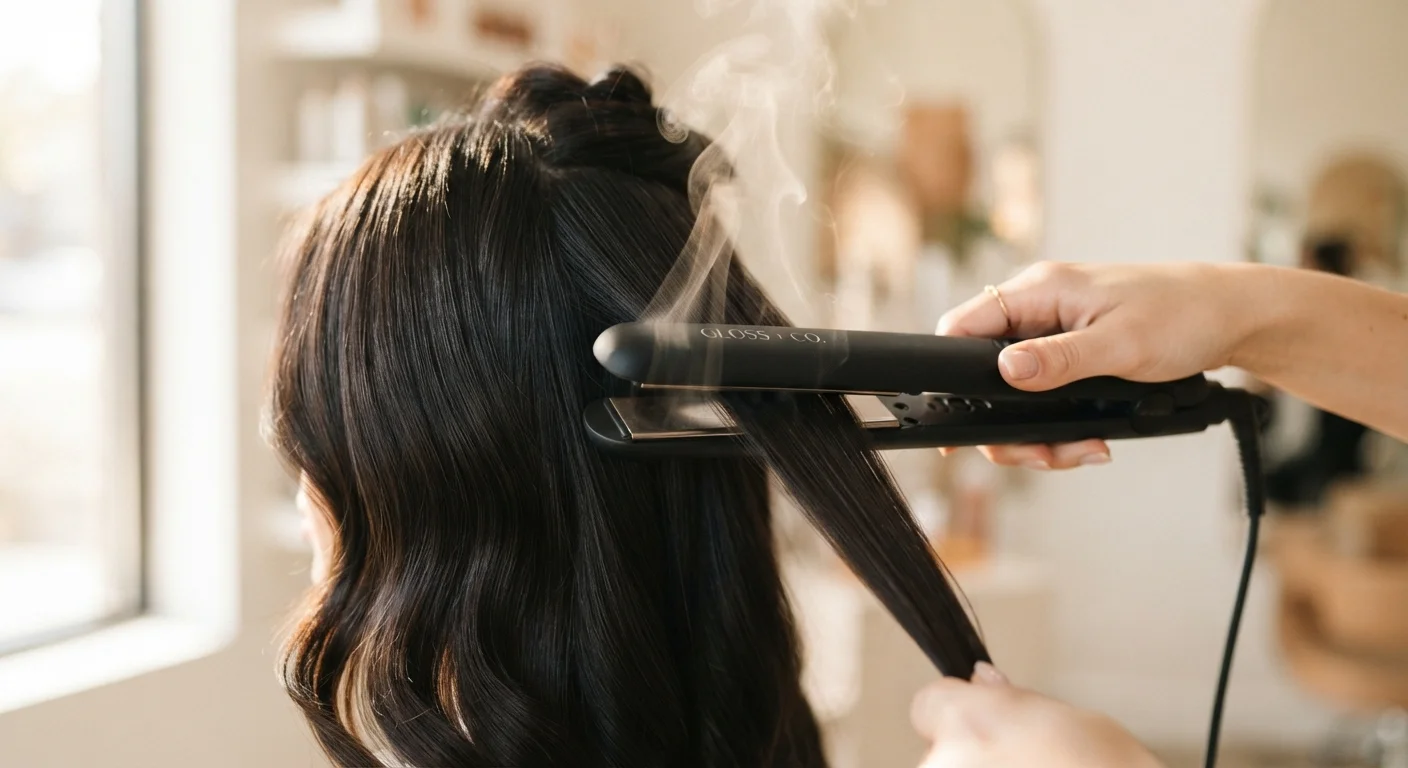
What Heat Actually Does Inside a Hair Strand
Hair looks simple from the outside, but each strand is a layered structure. The outermost layer — the cuticle — is made of overlapping, scale-like cells that protect the inner cortex, where the real strength and elasticity of your hair lives. The cortex is packed with keratin proteins held together by chemical bonds, including hydrogen bonds and stronger disulfide bonds.
When you apply a hot tool, heat travels from the surface inward. At moderate temperatures, hydrogen bonds — which are responsible for your hair's temporary shape — break and reform, which is actually how heat styling works. That's the desired effect. The problem starts at higher temperatures and with longer exposure times, when the more durable disulfide bonds also begin to break down. This is structural damage. The cuticle also lifts and can crack under intense heat, leaving the cortex exposed to further moisture loss and physical wear.
The result? Hair that feels rough, loses its natural pattern, snaps more easily, and develops split ends faster. See our guide to why hair ends keep breaking off for a closer look at how this plays out at the tips.
~300°F
Temperature at which disulfide bonds begin to degrade
Research in hair fiber science indicates significant keratin protein disruption begins around 300°F (149°C), with risk increasing sharply above that threshold.
450°F
Maximum heat setting on many consumer flat irons
Many widely available styling tools reach temperatures well above levels considered safe for everyday use, making manual temperature selection an important habit.
Up to 70%
Reduction in tensile strength after repeated heat exposure
Studies on thermally stressed hair fibers have shown substantial decreases in strand strength with consistent high-heat treatment over time.
How to Recognize Heat Damage vs. Ordinary Dryness
Dryness and heat damage can feel similar, but they respond very differently to care. Dry hair usually improves noticeably after deep conditioning — it regains some softness and bounce. Heat-damaged hair may feel temporarily better after a mask, but it won't spring back. Telltale signs of structural heat damage include:
- Loss of curl or wave pattern — sections that no longer coil or wave the way they used to, even after washing
- Extreme porosity — hair that soaks up water instantly but dries out just as fast
- Chronic breakage mid-shaft, not just at the ends
- A limp, gummy texture when wet, which signals compromised protein structure
- Rough, dull surface that doesn't reflect light smoothly
Understanding your hair's porosity level can help you identify whether heat has altered your cuticle structure — high-porosity hair absorbs moisture quickly and loses it just as fast, which is often a heat damage calling card.
Which Hair Types Face the Highest Risk
Not all hair responds to heat the same way, and that's worth understanding before you reach for a tool. Hair texture, curl pattern, and strand density all factor into heat vulnerability.
Fine hair has less keratin mass per strand, so there's simply less structure to absorb the thermal blow — damage accumulates faster. Chemically treated hair (color, bleach, relaxers, perms) already has altered protein bonds, making it more susceptible to heat stress at lower temperatures. Coily and tightly curled textures face a specific risk: repeated high-heat straightening can cause a permanent loss of curl pattern, sometimes called heat-trained or heat-damaged curl texture, which is difficult to reverse without significant new growth.
Thicker, coarser strands generally tolerate heat better, but that's not a license to skip protection — cumulative damage adds up regardless of hair type.
Test Before You Style
Before committing to a new heat setting, test a small section of hair at the back of your head. If it achieves your desired look at 300°F, there's no reason to push to 400°F. Training yourself to start low and adjust upward only when needed is one of the simplest protective habits you can build.
Practical Habits That Reduce Heat Damage
You don't have to give up your flat iron or blow dryer to protect your hair. The goal is minimizing thermal stress, not eliminating heat entirely.
- Always use a heat protectant. Apply it to hair before any direct heat exposure. Products containing film-forming polymers slow heat transfer into the cortex.
- Start low, go slow. Use the lowest temperature that achieves your desired result. One well-placed pass at 350°F does less damage than three passes at 450°F.
- Never style soaking-wet hair with a flat iron. Water trapped inside the strand superheats and essentially boils within the cortex, causing bubble-shaped damage called hygral tension fractures.
- Limit frequency. Daily heat styling compounds risk significantly. Building in heat-free days — or exploring protective styling options — gives hair recovery time.
- Keep tools clean. Product buildup on plates transfers unevenly and requires more passes to achieve the same smoothness.
“The hair fiber is not living tissue — it cannot repair itself. Every styling decision either preserves what you have or accelerates its degradation. Lower heat, applied less often, is always the more sustainable choice.”
— Trichology Research Consensus, Summary of hair fiber science findings widely cited in cosmetology education
This article is for general informational purposes only and is not professional hair care advice. For personalized guidance on your hair health or scalp concerns, consult a licensed cosmetologist or dermatologist.
Frequently Asked Questions
Most hair professionals suggest keeping flat irons and curling tools below 350°F (177°C) for normal hair, and below 300°F (149°C) for fine, color-treated, or already-damaged hair. Thicker, coarser strands may tolerate slightly higher heat, but even resilient hair benefits from the lowest effective temperature rather than the maximum setting.
Structural heat damage — broken protein bonds and degraded cuticle — cannot be reversed. Deep conditioning treatments and protein masks can temporarily improve the look and feel of damaged hair, but true restoration only comes from growing out and trimming away the affected sections.
Blow dryers can cause significant damage, especially when held too close to the scalp or used on soaking-wet hair without a heat protectant. However, because air flow distributes heat less intensely than a metal plate, the risk is generally lower than direct-contact tools used at equivalent temperatures.
Heat protectants typically contain film-forming polymers and conditioning agents that coat the hair shaft, slowing the transfer of heat into the cortex and reducing moisture evaporation. They don't make heat styling risk-free, but they meaningfully reduce the intensity of thermal stress on the strand.
Air drying avoids heat exposure, but prolonged wetness can cause a phenomenon called hygral fatigue — repeated swelling and shrinking of the hair shaft that weakens the fiber over time. A brief, low-heat blow dry on a mid or cool setting can sometimes be gentler than leaving hair wet for hours.
Yes, significantly. Fine strands have less keratin mass to absorb heat and damage faster. Chemically treated or high-porosity hair has a compromised cuticle that offers less natural protection. Coily and curly textures are more prone to losing their natural pattern permanently after repeated heat exposure.
The content on this site is for informational purposes only and is not a substitute for professional advice. Always consult a qualified professional for guidance specific to your situation.