

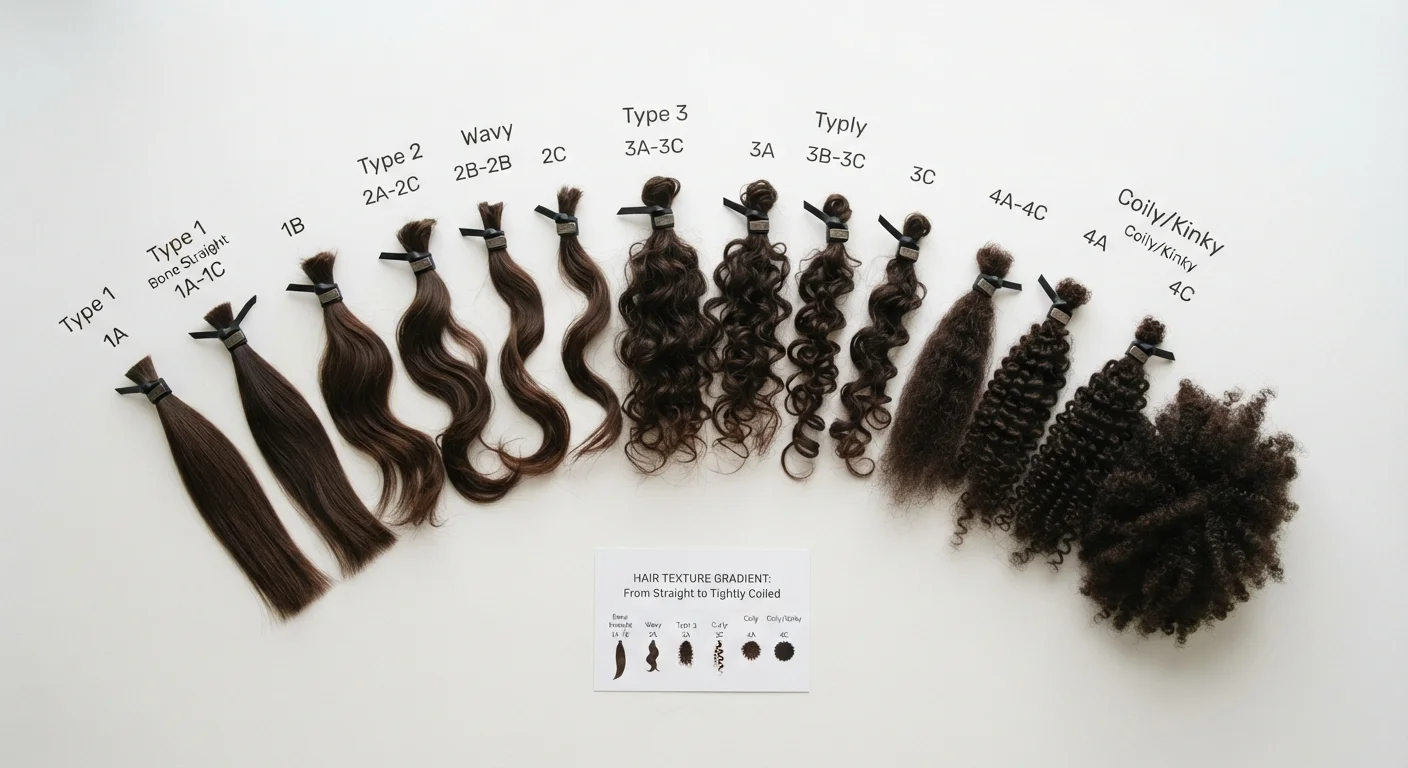
The Three Dimensions of Hair Type
When stylists and trichologists talk about hair type, they're really describing three distinct characteristics: curl pattern, texture (strand thickness), and density (how many strands you have). Each one influences how your hair behaves, how quickly it dries, and which care approaches tend to work best.
The good news: you don't need a professional consultation to identify yours. A few simple observations — done on clean, dry, product-free hair — tell you almost everything you need to know.
| Number of hair type categories | 4 main types (1–4), each with A, B, C subtypes |
| Average number of scalp hairs | Roughly 80,000–120,000 strands (American Academy of Dermatology) |
| Texture categories | Fine, Medium, Coarse |
| Density categories | Low, Medium, High |
| Best assessment condition | Clean, dry, product-free hair |
Curl Pattern: The Numbering System Explained
The most widely used curl classification system divides hair into four broad types (1–4), each with subtypes A, B, and C that reflect tighter or looser variations within that pattern.
- Type 1 (Straight): Hair lies flat with no natural bend. The cuticle lies close, which allows natural oils to travel easily from scalp to ends — great for shine, but can feel greasy faster.
- Type 2 (Wavy): Ranges from a loose S-bend (2A) to a more defined, frizz-prone wave (2C). Responds well to lightweight moisture without heavy creams that weigh waves flat.
- Type 3 (Curly): Forms springy loops — from loose, bouncy ringlets (3A) to tight corkscrews (3C). More prone to dryness because the curl shape slows oil distribution down the strand.
- Type 4 (Coily/Kinky): Ranges from a soft S-coil (4A) to a tight Z-pattern with almost no visible curl when stretched (4C). Highly susceptible to dryness and mechanical breakage, and benefits significantly from regular deep conditioning and protective approaches.
No system is perfect. Many people have two or three different patterns on one head — that's completely normal and worth factoring into how you section and style. For a deeper look at how styling choices interact with hair structure, see our guide on protective styling principles.
Curl pattern
The natural shape your hair forms when it's clean and dry — ranging from straight to tightly coiled. It's determined largely by the shape of your hair follicle.
Hair texture
The diameter of an individual hair strand, classified as fine, medium, or coarse. Texture affects how hair responds to heat, chemicals, and moisture.
Hair density
The total number of hair strands on your scalp. High density means more strands; low density means fewer — and it's independent of how thick each strand is.
Trichologist
A specialist who focuses on the science of the hair and scalp. They can assess hair and scalp health but are not medical doctors.
Cuticle
The outermost layer of a hair strand, made up of overlapping scales. When cuticles lie flat, hair looks shiny; when raised, it appears frizzy and may lose moisture more easily.
Texture and Density: The Two Often-Ignored Variables
Texture refers to the diameter of a single strand: fine, medium, or coarse. Fine strands have a smaller circumference and can be more vulnerable to heat and chemical damage; coarse strands are wider and generally more resistant but may need more moisture to feel soft. Medium falls in between and is the most common.
A quick test: pull out a single shed strand and hold it against a piece of white paper. If it's barely visible, you likely have fine hair. If it looks thick and rope-like, it's coarse.
Density is separate — it's the total number of strands on your scalp, not how thick each one is. High-density hair looks full even when individual strands are fine; low-density hair can appear thin even when each strand is coarse. To gauge yours, look at your scalp in the mirror while your hair is down. If your scalp is clearly visible without parting, density is likely low to medium.
~100,000
Average strands on a human scalp
According to the American Academy of Dermatology, the average person has between 80,000 and 120,000 hair strands — a wide range that illustrates natural density variation.
50–100
Strands shed per day (normal range)
The American Academy of Dermatology notes that shedding up to 100 strands daily is considered within a normal range for most adults.
Why does this matter? Texture and density together shape how products behave. Fine, high-density hair often gets weighed down by heavy butters and oils. Coarse, low-density hair may absorb those same products beautifully. Understanding your combination helps you stop troubleshooting the wrong problem. For the next layer — how your hair absorbs and retains moisture — check out hair porosity explained.
Putting It All Together
Knowing your curl pattern, texture, and density isn't about labeling yourself — it's about having a reliable starting point. Once you understand your baseline, product choices and technique adjustments become logical rather than guesswork.
A few practical takeaways:
- Always assess hair in its natural state — freshly washed, no products, air-dried — for the most accurate read.
- If you color, chemically relax, or heat-style regularly, your current state may differ from your natural pattern. Both versions are worth knowing.
- Your hair characteristics can shift with age, hormonal changes, or health shifts. Re-assess periodically rather than assuming your hair is the same as it was a decade ago.
Ready to turn this knowledge into a routine? Building a hair care routine from scratch walks through the core steps with your hair type in mind. And if you want to audit what you're already doing, your weekly hair care audit is a practical next step.
Hair Typing Is a Starting Point, Not a Rule
Classification systems are tools, not rigid categories. Two people with 3B hair may find their routines look completely different based on density, porosity, and lifestyle. Use your hair type as a helpful hypothesis, then refine based on how your hair actually responds. For a complementary perspective on how classification works in skincare, see what dermatologists mean by skin types.
The content on this site is for informational purposes only and is not a substitute for professional advice. Always consult a qualified professional for guidance specific to your situation.