

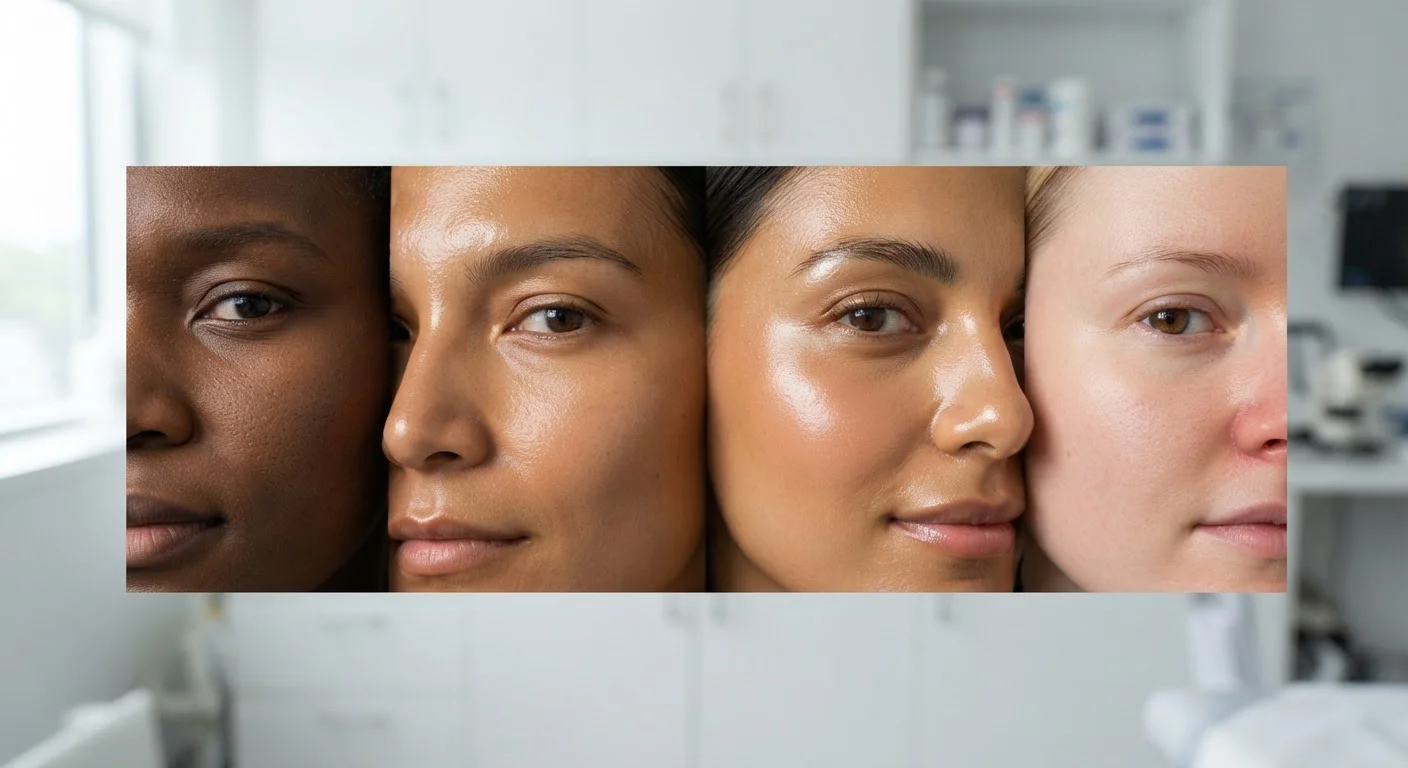
Skin Type Is About Behavior, Not a Label
Walk into any skincare aisle and you'll see the same four words looping endlessly: oily, dry, combination, sensitive. They're on every label, every quiz, every influencer's thumbnail — but rarely explained with any precision. Dermatologists use these terms to describe how your skin behaves — specifically, how it manages moisture and oil, and how it reacts to its environment.
Understanding your skin type isn't about fitting into a box. It's a starting point for choosing ingredients and routines that work with your skin rather than against it. And as dermatologists will tell you, skin type can shift with age, climate, hormonal changes, and even the products you're currently using — so it pays to reassess periodically.
Just as knowing your curl pattern helps you pick the right conditioner (see our guide to hair types), knowing your skin type helps you filter out the noise and focus on what your skin actually needs.
The Four Core Skin Types — Defined Clearly
Here's what each classification actually means in clinical terms:
Normal Skin
Normal skin produces sebum (oil) at a balanced rate, maintains adequate hydration without feeling tight or greasy, has small pores, and rarely reacts strongly to products. It's the baseline dermatologists measure other types against — not a moral achievement, just a description of equilibrium.
Oily Skin
Oily skin overproduces sebum, typically resulting in a shiny appearance, enlarged pores, and a tendency toward breakouts. The sebaceous glands are simply more active. This can be genetic, hormonally influenced, or triggered by using products that strip the skin and prompt a rebound oil response.
Dry Skin
Dry skin underproduces oil and/or struggles to retain water in the outer skin layer (the stratum corneum). It may feel tight after cleansing, look flaky or dull, and be prone to fine lines appearing more pronounced. Dry skin and dehydrated skin are often confused — dehydration is a temporary, fixable condition (lack of water), while dry skin is a type (lack of oil production). Our article on the skin barrier explains why this distinction shapes every product choice you make.
Combination Skin
Combination skin means different zones behave differently — classically, an oilier T-zone (forehead, nose, chin) paired with drier cheeks. This is actually the most common skin type, and it simply means a one-size-fits-all approach may not serve you as well as zone-specific care.
Sebum
An oily substance produced by sebaceous glands in the skin. It helps lubricate and protect the skin surface, but overproduction is associated with oily skin and acne.
Stratum corneum
The outermost layer of the epidermis, made up of dead skin cells. It acts as the primary barrier against moisture loss and environmental irritants.
Transepidermal water loss (TEWL)
The rate at which water evaporates through the skin's outer layers. High TEWL is associated with a compromised skin barrier and is a key marker of dry or dehydrated skin.
Sebaceous glands
Oil-producing glands attached to hair follicles throughout the skin. Their activity level — influenced by genetics and hormones — largely determines whether skin skews oily or dry.
T-zone
The forehead, nose, and chin area of the face, shaped like the letter T. This zone typically has a higher density of sebaceous glands and tends to be oilier in people with combination skin.
Reactive skin
Skin that responds easily to stimuli — products, temperature, stress — with redness, stinging, itching, or flushing. Often linked to a weakened skin barrier or underlying dermatological conditions.
Sensitive Skin: A Reactivity Pattern, Not a Type
Sensitive skin stands apart from the four types above because it describes reactivity, not oil balance. Sensitive skin tends to sting, flush, itch, or break out in response to ingredients, temperature changes, or environmental triggers that wouldn't bother most people. It's often linked to a compromised skin barrier or underlying conditions like rosacea or eczema.
Importantly, you can have oily and sensitive skin simultaneously. The two dimensions — oil production and reactivity — are independent of each other. If you suspect your skin reacts easily, a dermatologist can help identify whether there's a diagnosable condition at the root, rather than just a product sensitivity.
When Sensitivity Might Signal Something More
Persistent redness, flushing, or itching that doesn't resolve with gentle product swaps may indicate an underlying skin condition such as rosacea, eczema (atopic dermatitis), or contact dermatitis. These require a dermatologist's evaluation for accurate diagnosis and appropriate treatment — not just a product change. Don't try to self-diagnose or self-treat ongoing skin reactions.
When building a routine for sensitive skin, fewer actives and simpler formulas are generally a safer starting point. Our reference on skincare ingredients that don't mix well is particularly useful if reactivity is a concern for you.
How to Actually Identify Your Skin Type
Online quizzes are a fine entry point, but dermatologists often recommend the bare-face test: cleanse gently, apply nothing, and observe your skin after one hour. If it feels tight and looks flaky — likely dry. Shiny all over — likely oily. Shiny across the T-zone with normal or tight cheeks — likely combination. Consistently comfortable and balanced — likely normal.
Keep context in mind. Skin in a dry winter climate behaves differently than in humid summer heat. Hormonal shifts, stress, and aging all move the dial. If you're new to building a routine from scratch, our men's skincare starter guide walks through exactly how to translate a skin type assessment into a simple daily approach — and the principles apply regardless of gender.
Once you're comfortable reading your skin's behavior, you'll also get more out of decoding product labels, because you'll know which ingredient functions are solving for your actual needs rather than someone else's.
This article is for general informational and educational purposes only and is not a substitute for professional medical or dermatological advice. Consult a qualified healthcare provider about any skin concerns, conditions, or symptoms.
The content on this site is for informational purposes only and is not a substitute for professional advice. Always consult a qualified professional for guidance specific to your situation.